• Global CNC market projected to reach $128B by 2028 • New EU trade regulations for precision tooling components • Aerospace deman
NYSE: CNC +1.2%LME: STEEL -0.4%

How to Evaluate a CNC Machine Tool Manufacturer for Precision and Service Support

How to Evaluate a CNC Machine Tool Manufacturer for Precision and Service Support
Selecting a CNC machine tool manufacturer is a high-impact procurement decision because machine accuracy, uptime, and support quality directly affect production capacity and part profitability.
For buyers, the best supplier is rarely the one offering the lowest initial quotation or the most impressive brochure specifications alone.
A reliable decision requires evidence that the manufacturer can consistently build accurate machines, support real applications, supply parts, and respond when production stops.
This matters especially for CNC lathes, vertical machining centers, horizontal machining centers, five-axis systems, and automated production cells used in demanding operations.
Procurement teams should therefore evaluate the supplier as a long-term operating partner rather than treating the purchase as a one-time equipment transaction.
The central question is straightforward: can this CNC machine tool manufacturer deliver verified precision today and maintain usable performance throughout the machine's working life?
A strong evaluation combines technical validation, commercial due diligence, factory investigation, customer references, service review, and a clear total-cost-of-ownership comparison.
It should also involve production engineers, quality personnel, maintenance leaders, operators, finance teams, and application specialists before the final selection is made.
When these stakeholders assess the same evidence, procurement can avoid decisions based on isolated specifications, optimistic promises, or incomplete comparisons between suppliers.
Start With the Production Requirement, Not the Machine Catalog

Before comparing manufacturers, define the parts, tolerances, materials, annual volume, changeover needs, cycle-time targets, and automation requirements that the equipment must support.
Many procurement problems begin when buyers request a machine category without translating their actual manufacturing process into measurable technical and operational requirements.
For example, a machining center suitable for general aluminum components may not provide sufficient rigidity, thermal stability, chip control, or probing capability for aerospace alloys.
Similarly, a CNC lathe for standard shafts may be unsuitable for thin-wall parts, long workpieces, interrupted cuts, or demanding concentricity requirements.
Create a requirement matrix that separates essential capabilities from preferred features, including spindle speed, torque, axis travel, load capacity, and tool capacity.
The matrix should also identify part-specific performance needs such as positioning accuracy, repeatability, surface finish, runout, geometric tolerances, and in-process measurement capability.
Ask internal engineers to identify the most difficult existing or planned part, rather than basing requirements only on average production conditions.
This representative challenge part provides a realistic basis for machine demonstrations, trial cutting, cycle-time comparisons, and acceptance testing with each shortlisted supplier.
A manufacturer that asks detailed questions about materials, fixtures, tooling, programming, inspection, and downstream processes usually demonstrates stronger application engineering discipline.
Suppliers that immediately recommend a model without investigating the process may be selling equipment capacity rather than solving the buyer's production problem.
Verify Precision Through Measured Evidence
Published accuracy values are useful, but procurement teams should understand how those values were measured, under what conditions, and whether they reflect repeatable factory performance.
Request the manufacturer’s testing procedures for positioning accuracy, repeatability, spindle runout, circular interpolation, squareness, straightness, and thermal displacement where applicable.
International standards such as ISO 230 can provide a useful reference framework, although compliance claims should be supported by actual inspection records.
Ask whether each machine receives laser interferometer testing, ballbar testing, spindle vibration analysis, geometry inspection, and final cutting validation before shipment.
A credible CNC machine tool manufacturer should explain its calibration equipment, inspection frequency, traceability system, and corrective-action process when measurements fall outside specifications.
Machine geometry is particularly important because poor alignment can create taper, out-of-round conditions, inconsistent bores, poor surface finish, and difficult-to-diagnose quality variation.
For multi-axis machining, investigate rotary-axis accuracy, backlash compensation, kinematic calibration methods, synchronization quality, and the ability to maintain contouring performance over time.
Thermal behavior deserves equal attention because many machines achieve strong cold-condition results but drift after extended spindle operation or changing ambient temperatures.
Ask the supplier to demonstrate warm-up behavior, thermal compensation functions, coolant effects, spindle load behavior, and accuracy performance during a realistic production cycle.
Do not accept a demonstration based solely on simple test cuts. Require a documented sample using the buyer’s material, tooling approach, tolerance requirements, and production-relevant setup.
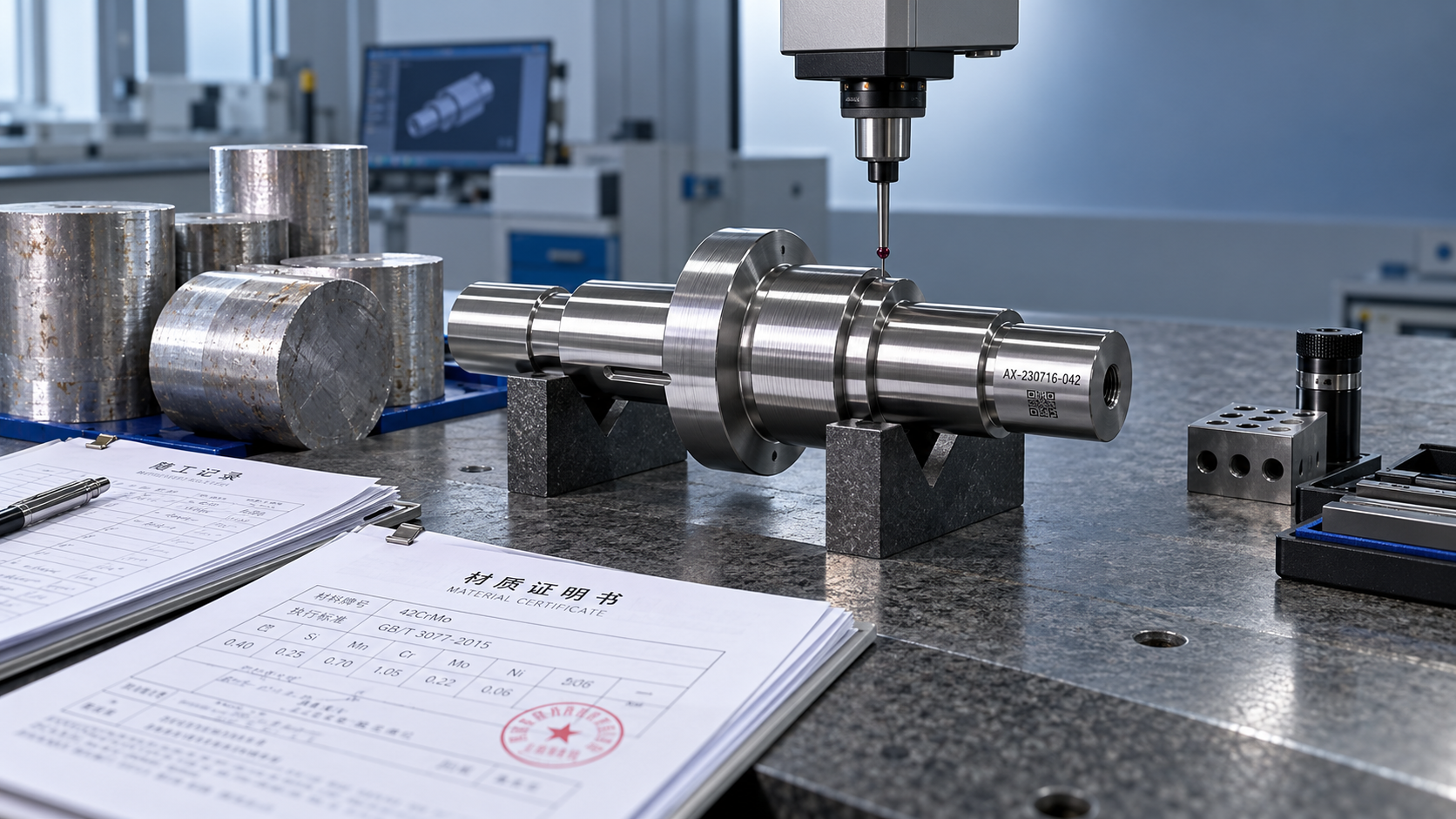
The sample should be measured by an agreed method, preferably using calibrated inspection equipment and a report showing all critical dimensions rather than selected favorable results.
Assess Machine Design, Component Quality, and Build Consistency
Precision is not created by software compensation alone. It begins with mechanical design, structural rigidity, quality components, controlled assembly, and consistent manufacturing practices.
Review the machine base design, casting or welded structure, guideway configuration, ballscrew arrangement, spindle construction, lubrication system, and chip-management design.
For heavy cutting or difficult materials, machine weight and structural layout can be meaningful indicators, although they should never replace engineering evidence and application testing.
Ask which components are manufactured internally and which are sourced externally, including CNC controls, servo systems, bearings, spindles, drives, probes, and hydraulic units.
Well-known component brands can reduce sourcing risk, but integration quality matters more than a supplier simply listing recognizable names in a machine specification sheet.
Investigate the manufacturer’s supplier qualification program and whether critical incoming components undergo inspection before entering final machine assembly.
Factory visits are valuable because buyers can observe assembly cleanliness, machining capability, metrology resources, work instructions, testing stations, and production discipline firsthand.
Look for standardization across models, clear identification of work-in-progress equipment, controlled storage of precision components, and documented quality checkpoints throughout assembly.
Inconsistent build practices often become visible through poor organization, unclear testing responsibilities, unexplained rework, or a lack of traceable records for completed machines.
Buyers should also ask about design updates and product maturity. A proven platform with controlled improvements may present less risk than an entirely new model.
Evaluate Application Engineering Before Signing the Purchase Order
A machine is only productive when tooling, fixturing, programs, cutting parameters, loading methods, and inspection processes work together as an integrated production system.
This is why application engineering should be a major evaluation criterion, particularly for complex parts, high-volume work, hard materials, and automated manufacturing projects.
Ask whether the supplier can recommend fixtures, toolholders, cutting tools, workholding methods, probing cycles, programming strategies, and optimized machining parameters.
For five-axis applications, assess the manufacturer’s ability to manage collision avoidance, tool-center-point control, postprocessor compatibility, and complex workpiece access requirements.
For turning applications, discuss bar feeding, subspindle transfer, live tooling, Y-axis functions, steady rests, tailstocks, part catchers, and chip evacuation.
A capable supplier should identify potential bottlenecks before delivery, including fixture rigidity, tool reach, swarf accumulation, unstable clamping, or unrealistic cycle-time assumptions.
Request a formal process proposal that states assumptions, planned cycle time, tooling scope, fixture responsibilities, acceptance criteria, and production limitations.
When automation is included, clarify interfaces among the machine builder, robot supplier, pallet system provider, safety integrator, and manufacturing execution software provider.
Responsibility gaps between vendors are a common source of delayed commissioning, poor handover, and disputes when an automated cell fails to meet promised output.
The strongest suppliers stay engaged during ramp-up and adjust programs, fixtures, parameters, or automation logic until the agreed process performance is achieved.
Examine Service Coverage, Response Time, and Spare-Parts Readiness
Service support often determines the true value of a CNC machine tool manufacturer because unplanned downtime can quickly exceed any savings achieved during purchase negotiations.
Ask where service engineers are located, how many technicians support the region, what languages they use, and whether remote diagnostics are available.
Local sales representation is not the same as local technical support. Buyers should confirm who can physically attend a machine failure and within what response time.
Request written service-level commitments covering remote response, onsite attendance, escalation procedures, weekend support, and emergency availability for critical production operations.
Spare-parts availability should be reviewed by category, including consumables, electrical components, control hardware, servo drives, spindles, bearings, seals, and safety devices.
Ask whether parts are stocked locally, held in regional warehouses, shipped from the manufacturing country, or dependent on third-party component suppliers.
Lead time is particularly important for expensive assemblies such as spindles, rotary tables, ball screws, motors, encoders, and control modules.
Buyers should request a recommended critical-spares list, associated pricing, expected replacement intervals, and guidance on which items should be held onsite.
Also investigate whether the supplier provides preventive maintenance plans, inspection visits, machine-health monitoring, calibration services, and operator maintenance training.
A responsive service organization should have documented case-management processes, escalation paths, and access to technical experts who understand both the machine and its application.
Customer references are especially useful here. Ask existing users about actual response times, spare-parts delays, repeat failures, warranty handling, and technician competence.
Compare Total Cost of Ownership Instead of Purchase Price
The lowest machine price can become the most expensive choice when it produces lower yields, requires frequent intervention, consumes excessive energy, or suffers long downtime.
Total cost of ownership should include acquisition cost, freight, installation, foundations, tooling, fixtures, training, maintenance, consumables, software, labor, and expected downtime exposure.
Estimate the value of one hour of lost production for the intended operation, then compare that figure against the supplier’s demonstrated service capability.
Energy consumption should be considered for high-utilization equipment, especially machines with large spindles, hydraulic systems, coolant equipment, and integrated automation.
Evaluate expected tool life and cutting efficiency because better rigidity, coolant delivery, control functions, and process support can improve production economics significantly.
Financing terms, warranty coverage, installation scope, and software licensing must be compared carefully because exclusions can materially change the effective project cost.
For strategic equipment, assess resale value, expected serviceability after ten years, software upgrade options, and the supplier’s long-term commitment to the product platform.
A scoring model helps procurement teams balance price with technical fit, precision evidence, service strength, lead time, operational risk, and lifecycle value.
Assigning weighted scores makes tradeoffs visible and prevents a supplier from winning solely because its initial quotation appears simpler or lower.
Use Factory Audits, References, and Acceptance Tests to Reduce Risk
Supplier claims should be verified through direct evidence before issuing a purchase order, particularly when the machine will support critical parts or large production volumes.
A factory audit can validate production capacity, quality systems, export experience, engineering depth, testing capability, and the manufacturer’s ability to meet committed delivery schedules.
During the audit, ask how the manufacturer handles nonconforming machines, customer complaints, warranty failures, supplier disruptions, and engineering changes after product release.
References should match the buyer’s application as closely as possible in machine type, industry, material, production environment, accuracy expectations, and automation complexity.
Speak with reference customers without the supplier present when possible. Their experience will reveal practical information that brochures and formal presentations often omit.
Before shipment, conduct a factory acceptance test with defined requirements for machine configuration, safety functions, accuracy reports, sample parts, cycle time, and documentation.
The factory acceptance test should specify pass-fail criteria, measurement methods, acceptable tolerances, corrective-action timing, and consequences if requirements are not met.
After installation, a site acceptance test should confirm that the machine performs correctly in the buyer’s facility, using local utilities, operators, tooling, and actual workpieces.
Link final payment milestones to successful acceptance testing where commercially feasible, especially for customized systems, multi-axis machines, or automated production lines.
Questions Procurement Teams Should Ask Every CNC Machine Tool Manufacturer
Ask how the manufacturer verifies positioning accuracy, repeatability, geometry, spindle performance, and thermal stability before a machine leaves the factory.
Ask which key components are sourced externally, how alternatives are qualified, and what happens when a critical supplier discontinues or delays a component.
Ask for regional service engineer numbers, guaranteed response targets, remote support capability, and historical parts lead times for common and critical failures.
Ask for a complete list of included items, exclusions, commissioning responsibilities, operator training hours, documentation languages, warranty limits, and annual service costs.
Ask whether the manufacturer can run a trial using your parts and whether it will guarantee agreed specifications under clearly defined production conditions.
Ask for customers with comparable applications and request evidence showing long-term machine accuracy, uptime, maintenance needs, and support performance after warranty expiration.
These questions encourage suppliers to provide verifiable answers and help procurement teams distinguish mature partners from organizations relying primarily on sales claims.
Conclusion: Choose Evidence, Capability, and Support
Choosing a CNC machine tool manufacturer should be treated as a production-risk decision, not simply a capital-equipment purchasing exercise.
The right supplier combines proven machine precision, robust engineering, relevant application knowledge, disciplined quality control, responsive service, and dependable spare-parts support.
Buyers should begin with difficult part requirements, demand measured accuracy evidence, validate service capacity, and compare lifecycle costs before evaluating commercial price differences.
Factory audits, customer references, trial machining, and detailed acceptance tests provide the strongest protection against costly assumptions during supplier selection.
When procurement teams use this evidence-based approach, they can select CNC equipment that supports stable quality, predictable output, and sustainable manufacturing performance over time.
Recommended for You
![]() Mitsubishi Electric Announces Physical AI System Linking Humanoid Robots and CNC MachinesMachine Tool Industry Editorial Team
Mitsubishi Electric Announces Physical AI System Linking Humanoid Robots and CNC MachinesMachine Tool Industry Editorial Team Precision Machining for Defense: Supplier Quality and Traceability ChecksManufacturing Market Research Center
![]() Nidec Machine Tool Launches MVR-5X Five-Axis Gantry MachineMachine Tool Industry Editorial Team
Nidec Machine Tool Launches MVR-5X Five-Axis Gantry MachineMachine Tool Industry Editorial Team Choosing a Precision Disc Parts Manufacturer in China: Tolerances and Quality ChecksManufacturing Market Research Center
![]() Siemens Executive Says AI Could Raise Factory Automation to 80%Manufacturing Market Research Center
Siemens Executive Says AI Could Raise Factory Automation to 80%Manufacturing Market Research Center Choosing Automated Machine Tools for High-Mix, Low-Volume ProductionMachine Tool Industry Editorial Team


Aris Katos
Future of Carbide Coatings
15+ years in precision manufacturing systems. Specialized in high-speed milling and aerospace grade alloy processing.
▶
How to Evaluate a Machine Tool Factory Before Sourcing CNC EquipmentGlobal Machine Tool Trade Research Center▶
How to Evaluate a CNC Machine Tool Manufacturer for Precision and Service SupportGlobal Machine Tool Trade Research Center▶
What Affects Cost-Effective CNC Manufacturing? Key Drivers Behind Part Price and Lead TimeGlobal Machine Tool Trade Research Center▶
How to Evaluate a CNC Tooling System Supplier in Germany for Quality, Lead Time, and CostGlobal Machine Tool Trade Research Center▶
How to Evaluate a CNC Tooling System Supplier in Germany for Quality, Lead Time, and SupportGlobal Machine Tool Trade Research Center
▶
Mastering 5-Axis Workholding Strategies
Join our technical panel on Nov 15th to learn about reducing vibrations in thin-wall components.

Providing you with integrated sanding solutions
Before-sales and after-sales services
Comprehensive technical support