• Global CNC market projected to reach $128B by 2028 • New EU trade regulations for precision tooling components • Aerospace deman
NYSE: CNC +1.2%LME: STEEL -0.4%

How to Evaluate an Automated Production Line for Output, Flexibility, and ROI

Start with the production target, not the machine list
An Automated Production Line usually looks attractive on paper: fewer operators, more stable output, cleaner scheduling. The mistake is evaluating the line by equipment count, robot brand, or spindle speed before defining what the line actually has to achieve. If the target is vague, almost any proposal can be made to look good.
For a decision-maker, the first check is simple: what mix of parts, volumes, change frequency, quality requirements, and staffing constraints is this line supposed to solve? In CNC machining and precision manufacturing, a line built for long, repeatable runs behaves very differently from one expected to switch between shafts, discs, structural parts, or mixed batches. Output, flexibility, and ROI all depend on that starting point.
Before comparing suppliers, write down the operating assumptions you will use for every proposal. If one supplier calculates performance with one product family and another uses a simpler part or longer batch size, the comparison is already distorted.
Check output where lines usually fail: bottlenecks, not nameplate speed
Most proposals highlight the fastest station. That is rarely the real output limit. In an Automated Production Line, actual throughput is constrained by the slowest stable step across machining, loading, unloading, gauging, part transfer, fixture change, chip handling, and recovery from minor interruptions.
Ask for the full cycle breakdown by station, including non-cutting time. In a machining line, transfer delays and handling motions can quietly consume the margin you thought you were buying. If the supplier only shows total cycle time, request the breakdown again. Without it, you cannot see where future expansion or failure risk sits.
- Separate cutting time from loading, indexing, tool change, and inspection time.
- Check whether the quoted output assumes ideal material flow with no waiting between stations.
- Look at planned buffer capacity between key processes. No buffer means one small stop can idle the whole line.
- Review how scrap, rework, or measurement holds affect downstream utilization.
A practical way to judge this is to ask: if one station loses ten minutes, how many minutes of total line output are lost? The answer tells you more than a headline throughput number.

Test flexibility against the part mix you actually sell
Flexibility is often overstated because the word itself is left undefined. Some lines are flexible across part lengths but not diameters. Some can switch programs quickly but still require long fixture replacement. Others are technically capable of mixed production, yet only with a level of offline preparation that creates planning headaches.
The right question is not “Is the line flexible?” but “Flexible for which changes, and at what cost?” If your business handles stable annual contracts, broad flexibility may matter less than uptime and repeatability. If order mix changes often, then changeover loss becomes a major ROI factor.
Use your current or expected part families and test the line against them. Review:
- Fixture commonality: how many dedicated fixtures are required, and how often will they be changed?
- Program change process: is it operator-driven, centrally managed, or dependent on the machine builder?
- Tooling impact: does a new part require a minor tool offset update or a substantial tool package change?
- Automation handling range: can the robot, gantry, or transfer system manage the weight, geometry, and orientation range you need?
One common buying error is paying for a highly flexible configuration while planning to run mostly one or two families for years. The opposite error is worse: buying a tightly optimized line that becomes expensive the moment product mix shifts.
Look beyond machine capacity and inspect the whole process chain
A production line is only as reliable as the least mature part of the process around it. In CNC environments, weak points are often outside the main machine tool itself. Tool management, clamping repeatability, chip evacuation, coolant control, part washing, in-line gauging, and final traceability can all limit stable output long before spindle power becomes an issue.
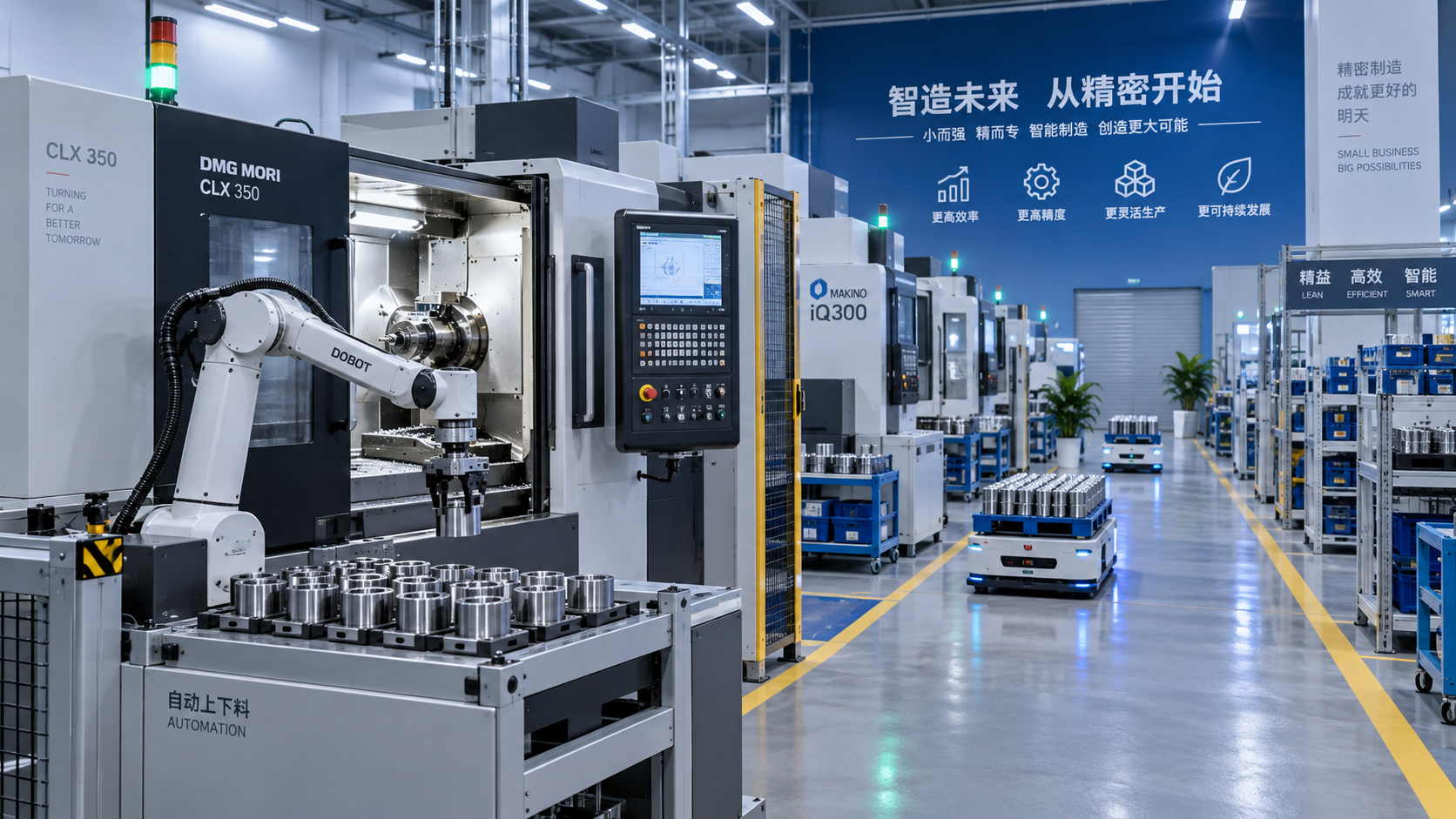
When reviewing a proposal, map the sequence from raw material input to finished part exit. Then ask where human intervention is still required. Manual loading of inserts, frequent fixture cleaning, hand-carried quality checks, or operator judgment at transfer points may be acceptable in a semi-automated cell, but they should not be hidden inside a “fully automated” claim.
Make uptime assumptions explicit
ROI models often fail because everyone talks about annual output while quietly assuming different uptime levels. A line that looks profitable at high utilization can become ordinary once maintenance, tool changes, training losses, and restart delays are included.
Ask the supplier to show how the forecast output is built. Not just the final number. You want to see the logic behind operating hours, planned stoppages, shift pattern, scrap allowance, and operator coverage. If the line depends on highly skilled intervention for every disturbance, do not treat it as lights-out capacity just because the layout includes robots.
This is especially important for sectors such as automotive, aerospace-related machining, energy equipment, and electronics components, where different traceability, tolerance, and scheduling demands can change the real operating rhythm of the same equipment set.
Evaluate quality control as part of output, not as a separate department problem
A line that produces faster but creates unstable dimensions is not a high-output line. It is just moving defects more efficiently. For precision manufacturing, output and quality are tied together through process capability, measurement feedback, and how quickly the line reacts when drift starts.
Review where measurement happens, how results are recorded, and what the line does when dimensions move toward a limit. Is there automatic compensation? Does the machine stop, divert, or continue? Who approves restart? Those answers affect labor needs, scrap exposure, and customer risk.
A frequent oversight is assuming the line can inherit existing quality routines without modification. That may work for simple parts. It usually breaks down when cycle times tighten and multiple stations interact.
Calculate ROI with full operating cost, not just labor savings
Labor reduction is the easiest benefit to model, so it often dominates the business case. That is too narrow. A sound ROI review for an Automated Production Line should include at least four buckets: throughput gain, quality impact, labor structure, and operating cost.
Go line by line through the expected economics:
- Capital cost: equipment, installation, tooling, integration, commissioning.
- Running cost: energy, consumables, spare parts, coolant management, maintenance labor.
- Changeover cost: downtime, fixture inventory, programming support, validation effort.
- Quality cost: scrap, rework, inspection labor, containment risk if problems escape downstream.
- Capacity value: whether added output actually removes a constraint in your factory or just shifts it elsewhere.
That last point matters. A faster line has limited financial value if heat treatment, washing, assembly, or outbound inspection cannot absorb the added volume. In that situation, you are not buying capacity. You are buying imbalance.
Review integration risk early
Many line investments underperform because the hardware arrives before the factory is ready. Check the interfaces now: upstream material format, downstream packaging, plant utilities, data connection requirements, floor loading, safety layout, and operator access for maintenance. In digitalized factories, also look at how production data, alarms, and quality records connect to your existing systems. A line that runs as an island may still produce parts, but it often creates management blind spots.
If multiple suppliers are involved, identify who owns the performance of the whole line, not just each machine. That single point of responsibility is worth clarifying before purchase, not during commissioning.
Use supplier review to test execution discipline
At this stage, you are not only buying equipment. You are buying engineering quality, documentation quality, and after-sales response. Ask for a review package that shows layout, process flow, utility list, maintenance access, changeover logic, and acceptance criteria. A supplier that cannot present the line clearly before the order often struggles to control the project after the order.
Also check whether the proposal distinguishes standard modules from customized sections. Heavy customization is not automatically bad, but it does change schedule risk, spare parts planning, and restart speed when problems occur.
A practical decision sequence
If you want a cleaner selection process, run the evaluation in this order: define the part mix and required output; identify the real bottleneck in the current process; compare line concepts based on station-level cycle logic; test changeover burden using your own product families; build ROI with realistic uptime and full operating cost; then review integration and project ownership.
That sequence keeps the conversation grounded. It prevents a polished proposal from winning on presentation alone and forces the Automated Production Line to prove itself where it matters: stable throughput, manageable change, and a return that holds up after commissioning, not just during the sales meeting.
Recommended for You
 CNC Lathe Quick Installation Guide: Alignment Checks Before First Production RunCNC Machining Technology Center
 How to Select a CNC Lathe for Small Parts Without Sacrificing Accuracy or Cycle TimeCNC Machining Technology Center
 How to Select a Slant Bed Lathe for High-Precision Shaft and Chuck WorkCNC Machining Technology Center
 Smart Manufacturing for Small Businesses: Where Automation Delivers the Fastest ROIMachine Tool Industry Editorial Team
 How to Specify a CNC Lathe for High-Volume Automotive Shaft ProductionCNC Machining Technology Center
 How Automated Precision Machining Maintains Tolerance in High-Mix ProductionCNC Machining Technology Center

Aris Katos
Future of Carbide Coatings
15+ years in precision manufacturing systems. Specialized in high-speed milling and aerospace grade alloy processing.
▶
Smart Manufacturing for Small Businesses: Where Automation Delivers the Fastest ROIMachine Tool Industry Editorial Team▶
How Smart Manufacturing Technology Improves OEE Across Industry 4.0 Production LinesMachine Tool Industry Editorial Team▶
How to Evaluate an Automation Line for Electronics Production Before InvestmentMachine Tool Industry Editorial Team▶
How to Evaluate an Automated Production Line for Output, Flexibility, and ROIMachine Tool Industry Editorial Team▶
How Smart Manufacturing Improves Traceability and Quality Control in Aerospace?Machine Tool Industry Editorial Team
Mastering 5-Axis Workholding Strategies
Join our technical panel on Nov 15th to learn about reducing vibrations in thin-wall components.

Providing you with integrated sanding solutions
Before-sales and after-sales services
Comprehensive technical support