• Global CNC market projected to reach $128B by 2028 • New EU trade regulations for precision tooling components • Aerospace deman
NYSE: CNC +1.2%LME: STEEL -0.4%

Is Industrial Automation Too Expensive for Mid-Sized Factories?
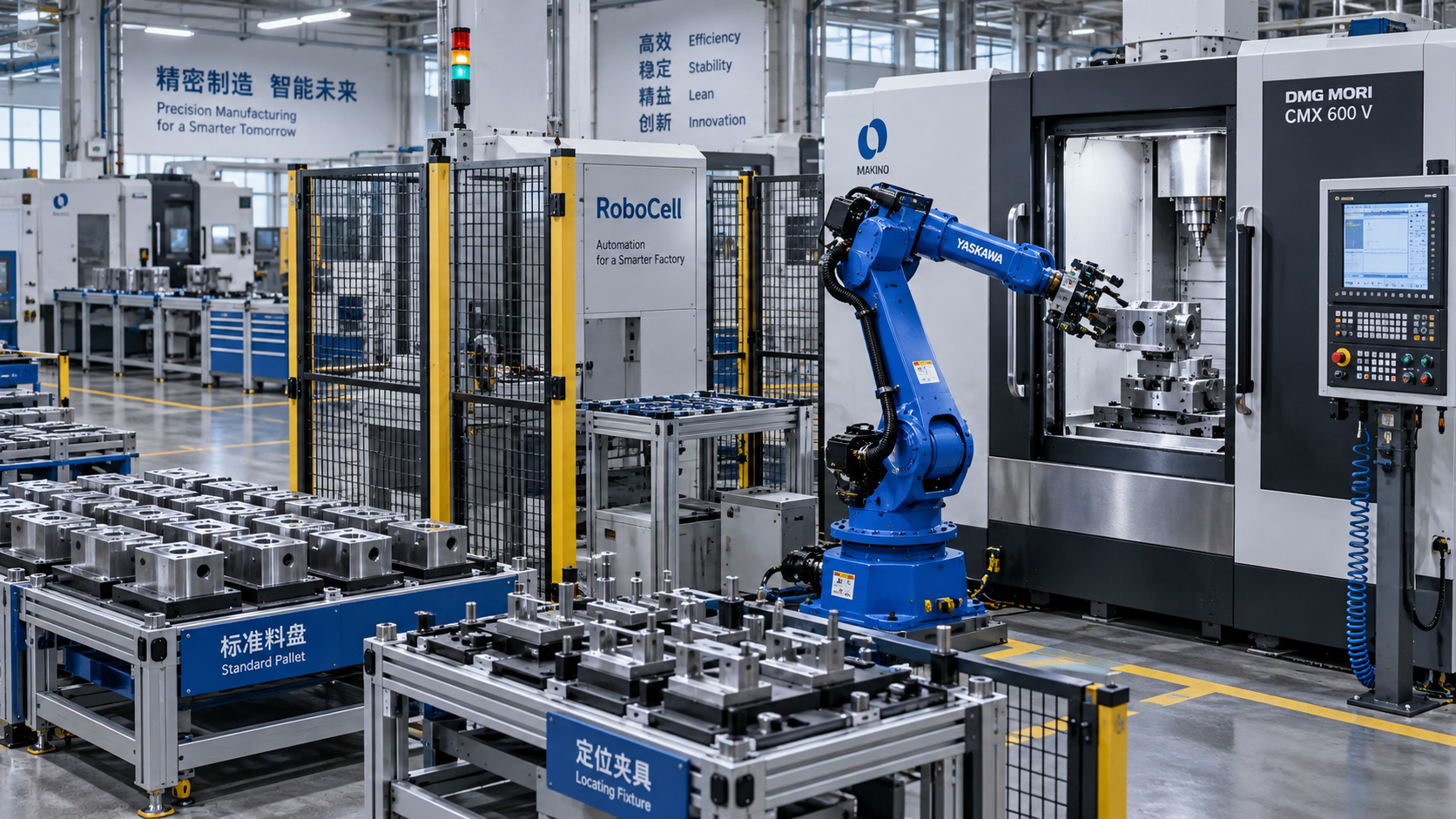
Industrial automation is not inherently too expensive for mid-sized factories. It becomes too expensive when the project cannot generate enough usable production value to cover its installed cost, operating expenses, and implementation risk. A narrowly scoped machine-tending cell can be financially sensible; a fully connected production line may not be, even within the same factory.
The decisive comparison is not equipment price versus wages. It is the total cost of a reliable production capability versus the cash benefits that capability can realistically deliver. Those benefits depend on order demand, process stability, staffing arrangements, and whether automation addresses the operation that actually limits output.
What makes automation affordable—or unaffordable?
Affordability has two separate meanings: whether the investment produces an acceptable return and whether the factory can fund it without putting daily operations under pressure. A project can pass one test and fail the other.
A robotic loading system might offer attractive lifetime savings but require deposits, installation payments, and production downtime before those savings begin. If that spending consumes cash needed for materials, payroll, or customer credit terms, the project may be financially unsuitable despite a positive return calculation.
Conversely, an inexpensive retrofit may be easy to fund but deliver little value. Automating a machine that already waits for orders does not create sales. Increasing machining output can also add work-in-progress rather than shipments if inspection or finishing remains the bottleneck.
The strongest investment case connects a specific operational constraint to a measurable financial result: avoiding recurring overtime, increasing saleable output from a constrained machine, reducing costly scrap, or keeping production running during otherwise unstaffed hours.
What costs belong in the budget beyond the equipment price?
A robot, CNC machine, or conveyor quotation is not necessarily a quotation for a functioning production system. The budget needs to cover everything required to produce acceptable parts safely and consistently.
For CNC machine tending, apparently minor interface details can change the scope substantially. Automatic doors, reliable chuck or vice actuation, part-presence checks, and access to machine status signals may all be necessary. An older machine can remain mechanically capable while requiring expensive controls work before it can operate unattended.
Cross-border purchases introduce additional budget questions. Freight, insurance, import charges, local installation responsibilities, and access to service must be explicit. A lower equipment price can lose its advantage if troubleshooting requires overseas travel or replacement components have long delivery times.
Quotes should therefore be compared against the same operating scope and acceptance requirements, not simply the same robot payload or machine specification.
How should a factory calculate payback without overstating savings?
A useful starting point is:
Simple payback = total installed investment ÷ annual net cash benefit.
Annual net cash benefit means realizable savings and additional contribution from sales, minus the recurring costs introduced by automation. It is not the value of every hour that a robot could theoretically operate.
Consider an illustrative project—not a market price benchmark—with the following assumptions:
These assumptions produce a simple payback of 2.4 years after the full annual benefit is achieved. Installation delays and a gradual production ramp would extend the calendar time needed to recover the investment.
The calculation needs several safeguards. Additional output should be valued at its contribution after relevant variable costs, not at sales revenue. Labor savings should reflect spending actually avoided; moving an employee to another task does not automatically reduce payroll. If redeployment creates value elsewhere, that value needs its own evidence and must not be counted twice.
Simple payback also ignores the time value of money and benefits beyond the recovery date. For a longer-lived investment, discounted cash-flow analysis provides a fuller comparison. Financing should be assessed separately so that borrowing proceeds are not mistaken for a project benefit.
Can automation pay off without reducing headcount?
Yes, but the financial mechanism needs to be clear. Keeping the same workforce while producing more can improve economics when there is demand for the extra output. Avoiding overtime, reducing outsourced processing, or removing the need for an additional shift can also create cash benefits without redundancies.
In a machining cell, automated loading may let an employee supervise several machines rather than repeatedly load one. That arrangement only works if walking distances, tool changes, inspection duties, and fault recovery fit within the available time. A staffing model based solely on automatic cycle time can overlook these competing tasks.
Extended operating hours offer another route, but “unattended” should not mean “uncontrolled.” Tool wear, chip accumulation, coolant condition, part seating, and measurement drift must remain within defined limits. Running longer while producing scrap is not a productivity gain.
Where the benefit is resilience rather than immediate savings—such as maintaining output during staffing gaps—it is better to show that value separately instead of presenting it as guaranteed payroll reduction.
Where is the most practical starting point?
The best first project is a bounded, repeatable task with a stable process and a measurable loss attached to it. In CNC production, that could be tending a machine that regularly sits idle between completed cycles, provided loading is the genuine constraint.
A suitable starting point has clear part presentation, predictable workholding, manageable variation, and an agreed method for confirming quality. It also has enough scheduled work to use the equipment. The shortest machining cycle is not automatically the best candidate: frequent handling may increase the opportunity for savings, but it also raises demands on robot speed, feeding, and reliability.
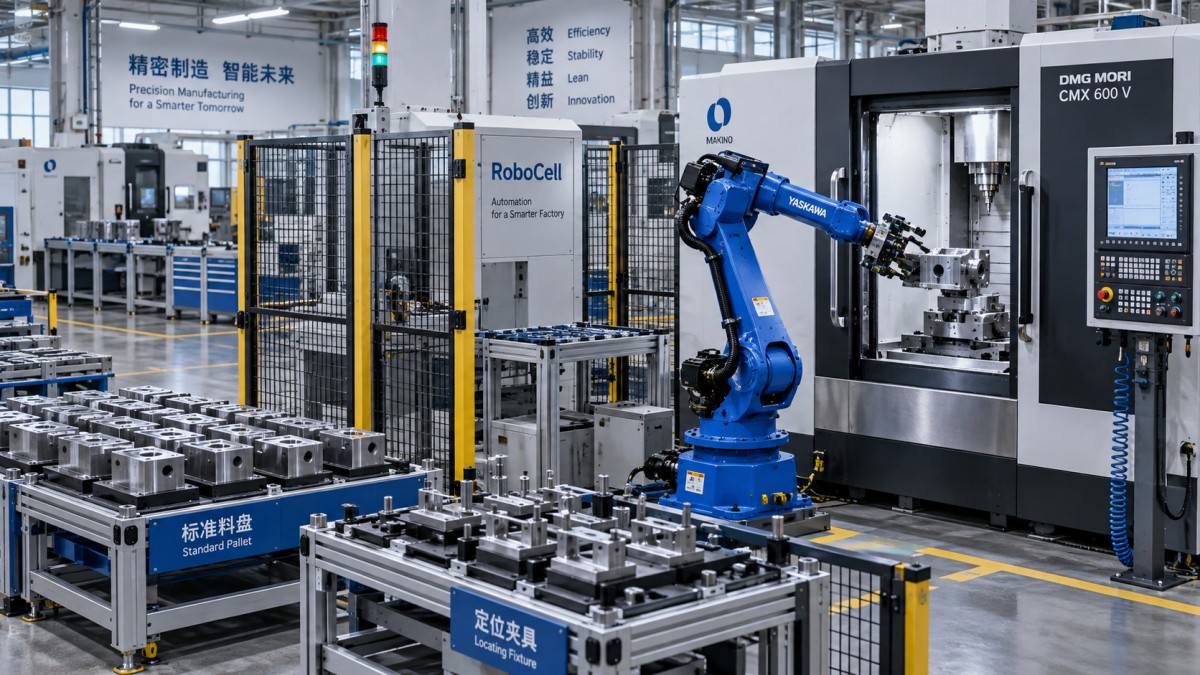
High-mix production requires a different calculation from long production runs. Gripper changes, fixture changes, program selection, first-piece approval, and feeder adjustment all consume time. A cell that handles one part efficiently can become uneconomic if each new batch requires extensive engineering.
Grouping parts into families can help when they share handling features, dimensions, and workholding principles. The relevant measure is productive time across the actual weekly schedule—not the fastest cycle demonstrated on a single part.
Some factories should begin with process improvements rather than robotics. Better fixtures, tool-life management, probing, or standardized setup methods may remove enough variability to improve output and make later automation less expensive to integrate.
Is a collaborative robot or a retrofit necessarily the cheaper option?
No. A lower-priced component does not guarantee a lower-cost production cell.
A collaborative robot may suit an application where access, handling requirements, and validated operating speeds align. However, the complete application still needs a risk assessment. The workpiece, gripper, machine tool, and surrounding equipment can introduce hazards that require protective measures. The “collaborative” label alone does not establish that unrestricted operation beside people is safe.
A guarded industrial robot may provide better economics where faster movement or greater payload materially improves throughput. Conversely, its footprint and access requirements may make it unsuitable for a constrained layout. Comparison should be based on safe, achievable cycle time and total installed cost.
Retrofitting existing equipment can preserve useful assets, but compatibility matters. Before committing, confirm machine-control access, automatic operating functions, documentation, spare-parts support, and responsibility for the integrated system. Reusing an unreliable machine can leave a new automation system waiting on old equipment.
What could make an apparently profitable project fail?
Three assumptions deserve particular scrutiny: how much the cell will run, how much acceptable output it will produce, and how much of that output the business can sell.
Technical availability alone is insufficient. A robot can be ready to operate while the cell waits for material, inspection clearance, a tool change, or someone authorized to reset an alarm. Scheduled production time must allow for these losses, as well as changeovers and maintenance.
A downside scenario should test lower demand, slower ramp-up, and more intervention than planned. For example, using the earlier illustrative investment, an annual net benefit of $45,000 rather than $75,000 would extend simple payback from 2.4 to four years. Whether that remains acceptable depends on financing, equipment life, customer commitments, and competing uses of cash.
Acceptance testing can reduce uncertainty before final payment. Relevant criteria include sustained output, first-pass quality, changeover time, intervention frequency, and recovery after a fault. Testing should use representative parts and production conditions, not only the easiest workpiece under a supplier demonstration setup.
Does leasing or phased implementation solve the cost problem?
It can solve a funding problem, but not a weak production case. Leasing spreads payments; it does not create demand or make an unstable process reliable. Compare total payments, maintenance obligations, usage restrictions, end-of-term conditions, and the consequences of early termination.
A phased approach can limit exposure if each stage produces useful value independently. Preparing a machine for automatic workholding, stabilizing the process, and then adding loading automation can be more manageable than replacing an entire line at once.
However, splitting the work can increase total engineering expense if interfaces are redesigned repeatedly. Future requirements should be considered early, particularly controls compatibility, floor space, safety architecture, and ownership of programs and documentation.
When should a factory postpone automation?
Postponement is reasonable when the process is still changing, demand cannot support the required utilization, quality problems remain unresolved, or nobody has responsibility for maintaining the cell. It is also justified when the investment depends on eliminating all downtime or achieving immediate full-speed production.
A credible approval case identifies the constraint being removed, defines the installed scope, separates cash savings from capacity benefits, and remains acceptable under a realistic downside scenario. If those conditions cannot be demonstrated, a smaller process improvement may be the better use of funds.
For a mid-sized factory, the affordable automation project is not necessarily the cheapest or the most advanced. It is the one whose production requirements, financial return, and ongoing support needs the business can sustain.
Recommended for You
![]() China's Official Manufacturing PMI Falls to 49.3 in OctoberManufacturing Market Research Center
 CNC Machine Tool Accuracy Standards Compared: ISO 230 vs. ASME B5.54CNC Machining Technology Center
![]() Li Daokui: China Overtakes Germany With 21.6% of Global Machine Tool ExportsGlobal Machine Tool Trade Research Center
 Machine Tool Prices: What to Budget Beyond the Purchase PriceGlobal Machine Tool Trade Research Center
![]() Survey: 81% Expect US Cutting Tool Shipments to Rise or Hold Steady in 2026Machine Tool Industry Editorial Team
 CNC Fixture Design: Locating and Clamping for Accurate MachiningCNC Machining Technology Center


Aris Katos
Future of Carbide Coatings
15+ years in precision manufacturing systems. Specialized in high-speed milling and aerospace grade alloy processing.
▶
How to Integrate Warehouse Palletizing Robots with Minimal DowntimeMachine Tool Industry Editorial Team▶
FANUC Invests $18 Million in Largest U.S. Corporate Automation Training CenterMachine Tool Industry Editorial Team▶
Automated Production Machining: Which Parts and Batch Sizes Are a Good Fit?Machine Tool Industry Editorial Team▶
Choosing Automated Machine Tools for High-Mix, Low-Volume ProductionMachine Tool Industry Editorial Team▶
Choosing Industrial Robots for Warehouse Picking and PalletizingMachine Tool Industry Editorial Team
▶
Mastering 5-Axis Workholding Strategies
Join our technical panel on Nov 15th to learn about reducing vibrations in thin-wall components.

Providing you with integrated sanding solutions
Before-sales and after-sales services
Comprehensive technical support