• Global CNC market projected to reach $128B by 2028 • New EU trade regulations for precision tooling components • Aerospace deman
NYSE: CNC +1.2%LME: STEEL -0.4%

How to Choose a CNC Machine for Plastic Parts: Materials, Tolerance, and Spindle Basics
How to Choose a CNC Machine for Plastic Parts: Materials, Tolerance, and Spindle Basics
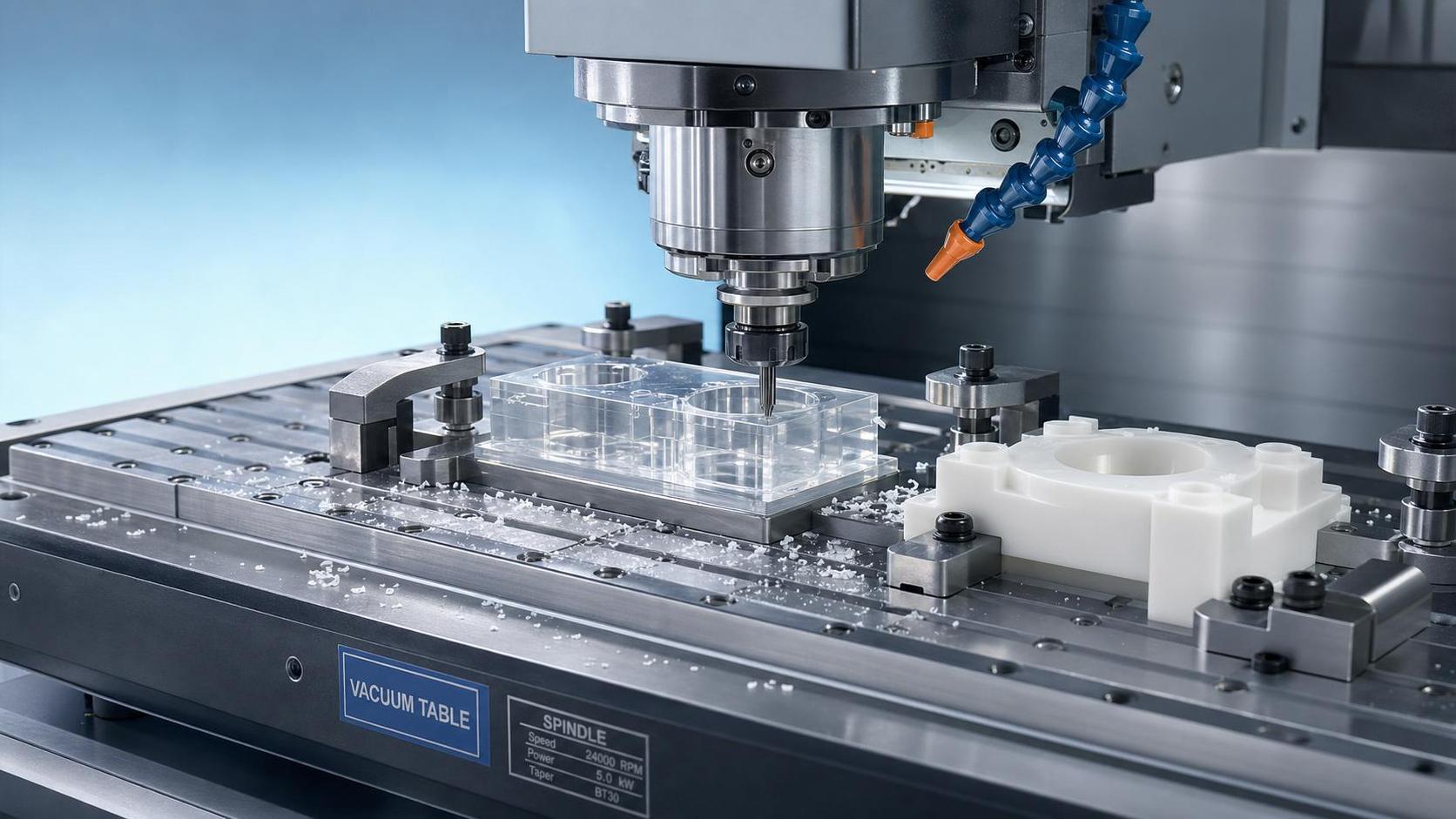
Choosing a CNC Machine for Plastic Parts is rarely a simple price comparison. Plastic behaves very differently from aluminum or steel, and that changes the entire machine decision.
Some polymers soften with heat. Others absorb moisture, creep under load, or warp after machining. That means machine structure alone does not guarantee stable output.
A good selection process starts with three basics: material behavior, tolerance target, and spindle suitability. If one of those is mismatched, scrap and rework usually follow.
In practical sourcing work, the best CNC Machine for Plastic Parts is the one that holds dimensions without overheating, chipping, or distorting the polymer.
This also means a machine for acrylic prototypes may be a poor fit for PEEK medical parts or glass-filled nylon housings produced in volume.
Start with the Plastic, Not the Machine Catalog
Material choice should lead the evaluation. Many selection mistakes happen when buyers compare spindle power first and polymer behavior second.
Common plastic machining materials include:
- ABS for housings and general prototypes
- Acrylic for optical and display parts
- Delrin or POM for low-friction precision components
- Nylon for wear parts and structural pieces
- PEEK and PTFE for high-performance applications
- PVC, HDPE, UHMW, and filled engineering plastics
Each material responds differently to cutting forces and heat. Acrylic can melt or chip. Nylon can move after cutting. PTFE can deform under clamping pressure.
That is why any CNC Machine for Plastic Parts should be assessed against the actual resin grade, not just the broad plastic category.
Filled plastics deserve extra attention. Glass-filled or carbon-filled polymers increase tool wear and require a more rigid machine and more stable spindle behavior.
From a decision standpoint, the first screening question is simple: what does the material do under heat, pressure, and repeated machining cycles?
Tolerance Requirements Define the Machine Class
Not every plastic part needs micron-level accuracy. Many need repeatability that is realistic for the polymer itself, not just the machine specification.
A technical review should separate three things:
- Machine positioning accuracy
- Repeatability in production
- Dimensional stability of the plastic part after machining
These are related, but not identical. A machine can be accurate, while the plastic still shifts because of internal stress or ambient moisture.
For many industrial plastic components, tolerance bands often fall between plus or minus 0.02 mm and plus or minus 0.10 mm.
If the drawing calls for tighter control, fixture design, thermal control, and cutting strategy matter as much as the CNC Machine for Plastic Parts itself.
A useful rule is to match machine capability to part function. Optical seats, sealing surfaces, and mating features justify higher machine precision.
Basic covers, guards, and non-critical brackets usually do not. Overspecifying the machine raises cost without creating real production value.
Why Spindle Basics Matter More Than Many Buyers Expect
Spindle selection is often discussed in terms of maximum RPM. That is only part of the story when evaluating a CNC Machine for Plastic Parts.
Plastic machining usually benefits from clean cutting, stable chip evacuation, and controlled heat generation. Those outcomes depend on several spindle factors:
- Usable speed range, not just peak speed
- Runout control for fine surface quality
- Bearing stability during longer cycles
- Power delivery at the actual cutting range
- Compatibility with small-diameter tools
For soft plastics, excessive spindle heat can smear edges or leave a cloudy finish. For harder engineering plastics, weak stability can cause chatter and dimensional variation.
High spindle speed helps with small tools and fine features, especially in acrylic, POM, and thin-wall components. But speed without balance is a risk.
In actual machine comparison, ask for spindle runout data, bearing type, thermal behavior, and recommended tool size range for plastic applications.
This is where a general-purpose machining center and a better-matched CNC Machine for Plastic Parts begin to separate clearly.
Machine Structure, Workholding, and Motion Control
Plastic parts are lighter than metal parts, but that does not mean machine structure becomes unimportant. In many cases, it becomes important in a different way.
The machine should move smoothly, avoid vibration, and support delicate workholding. Thin walls and flexible parts can deform before cutting even starts.
When selecting a CNC Machine for Plastic Parts, check these structural and control points:
- Frame rigidity for filled plastics and stable interpolation
- Servo tuning for smooth contouring
- Backlash control on small-feature machining
- Table flatness and vacuum fixture compatibility
- Chip removal and air blast options
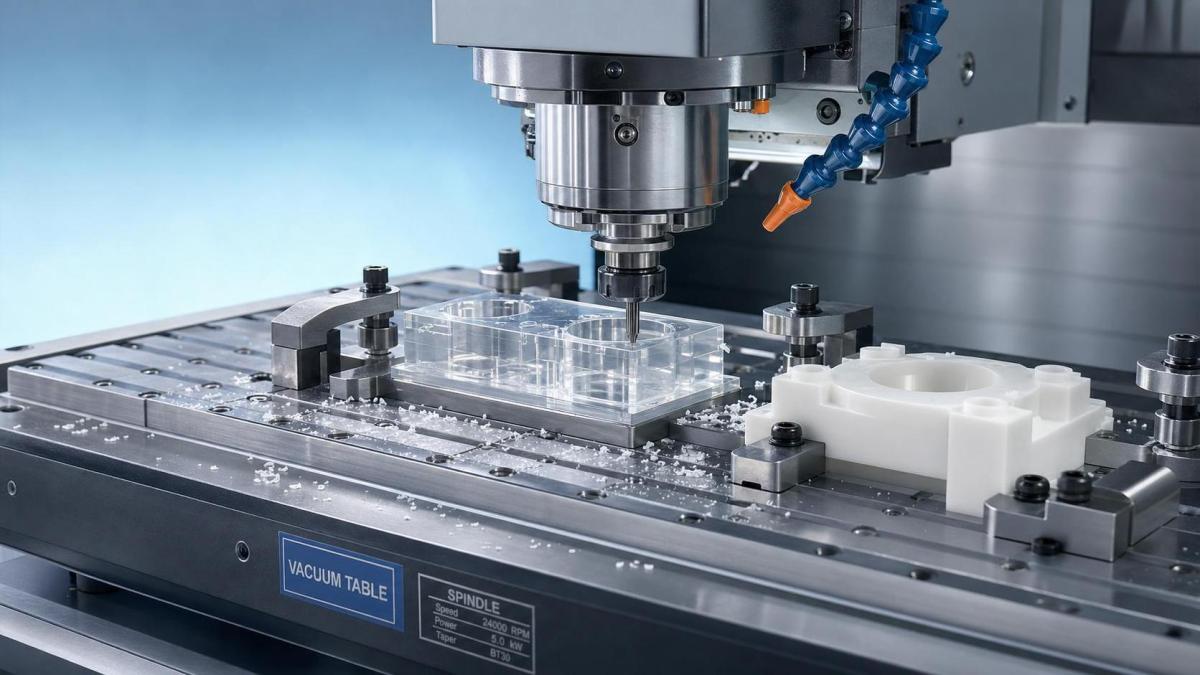
Vacuum workholding is useful for sheets, panels, and large thin parts. Mechanical clamping works better for blocks and smaller precision components.
The more complex signal is motion control quality. Jerky acceleration leaves witness marks, especially on visible surfaces and contour-critical plastic parts.
A stable machine with smoother axis behavior often outperforms a heavier machine that was mainly optimized for aggressive metal cutting.
Cooling, Chip Control, and Surface Finish Risks
Cooling strategy for plastics is not always the same as for metals. Flood coolant may help in some cases, but it can create contamination or absorption issues.
Many shops prefer clean air blast, mist control, or carefully selected coolants. The goal is to limit heat while keeping chips from rewelding to the cut surface.
This becomes more critical with transparent plastics. A poor setup can leave haze, micro-cracks, burrs, or edge whitening that fails the visual standard.
For a CNC Machine for Plastic Parts, surface finish quality depends on spindle condition, feed strategy, tool geometry, and chip evacuation working together.
If the machine enclosure handles chips badly, recutting becomes likely. That raises heat and can damage accuracy on small precision features.
During evaluation, request sample parts with visible edges, drilled holes, pockets, and thin ribs. Surface quality tells the truth faster than brochure data.
Questions That Improve Selection Decisions
A strong machine review is based on process evidence. The right questions usually reveal whether a supplier understands plastic machining or just general CNC sales.
Use this shortlist during technical evaluation:
- Which plastic grades were tested on this machine?
- What tolerances were achieved after part stabilization?
- What spindle runout was measured at the tool holder?
- What fixture method is recommended for thin plastic parts?
- How is heat controlled during long production runs?
- Can the supplier provide reference parts or trial cuts?
These questions shift the conversation from catalog claims to process capability. That is usually where the most useful buying signals appear.
In broader manufacturing markets, suppliers with experience in electronics, medical, and precision industrial parts tend to answer these points more clearly.
A Practical Way to Compare Options
To choose a CNC Machine for Plastic Parts with less risk, score each option against the same decision criteria.
A structured comparison also helps justify capital decisions internally. That matters when the machine will support multiple plastic product lines.
The market is clearly moving toward smarter, more integrated machine tools. Still, the fundamentals of plastic machining remain unchanged.
The best CNC Machine for Plastic Parts is the one matched to polymer behavior, realistic tolerances, and spindle performance under actual shop conditions.
Before making a final decision, run a sample program, inspect the part after stabilization, and compare finish, consistency, and cycle repeatability.
That process takes more effort upfront, but it is usually the fastest way to avoid an expensive mismatch later.
Recommended for You
 Selecting Machine Tools for Automotive Parts: Accuracy, Throughput, and AutomationMachine Tool Industry Editorial Team
 Industrial Machining: Selecting Processes for Tight-Tolerance Metal PartsCNC Machining Technology Center
 Manufacturing Technology Trends That Improve Throughput and Quality ControlManufacturing Market Research Center
 How to Design Cost-Effective Fixtures That Maintain Cycle Time in Mass ProductionCNC Machining Technology Center
 Is Learning CNC Programming Worth It for Shop Owners Seeking Higher Margins?CNC Machining Technology Center
 CNC Machine Arrival Inspection: Check Shipping Damage, Accuracy, Safety, and DocumentsCNC Machining Technology Center

Aris Katos
Future of Carbide Coatings
15+ years in precision manufacturing systems. Specialized in high-speed milling and aerospace grade alloy processing.
▶
Is Learning CNC Programming Worth It for Shop Owners Seeking Higher Margins?CNC Machining Technology Center▶
How to Select CNC Equipment for High-Mix, Low-Volume ProductionCNC Machining Technology Center▶
Can CNC Machining Inconel Control Tool Wear in High-Temperature Aerospace Parts?CNC Machining Technology Center▶
How Automated Precision Machining Maintains Tolerance in High-Mix ProductionCNC Machining Technology Center▶
CNC Programming Explained: From CAD Models to Reliable Shop-Floor ToolpathsCNC Machining Technology Center
Mastering 5-Axis Workholding Strategies
Join our technical panel on Nov 15th to learn about reducing vibrations in thin-wall components.

Providing you with integrated sanding solutions
Before-sales and after-sales services
Comprehensive technical support