• Global CNC market projected to reach $128B by 2028 • New EU trade regulations for precision tooling components • Aerospace deman
NYSE: CNC +1.2%LME: STEEL -0.4%

CNC Manufacturing for Medical Devices: ISO 13485, Traceability, and Validation Basics

CNC manufacturing for medical devices sits at the intersection of precision engineering, regulated quality, and production discipline. Tolerance alone is not enough. In this field, every machined feature, material lot, inspection record, and process change can affect patient safety, regulatory confidence, and product release.
That is why ISO 13485, traceability, and validation matter so much. They turn a capable machine shop into a controlled manufacturing environment. For companies evaluating CNC manufacturing for medical devices, these basics shape supplier selection, risk control, and long-term scalability.
Why medical machining demands a different standard
Medical components often look similar to parts made for aerospace, electronics, or energy equipment. The machining technologies may also overlap. Multi-axis machining centers, CNC lathes, fixtures, metrology systems, and automated workflows are common across advanced manufacturing.
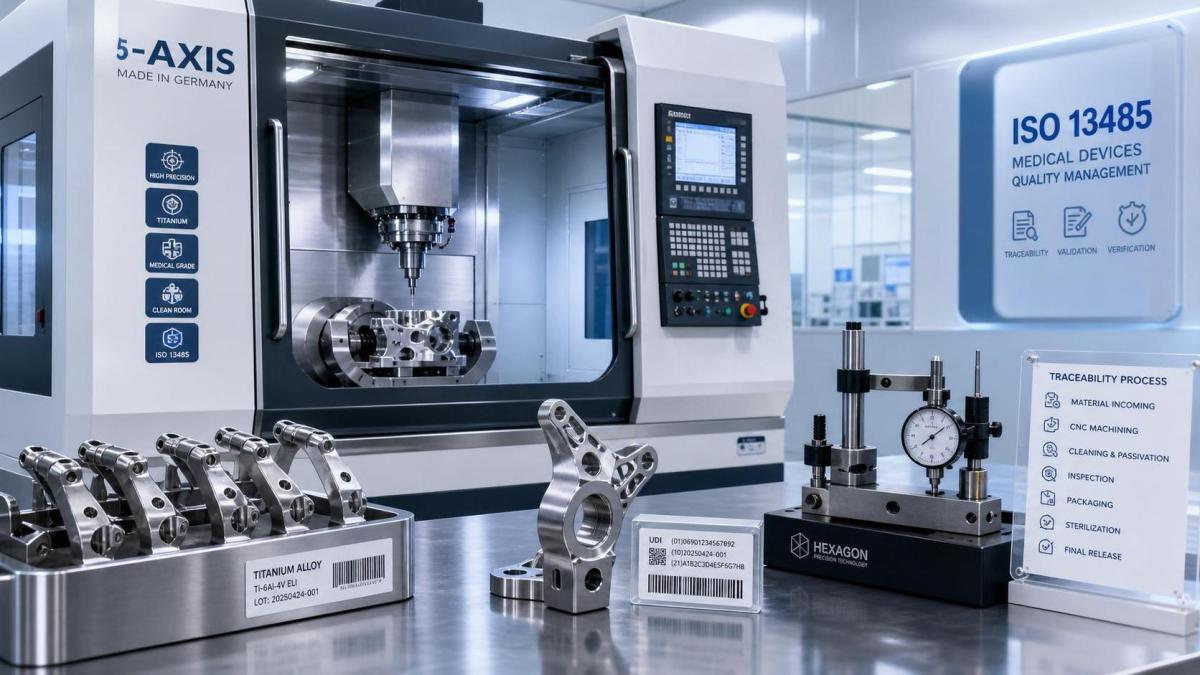
The difference is the control environment around the cut. A bone screw, surgical guide, implant instrument, or diagnostic housing may require not only dimensional accuracy, but also documented evidence that the part was made, handled, inspected, and released under defined conditions.
In broader industrial sectors, a capable process may be judged mainly by output and efficiency. In CNC manufacturing for medical devices, a process is judged by repeatability, record integrity, risk management, and change control as well.
What ISO 13485 means in a machining context
ISO 13485 is a quality management standard for medical devices. It does not tell a shop how to machine a titanium part. It defines how the organization controls documents, training, purchasing, production, inspection, nonconformance, corrective action, and traceable records.
For CNC manufacturing for medical devices, ISO 13485 usually influences daily operations in practical ways. Work instructions become controlled documents. Operator training must be current. Inspection plans need revision control. Suppliers for raw material, coating, heat treatment, and cleaning require qualification.
It also raises expectations around risk. If a machining offset changes, if a fixture is replaced, or if coolant management shifts, the question is no longer only whether the part still passes inspection. The question is whether the change was reviewed, approved, and documented correctly.
Core areas usually affected
- Document control for drawings, routings, setup sheets, and inspection methods.
- Training records for machinists, inspectors, and quality personnel.
- Supplier control for raw materials and external special processes.
- Equipment maintenance and calibration for machines and metrology tools.
- Nonconformance handling, CAPA, and complaint-related investigation support.
Traceability is more than a serial number
Traceability is often misunderstood as simple part marking. In reality, CNC manufacturing for medical devices requires a traceable chain of evidence. A finished component should connect back to material certification, machine routing, tooling status, inspection results, operators, and approved process documents.
The depth of traceability depends on the device class, customer requirements, and risk profile. Some programs need lot-level control. Others need unit-level traceability. The key is consistency. Gaps in records can become just as serious as dimensional failures.
This is one reason digital integration is gaining importance. Across global machine tool clusters in China, Germany, Japan, and South Korea, manufacturers are combining CNC equipment with MES, ERP, barcode systems, and automated data capture. In medical work, that trend supports cleaner records and faster investigation when something goes wrong.
Typical traceability elements
Validation basics for CNC manufacturing for medical devices
Validation can sound abstract, but the idea is straightforward. A manufacturer must show that a process, under defined conditions, can consistently produce acceptable results. In medical production, that confidence cannot rely on informal experience alone.
For CNC manufacturing for medical devices, validation often blends machine capability, inspection strategy, and documented process control. Some characteristics are verified through first article inspection and ongoing in-process checks. Others may require stronger statistical evidence or a formal validation protocol.
Validation is especially relevant when the output cannot be fully confirmed later, or when process variation could remain hidden until assembly or clinical use. Surface condition, burr control, passivation readiness, or geometry affecting mating function can fall into this category.
Where validation usually shows up
- New product introduction with critical dimensions or complex geometries.
- Transfer from prototype machining to repeatable production.
- Changes in machine platform, fixture design, or tool path strategy.
- Secondary operations such as cleaning, marking, or outsourced finishing.
- Programs involving implants, surgical instruments, or tight assembly interfaces.
Common risk points that deserve closer review
Medical machining risk often enters through ordinary production details. Tool wear can drift a diameter gradually. Fixture variation can alter repeatability between setups. Mixed material lots can create traceability confusion. A drawing revision change can bypass the shop floor if document control is weak.
More subtle issues matter too. Deburring methods can affect edge conditions. Packaging choices can damage cleaned parts. External processes such as anodizing, coating, heat treatment, or laser marking may sit outside the machine shop, but they still affect final compliance.
This is where the broader CNC industry trend toward automation helps. Barcode-driven routing, tool life monitoring, machine data capture, and connected inspection systems reduce manual gaps. They do not replace quality judgment, but they make control more reliable.
How to assess a capable supplier or internal process
A credible medical machining operation should be evaluated as a system, not as a machine list. Five-axis capacity, modern lathes, and advanced metrology are important, but they only tell part of the story.
Useful assessment points include:
- Whether ISO 13485 certification is current and relevant to the site scope.
- How material, work orders, and finished parts are identified and segregated.
- What validation evidence exists for critical programs and process changes.
- How calibration, maintenance, and preventive actions are documented.
- How external processors are qualified and monitored over time.
- Whether inspection data supports trend analysis, not only pass or fail release.
In practical terms, strong CNC manufacturing for medical devices looks orderly long before the final inspection. The paperwork aligns with the process. Records are easy to retrieve. Process owners can explain why controls exist, not just where forms are stored.
A sensible next step for evaluation and planning
For anyone comparing partners, launching a new program, or expanding into regulated work, the most useful starting point is a structured gap review. Map the part flow from raw material receipt to final shipment. Then check where traceability, documented approval, and validation evidence are strong or incomplete.
That approach keeps the discussion grounded. It also helps separate generic machining capability from true readiness for CNC manufacturing for medical devices. In a market moving toward higher precision, automation, and digital control, the shops that stand out are the ones that can prove consistency as clearly as they can machine complexity.
From there, the next decisions become clearer: which processes need tighter records, which suppliers need deeper qualification, and which programs are ready for scale under medical requirements.
Recommended for You
 How to Design Cost-Effective Fixtures That Maintain Cycle Time in Mass ProductionCNC Machining Technology Center
 Is Learning CNC Programming Worth It for Shop Owners Seeking Higher Margins?CNC Machining Technology Center
 CNC Machine Arrival Inspection: Check Shipping Damage, Accuracy, Safety, and DocumentsCNC Machining Technology Center
 How to Select a Machine Tool for Aerospace Parts with Tight Tolerances?Machine Tool Industry Editorial Team
 How to Select CNC Equipment for High-Mix, Low-Volume ProductionCNC Machining Technology Center
 Can CNC Machining Inconel Control Tool Wear in High-Temperature Aerospace Parts?CNC Machining Technology Center

Aris Katos
Future of Carbide Coatings
15+ years in precision manufacturing systems. Specialized in high-speed milling and aerospace grade alloy processing.
▶
CNC Machine Arrival Inspection: Check Shipping Damage, Accuracy, Safety, and DocumentsCNC Machining Technology Center▶
What Should You Check When a CNC Machine Arrives at Your Factory?CNC Machining Technology Center▶
What Safety Checks Are Required for CNC Cutting Operations?CNC Machining Technology Center▶
What Are Machine Tools? Common Types, Functions, and Typical Shop ApplicationsCNC Machining Technology Center▶
CNC Industrial Machines Maintenance Checklist: How to Reduce Downtime and Tool WearCNC Machining Technology Center
Mastering 5-Axis Workholding Strategies
Join our technical panel on Nov 15th to learn about reducing vibrations in thin-wall components.

Providing you with integrated sanding solutions
Before-sales and after-sales services
Comprehensive technical support