• Global CNC market projected to reach $128B by 2028 • New EU trade regulations for precision tooling components • Aerospace deman
NYSE: CNC +1.2%LME: STEEL -0.4%

Why Automated Production Line ROI Often Looks Better on Paper
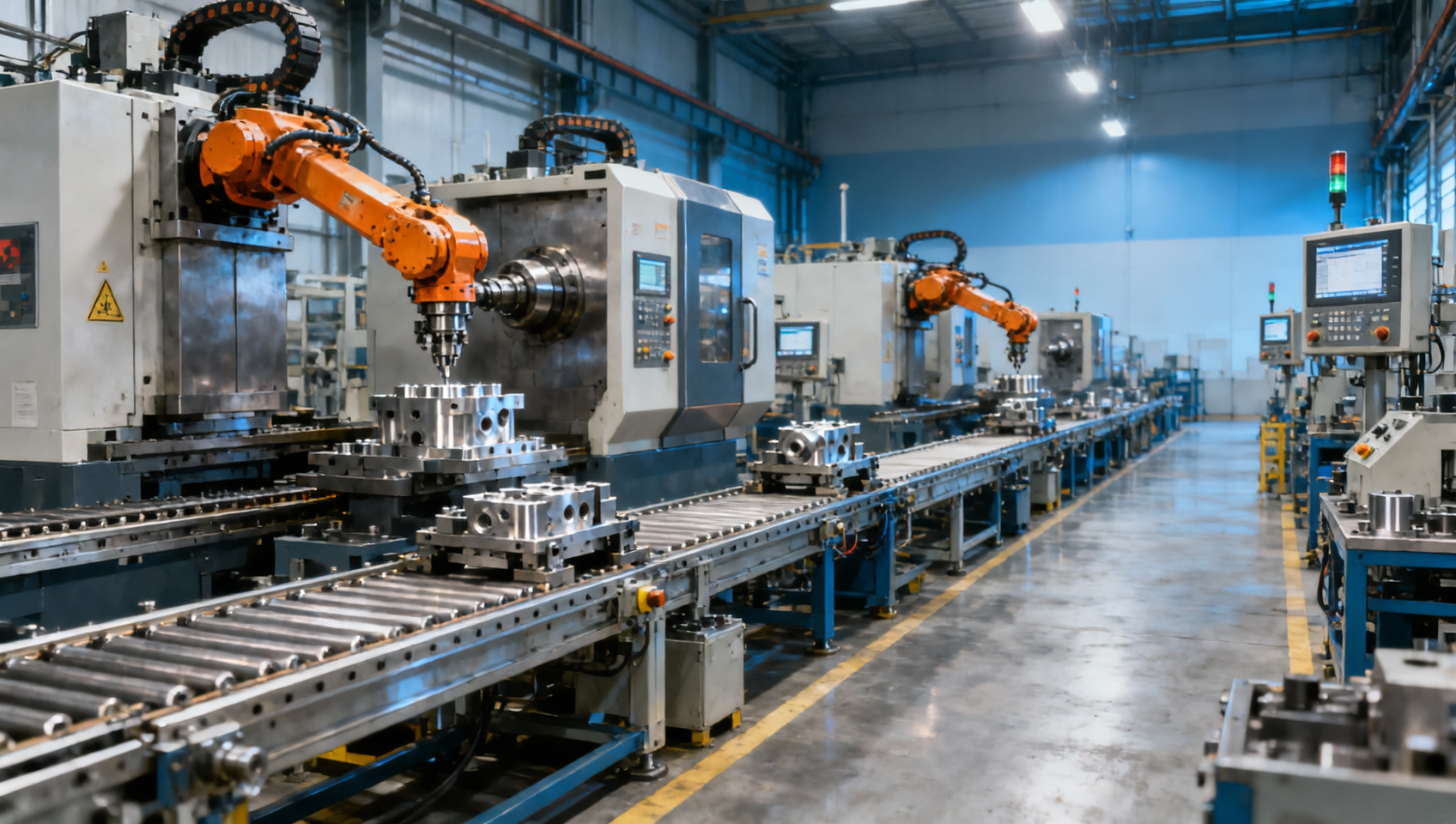
Automated Production Line ROI often appears compelling in boardroom models, yet real-world results in metal machining and industrial CNC environments can differ sharply. From CNC milling and automated lathe integration to labor, downtime, CNC Programming, and Production Process complexity, the true return depends on more than equipment output. For buyers, operators, and decision-makers across the Manufacturing Industry, understanding these hidden variables is essential before scaling automated production.
Why does automated production line ROI look strong in proposals but weaker on the shop floor?
In capital planning, automated production line ROI is usually built on clean assumptions: steady cycle time, stable part quality, full machine utilization, predictable labor savings, and limited downtime. In real CNC machining environments, however, those assumptions often break down within the first 3–6 months after installation. The result is not that automation fails, but that the model used to justify it was too narrow.
A typical ROI worksheet may calculate output from spindle hours, loading time, and expected labor reduction, yet omit scrap during ramp-up, fixture refinement, robot teach adjustments, tool life variation, and schedule disruptions from mixed production. In a high-mix manufacturing industry setting, these factors can influence actual return far more than the theoretical speed of a CNC lathe or machining center.
This matters across automotive components, aerospace structures, energy equipment, and electronics production. The more precise the component and the more complex the production process, the more sensitive ROI becomes to setup accuracy, CNC Programming quality, and cross-station coordination. A line that looks excellent on paper at 85% utilization may operate at 50%–65% during early deployment.
For procurement teams and enterprise leaders, the central question is not whether automation can improve output. It usually can. The better question is whether the planned automated production line matches actual part families, batch sizes, operator capability, maintenance resources, and digital management maturity. That is where expected ROI is often won or lost.
The boardroom model usually rewards measurable gains first
Financial models tend to favor variables that are easy to quantify within 12–24 months: direct labor reduction, target cycle time, estimated annual output, and machine uptime assumptions. These are useful, but incomplete. Many indirect costs only appear after commissioning, especially when one automated cell must serve several part numbers with different tolerances, materials, or cutting conditions.
In CNC production, output is shaped not only by machine speed but also by tooling strategy, clamping repeatability, chip evacuation, in-process inspection, and response time when alarms occur. When these factors are excluded, automated production line ROI looks cleaner than it should. The proposal remains attractive, but the confidence level becomes misleading.
Common blind spots in early ROI calculations
- Ramp-up loss during the first 4–12 weeks, when programs, fixtures, and robot motion still need optimization.
- Unplanned downtime linked to sensors, conveyors, grippers, coolant contamination, and tool breakage recovery.
- Lower-than-expected flexibility when one line handles both small batch and medium batch production.
- Hidden staffing needs for programming, maintenance, and quality supervision during multi-shift operation.
Which hidden cost drivers distort automated production line ROI in CNC manufacturing?
The most common reason automated production line ROI looks better on paper is that cost categories are simplified too aggressively. In CNC machining and precision manufacturing, the real cost structure includes far more than machine purchase and labor reduction. Integration cost, training time, process engineering, part validation, and spare parts planning all influence the payback period.
Downtime is especially underestimated. A manual process may lose efficiency locally, but an automated line can stop multiple linked stations at once. A single issue in a loading unit, barcode reader, probe routine, or chip removal path can reduce throughput across the entire line. On paper, a 90-second cycle looks excellent. In practice, 8–15 minutes of interruption several times per shift can erase that advantage.
Another hidden driver is engineering change frequency. If part revisions occur every quarter, or if customers often switch dimensions, materials, or tolerance windows, then fixture redesign, CNC Programming updates, and validation runs consume both time and money. Flexible production lines help, but flexibility itself has a cost in software, controls, and operator skill requirements.
Quality risk must also be treated as a cost driver. In automated CNC milling or turning, a repeatable error can create a repeatable scrap stream. If the line processes expensive alloy parts or precision discs with tight tolerance demands, one undetected offset issue can affect dozens of parts before intervention. Scrap exposure in such systems is often under-modeled during investment review.
A practical breakdown of cost categories
Before approving an automated production line, it helps to separate visible capital expenditure from operational and transitional costs. The table below summarizes where ROI models often look incomplete in the manufacturing industry.
The table shows why automated production line ROI should be reviewed as a full operating system, not just as a machine investment. When procurement, operations, and finance assess these categories together, the payback estimate becomes more conservative, but also more credible and more useful for decision-making.
Questions buyers should ask before accepting a payback claim
- How many part families will run on the same line over a 12-month period, and how long does each changeover actually take?
- What utilization rate is assumed in the ROI model: 60%, 75%, or 85%, and what evidence supports it?
- How are scrap, first-pass yield, and in-process measurement handled for precision parts?
- What is the recovery plan if a key component fails and replacement lead time is 2–4 weeks?
When does automation deliver real value, and when is the ROI model too optimistic?
Automated production line ROI becomes more reliable when the production environment is relatively stable. Examples include high-volume shaft components, repeatable structural parts, or standardized housings with consistent fixtures and limited engineering change. In these cases, automation can reduce labor exposure, improve output consistency, and support multi-shift production with fewer interruptions.
The model becomes optimistic when a company treats automation as a cure for process instability. If part drawings change frequently, tolerances are still being refined, tool paths are not mature, or upstream material quality varies, a robot or transfer line will not remove those problems. It may simply amplify them at a faster rate. This is a common issue in CNC milling cells introduced before process discipline is established.
Another mismatch occurs when a plant expects labor savings but still requires high manual oversight. Operators may no longer load every part by hand, yet they still monitor alarms, replace tools, inspect dimensions, manage offsets, and maintain coolant or chips. In some shops, the labor profile changes rather than disappears. ROI should reflect that shift honestly.
For enterprise decision-makers, the practical rule is simple: the more stable the part mix, the more standardized the process, and the stronger the maintenance capability, the more defensible the automated production line ROI. The less stable those conditions are, the more carefully alternatives should be compared.
Scenario comparison for decision support
The next table helps procurement teams compare where automation usually performs well and where ROI often needs additional caution.
This comparison is useful for buyers evaluating CNC lathes, machining centers, robot tending, and flexible production lines. It shows that good ROI is not determined by automation level alone. It depends on fit between equipment, process maturity, and the actual production mix over time.
Signals that a proposal may be too optimistic
- The payback assumes immediate full-rate production with no 4–8 week stabilization period.
- Cycle time is presented without including loading, inspection, alarm recovery, or tool change delays.
- The labor model removes operators but does not add programming or maintenance support.
- Changeover frequency is ignored even though the line serves several customers or product revisions.
How should procurement teams evaluate an automated production line before purchase?
A sound procurement decision starts with production reality, not equipment appearance. Buyers should map at least 3 categories before requesting quotations: part family stability, target output by shift, and internal support capability. Without those inputs, comparing automation solutions becomes a price discussion rather than a performance discussion, which often leads to poor line fit.
For CNC machine tool projects, selection should include machine capacity, robot handling logic, fixture repeatability, software openness, maintenance accessibility, and supplier support scope. Lead time also matters. A line may have an equipment delivery cycle of 10–20 weeks, but commissioning and process validation can extend the usable startup horizon by another 2–6 weeks depending on complexity.
Procurement teams should also request acceptance criteria in writing. This reduces confusion later. For example, define whether output is measured per hour, per shift, or per operator; whether uptime excludes planned maintenance; and which dimensional checks are required before sign-off. Clear criteria improve both supplier alignment and internal accountability.
Most importantly, compare alternatives honestly. In some plants, a semi-automated CNC cell with improved fixturing and better CNC Programming can outperform a fully linked line in ROI terms. That is not a step backward. It is often a better match for current production conditions and budget limits.
A practical procurement checklist
The table below can be used during supplier discussions to assess automated production line suitability across technical, operational, and commercial dimensions.
Using a checklist like this helps procurement professionals move beyond nominal machine price. It aligns the buying process with real manufacturing needs, which is exactly where automated production line ROI should be validated.
Implementation steps that reduce ROI risk
- Run a baseline study on current output, scrap, labor allocation, and unplanned stoppages for at least 2–4 weeks.
- Define 5–6 acceptance points, such as cycle time, repeatability, alarm response, part qualification, and training completion.
- Plan a staged launch rather than immediate full load, especially for flexible CNC production lines.
- Review actual performance after 30, 60, and 90 days to update the ROI model with real operating data.
Common misconceptions, buyer questions, and what decision-makers should do next
Many people assume that more automation automatically means better economics. In the CNC machine tool industry, that is only true when the process is ready, the part mix supports it, and the organization can maintain it. A well-designed automated production line can transform throughput and consistency, but a poorly matched one can lock a factory into expensive complexity.
Another misconception is that labor savings alone justify investment. In practice, buyers should value resilience, process visibility, and quality stability as much as headcount reduction. If a line improves traceability, stabilizes critical dimensions, and supports predictable output across 2 or 3 shifts, those gains may justify the project even when labor savings are moderate.
For information researchers, operators, purchasers, and executives, the most useful approach is cross-functional review. Production, engineering, quality, maintenance, and procurement should evaluate the same automated production line from different angles. This reduces the risk of approving a system that looks good in a spreadsheet but performs poorly in live manufacturing.
In global CNC machining and precision manufacturing, automation remains a powerful direction. Industrial robots, flexible production lines, and digital integration are expanding rapidly. Still, the strongest ROI comes from realistic modeling, process readiness, and supplier dialogue focused on actual production conditions rather than idealized assumptions.
FAQ: what buyers and plant teams ask most often
How long does it usually take for an automated production line to reach stable output?
For many CNC automation projects, stable output does not begin on day one. A realistic stabilization window is often 4–12 weeks after mechanical installation, depending on fixture maturity, program readiness, inspection method, and the number of part variants. Projects with tighter tolerances or more frequent changeovers usually need longer validation.
Is full automation always better than a semi-automated CNC cell?
No. Full automation is usually more attractive for high-volume, stable parts. A semi-automated solution can be better for mixed production, limited budgets, or plants still strengthening process discipline. In many cases, the best ROI comes from the lowest-complexity solution that still meets output, quality, and labor goals.
What should procurement focus on besides equipment price?
Focus on at least 4 areas: process fit, changeover demand, support scope, and acceptance standards. Also confirm spare parts planning, training content, remote service response, and how performance will be measured after installation. A lower upfront price can become expensive if downtime, debugging, or expansion costs are not considered.
Which standards or compliance topics are commonly relevant?
Requirements vary by market and equipment configuration, but buyers commonly review machine safety, electrical integration, guarding, emergency stop logic, and documentation for operation and maintenance. For export-oriented projects, it is important to align compliance expectations early so redesign or approval delay does not affect delivery.
Why work with us on automation evaluation and sourcing?
We focus on the global CNC machining and precision manufacturing industry, with attention to machine tools, automated production lines, technical trends, and international trade realities. That allows us to support not only product selection, but also the broader decision context behind an automation investment.
If you are comparing CNC lathes, machining centers, robot loading cells, or flexible production lines, we can help you review key parameters, batch suitability, line configuration logic, estimated delivery windows, and implementation risks. We can also help structure supplier discussions around acceptance points, customization scope, and spare parts planning.
For buyers with urgent projects, we can support quotation communication, solution comparison, and clarification of items such as fixture approach, programming responsibility, startup support, and typical commissioning stages. If your team is still in the research phase, we can help narrow options based on part type, tolerance level, production volume, and expansion goals.
Contact us to discuss parameter confirmation, product selection, delivery cycle expectations, custom automation plans, compliance considerations, sample part evaluation, or quotation alignment. A realistic automated production line ROI starts with the right questions, and those questions should be answered before capital is committed.
PREVIOUS ARTICLE
Recommended for You
 Heavy-duty Machining Center for mold making: Why coolant filtration standards evolve faster than OEM manualsMachine Tool Industry Editorial Team
 Quick-change Fixture Design for CNC turning: Why clamping force consistency drops after 200 cyclesCNC Machining Technology Center
 5 Axis Machining for impeller manufacturing: Why toolpath smoothing affects surface fatigue lifeCNC Machining Technology Center
 Lean Production Process implementation: Where value stream mapping fails to expose hidden machine downtimeManufacturing Market Research Center
 Modular Tooling System for flexible manufacturing: Why interface repeatability degrades faster than expectedMachine Tool Industry Editorial Team
 Industrial Automation control system for CNC machines: When cybersecurity updates disrupt scheduled maintenanceMachine Tool Industry Editorial Team

Aris Katos
Future of Carbide Coatings
15+ years in precision manufacturing systems. Specialized in high-speed milling and aerospace grade alloy processing.
▶
Industrial Automation control system for CNC machines: When cybersecurity updates disrupt scheduled maintenanceMachine Tool Industry Editorial Team▶
Automated Production Line troubleshooting: Why intermittent faults resist standard diagnostic treesMachine Tool Industry Editorial Team▶
Automated machine tool: When integrated vision systems introduce new validation headachesMachine Tool Industry Editorial Team▶
How a CNC manufacturing factory balances automation with skilled operator oversightMachine Tool Industry Editorial Team▶
Industrial Robotics Payback Gets Delayed by These GapsMachine Tool Industry Editorial Team
Mastering 5-Axis Workholding Strategies
Join our technical panel on Nov 15th to learn about reducing vibrations in thin-wall components.

Providing you with integrated sanding solutions
Before-sales and after-sales services
Comprehensive technical support