• Global CNC market projected to reach $128B by 2028 • New EU trade regulations for precision tooling components • Aerospace deman
NYSE: CNC +1.2%LME: STEEL -0.4%

Vertical Lathe Limits to Check Before Taking Larger Workpieces
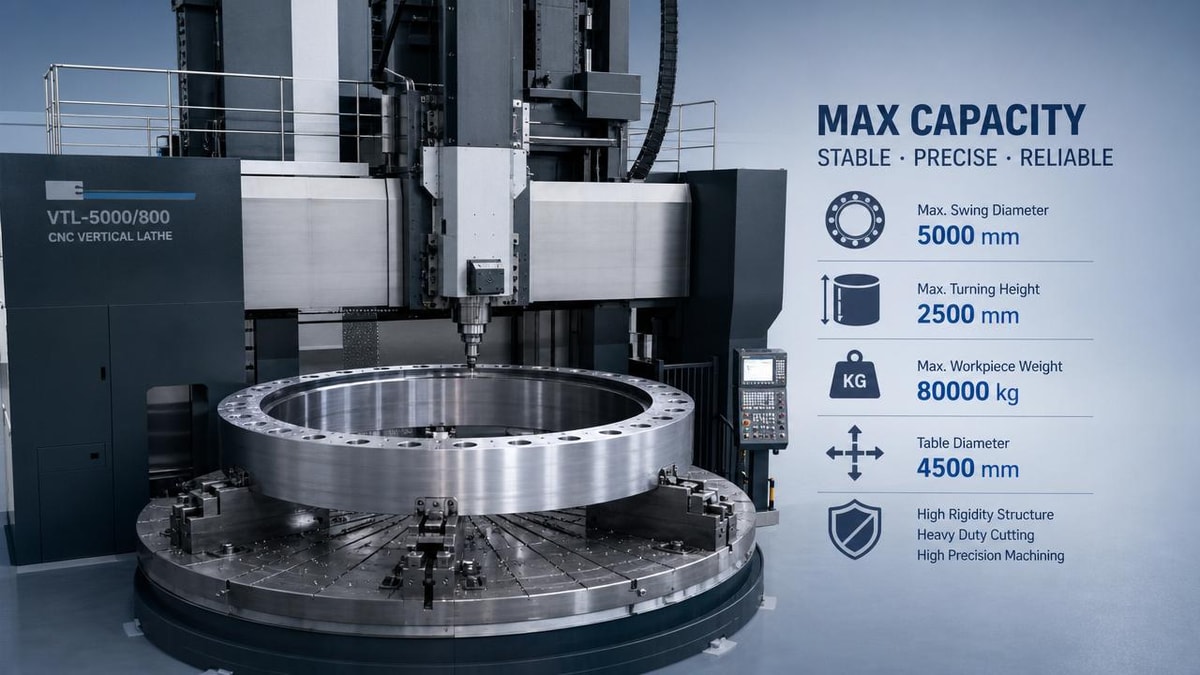
Before loading oversized parts onto a vertical lathe, technical evaluators need to verify more than just swing diameter. Capacity limits, table load, workpiece height, rigidity, clamping stability, and tool reach all affect machining safety and accuracy. This article outlines the key vertical lathe constraints to review before accepting larger workpieces, helping reduce risk, avoid costly errors, and support sound equipment assessment.
In precision manufacturing, larger workpieces often promise higher order value, but they also introduce higher mechanical stress, tighter process windows, and greater risk exposure. For technical evaluators working in automotive, energy equipment, aerospace, heavy components, or contract machining, a vertical lathe assessment should go beyond catalog ratings. Real acceptance decisions depend on how machine structure, fixture design, tooling, and process planning interact under load.
A machine may appear capable on paper because the workpiece fits within the stated turning diameter, yet problems can still emerge during clamping, roughing, interrupted cutting, or long-cycle finishing. When the part diameter increases by 15% to 30%, the impact on torque demand, vibration sensitivity, and setup complexity can be disproportionate. That is why larger-part feasibility on a vertical lathe must be reviewed as a system-level question rather than a single-parameter check.
Core Capacity Limits That Matter First
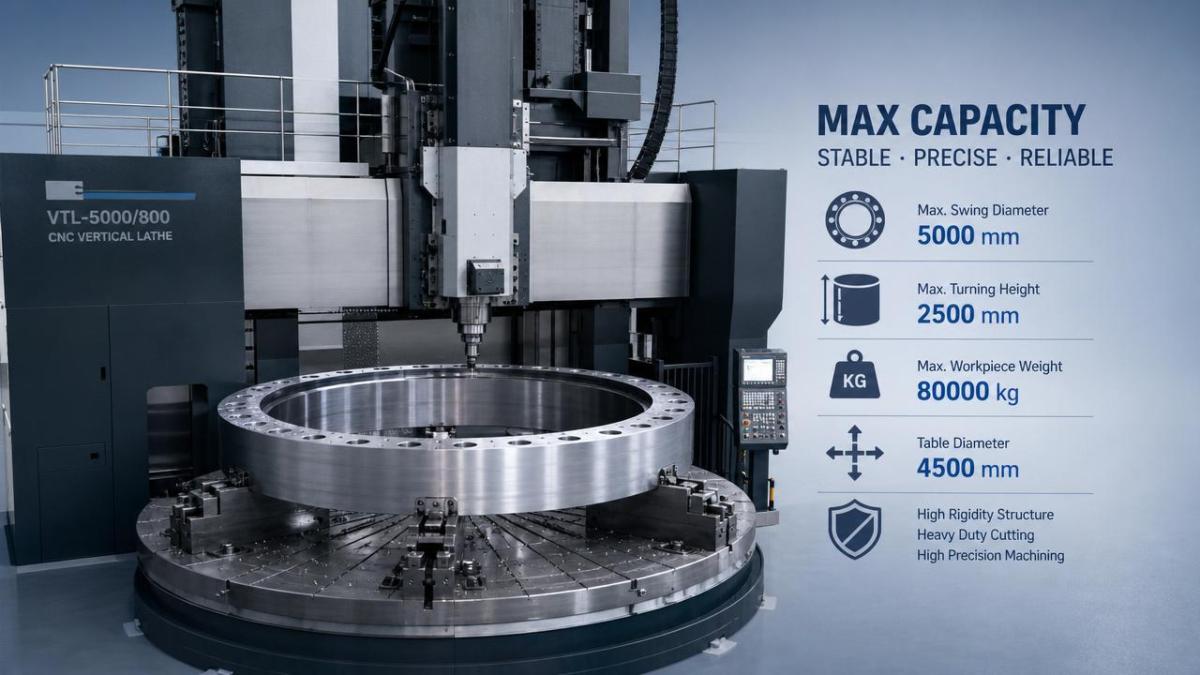
The first stage of evaluation is confirming whether the vertical lathe can physically and mechanically carry the job. This means checking at least 6 basic constraints: maximum turning diameter, maximum swing, maximum workpiece height, table load capacity, ram stroke, and allowable tool overhang. These numbers form the initial go or no-go screen before any deeper process review begins.
Diameter Is Only the Starting Point
Technical evaluators often begin with swing diameter because it is easy to compare. However, the nominal turning diameter does not always represent usable capacity. Guarding, toolpost position, chuck jaws, and boring bar interference can reduce effective machining envelope by 5% to 12%. On a vertical lathe, the practical machining diameter may be smaller than the published maximum, especially for deep-face or stepped components.
For example, if a machine lists a maximum turning diameter of 2,000 mm, a safe planning limit may be closer to 1,800 to 1,900 mm once clamping clearance and tool approach are considered. Evaluators should request the actual working envelope drawing, not just brochure specifications. This is particularly important for parts such as bearing rings, turbine housings, valve bodies, and large flanges with uneven external geometry.
Table Load and Load Distribution
Table load is one of the most misunderstood vertical lathe limits. A published load capacity, such as 8 tons, 12 tons, or 20 tons, usually assumes centered loading and stable rotational balance. A workpiece weighing 9 tons is not automatically safe on a 10-ton table if the center of gravity is offset by 80 mm to 150 mm, or if the part has asymmetric cutouts that create imbalance during rotation.
When evaluating larger workpieces, ask 4 specific questions: Is the load centered? What is the center-of-gravity height above the table? Will roughing remove material unevenly? Is the part rotationally balanced within acceptable machine limits? These factors affect bearing life, spindle heating, and vibration behavior. In many heavy-cutting conditions, a conservative planning margin of 10% to 20% below rated table load is more realistic than working at the absolute limit.
The table below summarizes the primary capacity checks that should be reviewed before accepting oversized parts on a vertical lathe.
A key takeaway is that listed machine capacity should rarely be treated as the production limit. For larger parts, the usable operating window is often narrower than the nameplate suggests. Evaluators who apply planning margins early can reduce setup failures, excessive vibration, and costly test cuts later in the process.
Workpiece Height and Vertical Clearance
Height limits affect more than simple fit. On a vertical lathe, a tall workpiece can shift the cutting zone farther from the machine’s most rigid structural position. As height increases, leverage on the setup grows, and cutting stability may decline. A component with a height of 1,200 mm may be nominally acceptable, yet still create poor tool access if the ram stroke is limited or the upper section requires internal profiling.
Minimum practical clearance checks
- Allow 50 mm to 100 mm for jaw and fixture projection above the table surface.
- Reserve 30 mm to 80 mm for safe tool approach and retract movement.
- Confirm enough overhead clearance for probes, boring bars, and measurement tools.
- Check whether chip accumulation zones will interfere with deep internal features.
These checks are especially relevant in digitally integrated workshops where one machine may be scheduled across several product families. A vertical lathe used for both low-profile rings and tall housings may require different fixture stacks and different safe-envelope assumptions.
Rigidity, Clamping, and Dynamic Stability Under Load
Once physical size and weight are cleared, the next question is whether the vertical lathe can cut the part accurately and safely. This is where rigidity becomes decisive. A machine can hold the part but still fail to control vibration, taper, chatter, thermal distortion, or tool deflection. For heavy or interrupted cuts, dynamic stability often becomes the real production limit.
Machine Structure and Cutting Force Response
Larger diameters usually mean larger cutting radii, longer chip travel, and wider variation in surface speed between inner and outer zones. During roughing, radial and tangential forces can rise sharply, especially on forged or cast surfaces with scale or interrupted areas. If the vertical lathe column, cross rail, or ram lacks sufficient rigidity, surface finish may deteriorate and dimensional deviation may exceed tolerance after several passes.
As a practical rule, evaluators should compare the expected stock removal rate with machine stiffness and spindle power characteristics, not only with maximum spindle torque. If a large part requires roughing depths of 4 mm to 8 mm per pass and feeds of 0.3 mm/rev to 0.8 mm/rev, even moderate imbalance can trigger chatter. This is why trial process review should include cutting force estimation and not stop at static loading checks.
Clamping Stability Is a Primary Safety Limit
Clamping failure on a vertical lathe is particularly serious because large workpieces carry high inertia. Evaluators should review the fixture method, contact area, jaw engagement depth, and anti-slip margin before approving oversized parts. A large disc with only narrow jaw contact may rotate safely at low speed but become unstable when roughing generates intermittent force peaks.
For larger workpieces, 5 clamping variables deserve close attention: contact width, axial support method, radial location accuracy, friction condition, and repeatability after part reloading. In many cases, adding soft jaws, custom pads, or a dedicated support ring provides more value than simply reducing spindle speed. Clamping should be reviewed together with machining sequence because material removal can alter the load path as the cycle progresses.
The following matrix helps technical evaluators judge whether setup stability on a vertical lathe is acceptable for heavier and larger parts.
This matrix shows that oversized-part approval is rarely a single-machine decision. It depends on how the vertical lathe, fixture, cutting tool, and process plan work together. Where warning signs appear, evaluators should request a controlled test cut or simulation review instead of relying on assumptions.
Tool Reach, Overhang, and Feature Accessibility
Many larger workpieces include deep counterbores, recessed faces, internal grooves, or stepped sealing surfaces. These features may be reachable only with long tools or extended boring bars. Once tool overhang exceeds a stable limit, the vertical lathe may lose both accuracy and productivity. Surface waviness, dimensional taper, and insert wear can increase quickly even when the spindle and table remain within safe load.
A useful review method is to separate external turning, face turning, boring, grooving, and drilling into individual reach checks. If even 1 of these operations requires excessive extension, the whole setup may need redesign. In practical terms, technical evaluators should inspect 3 things: available toolholder space, turret collision envelope, and the ratio between tool extension and feature depth.
A Practical Evaluation Workflow Before Accepting Large Parts
In modern CNC machining and smart manufacturing environments, assessment speed matters, but so does risk control. A structured workflow helps technical evaluators make consistent decisions across different factories, suppliers, and vertical lathe configurations. Instead of relying on informal judgment, use a repeatable review path that can be applied within 1 to 3 engineering meetings.
A 5-Step Screening Process
- Confirm basic part data: diameter, height, weight, material, and stock allowance.
- Compare with vertical lathe limits: turning diameter, table load, ram stroke, and spindle range.
- Review setup concept: jaw layout, support method, balancing, and loading sequence.
- Check process feasibility: roughing force, tool reach, tolerance target, and finish requirement.
- Decide acceptance level: direct production, trial cut required, or external capacity needed.
This 5-step method reduces the chance of approving a job that fits dimensionally but fails in execution. It also improves cross-functional coordination between machining engineers, production planners, and sourcing teams, especially when evaluating subcontracted capacity across multiple machine tool suppliers.
Common Misjudgments in Vertical Lathe Assessment
One common error is treating larger workpieces as a simple scale-up of smaller ones. In reality, once a part crosses certain thresholds, such as 1.5 m diameter, 5-ton weight, or 800 mm height, setup complexity and process sensitivity often increase sharply. Another mistake is assuming low spindle speed automatically creates a safe condition. Lower speed can reduce centrifugal effects, but it does not eliminate weak clamping, unstable boring bars, or structural deflection.
A third misjudgment is ignoring cycle-time economics. Even if a vertical lathe can machine the part technically, excessive pass count, slow feed settings, or repeated re-clamping may make the job commercially unattractive. For B2B procurement and equipment planning, feasibility should always be evaluated in terms of safety, quality, and throughput together.
Questions evaluators should ask before approval
- Will the part remain stable after 20% to 40% of stock is removed?
- Can the required tolerance be held in one setup, or is re-clamping necessary?
- Does the vertical lathe have enough torque at the planned cutting speed range?
- Are special jaws, support plates, or balancing steps needed before machining starts?
- Is there enough crane capacity and loading clearance around the machine?
When to Escalate to Trial Cutting or Alternative Equipment
If more than 2 major uncertainty factors remain after the screening process, a trial cut is usually justified. These factors may include unclear balancing behavior, unproven fixture rigidity, difficult interrupted cuts, or uncertain internal feature accessibility. Trial runs are particularly valuable for first-time parts in industries such as energy, aerospace support structures, and large industrial transmission systems where material cost and machining time are both high.
There are also situations where a vertical lathe is simply not the best choice. If the workpiece demands extreme internal reach, multi-face machining in one cycle, or tight concentricity across complex features, a larger turn-mill system, floor-type boring machine, or alternate fixture strategy may produce better results. Sound assessment includes the discipline to reject unsuitable jobs, not just the desire to maximize machine utilization.
Final Decision Criteria for Technical Evaluators
A reliable vertical lathe assessment should end with documented decision criteria. In most manufacturing organizations, the final approval should combine 4 dimensions: capacity fit, process stability, quality risk, and operational efficiency. If one dimension fails clearly, the job should not move forward without mitigation. This protects machine health, delivery performance, and customer confidence.
For technical evaluators, the goal is not to use the largest possible percentage of machine capacity. The goal is to define a safe and repeatable production window. When larger workpieces approach the upper 10% to 15% of a vertical lathe’s rated envelope, hidden risks multiply. A disciplined review of load, height, rigidity, clamping, and tool access provides a far better basis for acceptance than diameter alone.
If you are assessing larger components for CNC turning, heavy part machining, or global sourcing of precision manufacturing capacity, a structured vertical lathe review can prevent avoidable downtime and quality loss. To discuss a specific part drawing, machining challenge, or equipment matching question, contact us for a tailored evaluation, product detail consultation, or a more complete manufacturing solution review.
PREVIOUS ARTICLE
Recommended for You
 Industrial Machining Equipment Lead Times Are Changing AgainManufacturing Market Research Center
 Where Industrial Robotics Adds Value Beyond Simple Labor SavingsMachine Tool Industry Editorial Team
 Shaft Parts Machining Problems That Show Up After Final InspectionCNC Machining Technology Center
 Production Process Variations That Quietly Raise Scrap RatesCNC Machining Technology Center
 Industrial Automation Projects Fail When Data Is Added Too LateCNC Machining Technology Center
 CNC Metal Cutting Quality Drops Often Start With ClampingMachine Tool Industry Editorial Team



Aris Katos
Future of Carbide Coatings
15+ years in precision manufacturing systems. Specialized in high-speed milling and aerospace grade alloy processing.
▶
CNC Metal Lathe Selection Mistakes That Increase Rework RatesMachine Tool Industry Editorial Team▶
Vertical Lathe Limits to Check Before Taking Larger WorkpiecesMachine Tool Industry Editorial Team▶
Choosing a Metal Lathe for Mixed Materials Without OverspendingMachine Tool Industry Editorial Team▶
Is an automated lathe worth it for short-run metal parts?Machine Tool Industry Editorial Team▶
CNC metal lathe problems that appear after heavy loadsMachine Tool Industry Editorial Team
Mastering 5-Axis Workholding Strategies
Join our technical panel on Nov 15th to learn about reducing vibrations in thin-wall components.

Providing you with integrated sanding solutions
Before-sales and after-sales services
Comprehensive technical support