• Global CNC market projected to reach $128B by 2028 • New EU trade regulations for precision tooling components • Aerospace deman
NYSE: CNC +1.2%LME: STEEL -0.4%

Automated Production Needs Flexibility More Than Speed Now
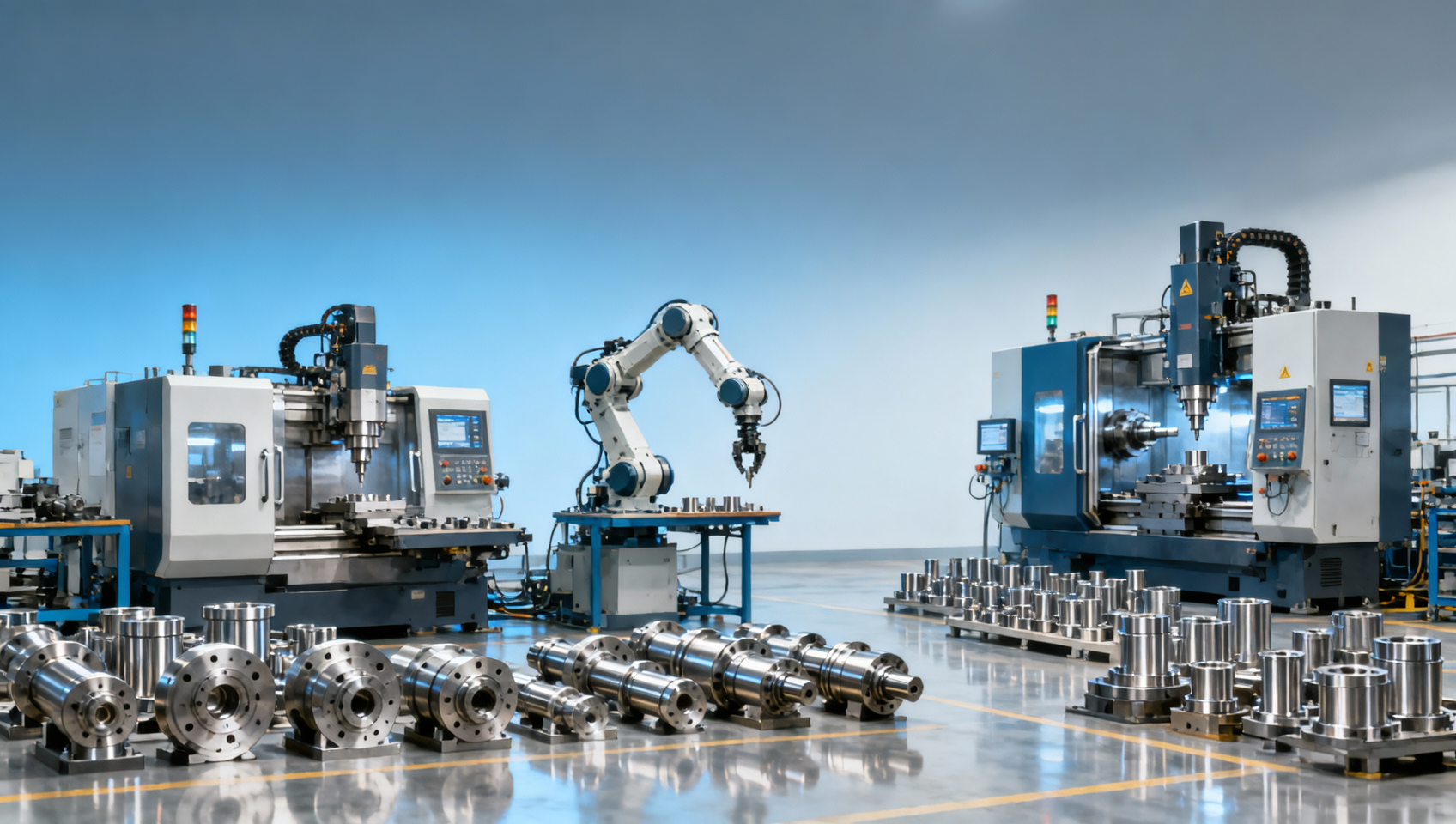
In today’s Global Manufacturing landscape, automated production is no longer driven by speed alone. For the Manufacturing Industry, flexible industrial CNC systems, CNC milling, automated lathe solutions, and smarter production process design are becoming essential to handle diverse shaft parts, tighter tolerances, and fast-changing demand. This shift is reshaping the Machine Tool Market and redefining how companies approach Industrial Automation and CNC production.
Why flexibility is becoming the real measure of automated production
For many years, automated production was judged mainly by cycle time, spindle speed, and hourly output. That logic still matters in stable, high-volume manufacturing, but it is no longer enough for many CNC machining and precision manufacturing environments. Buyers and production managers increasingly face mixed-batch orders, shorter product life cycles, and more frequent design revisions.
In practical terms, flexibility means a production system can switch between part families with less downtime, fewer fixture changes, and lower programming friction. In a typical workshop, a changeover that once took 4–6 hours now becomes a major cost center when customer schedules shift every 2–3 weeks. Speed without changeover control often creates idle equipment, not real productivity.
This is especially visible in industries producing shaft parts, precision discs, housings, and structural components. Automotive suppliers may still run medium-to-large batches, but aerospace, energy equipment, and electronics manufacturing often require tighter tolerances, more traceability, and lower batch quantities. In these cases, a flexible CNC production strategy protects delivery performance better than simply chasing the shortest takt time.
For researchers, operators, procurement teams, and business decision-makers, the key question is no longer “Which machine is fastest?” It is “Which automated production setup can maintain precision, support part variation, and keep total manufacturing risk under control across 3–5 years of changing demand?”
What flexibility includes in a modern CNC environment
- Machine adaptability across different materials, dimensions, and process routes, including turning, milling, drilling, and secondary finishing.
- Fast setup capability through standardized fixtures, tool libraries, probing systems, and consistent program management.
- Digital integration with MES, ERP, or machine monitoring platforms so planners can react to demand changes in hours instead of days.
- Labor resilience, meaning operators can manage multiple machines or product variants with clearer interfaces and repeatable procedures.
Which production scenarios demand flexibility more than raw output?
Not every factory needs the same level of flexibility. A dedicated transfer line for one component may still be the right choice when annual volumes are stable and engineering changes are rare. However, many manufacturers now serve several customers, export to multiple regions, or support prototype, pilot, and mass production in the same facility. That operating model changes equipment priorities.
CNC lathes, machining centers, and multi-axis systems are often selected today not only for cutting performance but also for part-range coverage. A machine that handles diameters across a wider envelope, accommodates different chucking strategies, and supports unattended running for 6–10 hours overnight may create more value than a faster but less adaptable alternative.
Flexible production lines are also becoming more relevant in global supply chains. When sourcing shifts between China, Germany, Japan, South Korea, and other manufacturing hubs, buyers need production systems that can absorb supplier variation, material substitution, and schedule compression. The ability to rebalance production in 1–2 shifts can matter more than nominal peak speed.
The table below shows where flexibility typically has stronger business impact than pure throughput in the machine tool market.
The comparison highlights a practical point: flexibility is not a vague concept. It directly affects setup hours, scrap exposure, machine utilization, and delivery confidence. For procurement teams, this means equipment evaluation should include the cost of change, not only the cost per piece at full speed.
Typical warning signs that a factory needs a more flexible CNC setup
- More than 20% of available machine time is lost to setup, waiting, or reprogramming.
- Operators rely on manual offsets and repeated trial cuts after every product switch.
- Order priority changes weekly, but production planning still assumes fixed routing and fixed fixtures.
- The plant must handle prototype, trial, and regular production without separate equipment islands.
How to compare fast automation with flexible automation in procurement
Procurement decisions in the CNC machine tool industry often become distorted by headline specifications. High spindle speed, rapid traverse, and nominal capacity are easy to compare on paper. Yet for real B2B investment decisions, a better method is to compare three layers at the same time: cutting capability, changeover capability, and digital coordination capability.
A production line designed for maximum speed may perform strongly in a narrow window of stable demand. By contrast, a flexible industrial automation solution usually combines moderate to high output with broader process tolerance. It can support more SKUs, more tooling combinations, and more routing variation without a complete line redesign. For buyers with uncertain order structure over the next 12–36 months, that can reduce investment risk.
This does not mean speed is unimportant. It means speed must be evaluated within the total process. A machine that cuts 15% faster but requires 2 additional hours of setup per changeover may lose its advantage in mixed production. The more varied the order book, the more total equipment effectiveness depends on recovery time, not only on peak machining performance.
The following table can be used as a practical procurement reference for comparing automated production options.
For enterprise decision-makers, the comparison often comes down to revenue stability. If the plant serves one mature program, speed may dominate. If it serves several sectors with different tolerance classes, material types, and forecast reliability, flexible automation is often the safer capital allocation.
A 5-point procurement checklist for CNC flexibility
- Check the real setup time between two dissimilar parts, not just repeated cycles on one sample part.
- Confirm tooling, fixture, and automation compatibility across at least 3 common workpiece families.
- Review whether the control system supports program versioning, probing, offset management, and data traceability.
- Ask how the line performs during urgent order insertion within a 24–48 hour planning window.
- Evaluate service responsiveness, spare parts supply, and remote support for the first 12 months of operation.
What technical and operational factors actually improve production flexibility?
Flexibility in industrial CNC systems is built through a combination of hardware, software, and process discipline. From the machine side, users should look at axis configuration, work envelope, tool magazine capacity, spindle range, probing support, and automation interface readiness. On the process side, fixture standardization and tool presetting frequently have as much impact as the machine itself.
For operators, repeatability is a central issue. If production depends on manual interpretation at every changeover, flexibility becomes unstable. Standard work instructions, tool life tracking, and in-process measurement can reduce variation between shifts. In many factories, the difference between an 8-hour recovery cycle and a 2-hour recovery cycle is not machine power alone but process consistency.
Digital integration also matters. Smart manufacturing environments increasingly connect CNC machines with scheduling, quality control, and maintenance systems. Even a basic 4-step digital workflow—program release, setup confirmation, production monitoring, and inspection feedback—can improve decision speed and reduce scheduling confusion when demand changes midweek.
Below are the technical and operational dimensions most buyers should review when selecting a flexible automated production solution.
Technical priorities
- Broad machining coverage, such as turning plus milling capability, or multi-axis motion that reduces secondary handling.
- Tool capacity sized for real process variation, often more important than top spindle speed in mixed-part environments.
- Interfaces for robots, bar feeders, pallet systems, or part handling modules when unattended operation is planned.
- Stable thermal behavior and process control for tolerance-sensitive components, especially when tolerances tighten into the micron-level range.
Operational priorities
- Fixture modularity so a line can switch part families without full re-engineering.
- Program control discipline, including version approval and backup management across shifts and locations.
- Maintenance planning, with daily checks, weekly cleaning, and monthly verification routines to reduce unplanned stoppage.
- Operator training paths that allow new staff to reach stable machine handling in a defined 2–6 week ramp-up period.
These factors are highly relevant in global machine tool trade. Equipment may be sourced internationally, but flexibility depends on whether local teams can implement the process reliably. A strong machine with weak setup discipline rarely delivers the flexibility promised at the quotation stage.
What are the most common mistakes when companies pursue faster automation?
One common mistake is treating all automated production as the same. A line optimized for one shaft component is not automatically suitable for a mixed portfolio of discs, sleeves, housings, and structural parts. When management copies a speed-first solution from another plant without matching the product mix, the result is often excessive fixture cost, underused capacity, or repeated engineering modifications.
Another mistake is ignoring the hidden cost of inflexibility. These costs appear in overtime, emergency scheduling, duplicated tooling, expedited freight, and scrap during transition runs. They may not appear in the initial machine price, but over 12–24 months they can strongly affect return on investment. This is why procurement should evaluate total operating fit, not just acquisition cost.
A third issue is underestimating compliance and documentation requirements. In aerospace, energy, export-oriented manufacturing, or supplier audits, process traceability and calibration records matter. Flexible automation should still support standard shop controls such as maintenance logs, inspection planning, and, where applicable, alignment with common quality frameworks like ISO 9001-based management practices.
The most resilient factories avoid these mistakes by balancing 4 decision layers: part complexity, order volatility, labor capability, and digital maturity. That balanced approach allows speed where it creates value and flexibility where it protects delivery and quality.
FAQ: practical questions from buyers and operators
How should I choose between a dedicated line and a flexible CNC cell?
Start with order stability. If one part family dominates for 12 months or longer and engineering changes are rare, a dedicated solution may be justified. If your order mix changes monthly, if new variants appear every quarter, or if several customers share the same machine capacity, a flexible CNC cell is usually the more practical choice.
What delivery cycle is typical for automated CNC equipment projects?
Delivery depends on configuration depth, automation scope, and whether custom fixtures or integration are required. In many cases, standard machine supply may fall within 4–12 weeks, while more integrated automated production lines can require several additional stages for design review, commissioning, and acceptance. Buyers should confirm timelines for machine delivery, tooling, software integration, and operator training separately.
Is high flexibility always more expensive?
Not always. Initial investment may be higher when modular fixtures, probing systems, automation interfaces, or software connectivity are included. However, for mixed production, those costs can be offset by fewer stoppages, lower scrap during changeover, and better capacity utilization. The right comparison is total cost over the expected production mix, not simply the machine purchase price.
What should operators pay attention to when running flexible automated production?
Operators should focus on setup discipline, tool status, workholding repeatability, and program control. Flexible production succeeds when every job change follows a standard routine. In most shops, the biggest gains come from reducing manual adjustment, confirming first-piece quality faster, and maintaining consistent shift-to-shift execution.
Why choose us for CNC market insight and solution support?
We focus on the global CNC machining and precision manufacturing industry, with attention to machine tools, automated production lines, industrial robots, tooling systems, and international trade developments. That industry focus helps us discuss not only machine specifications, but also the real purchasing and implementation questions faced by users, sourcing teams, and factory management.
If you are evaluating automated lathe solutions, CNC milling systems, machining centers, or flexible production planning, we can support structured information review rather than generic sales language. Discussions can cover parameter confirmation, part suitability, process route matching, likely delivery stages, fixture strategy, and common risk points in multi-industry manufacturing projects.
For procurement teams, useful consultation topics often include 3 areas: equipment selection logic, supplier comparison criteria, and implementation readiness. For operators and process engineers, the priorities may be setup reduction, tooling compatibility, training needs, and inspection workflow. For decision-makers, the focus is usually investment fit, production resilience, and long-term scalability.
Contact us if you need support with CNC parameter review, automated production solution selection, delivery cycle planning, customization scope, standard compliance questions, sample evaluation logic, or quotation communication. A focused technical discussion at the start often prevents costly misalignment later in the project.
Recommended for You
 Global Manufacturing Lead Times Improve but Not EverywhereGlobal Machine Tool Trade Research Center
 Machine Tool Market Inventory Pressure Is Building AgainGlobal Machine Tool Trade Research Center
 Metal Lathe vs CNC Milling for Low Volume Round PartsCNC Machining Technology Center
 CNC Cutting Gas Choice Affects More Than Edge FinishCNC Machining Technology Center
 CNC Metalworking Shops Face New Pressure on TraceabilityManufacturing Policy Research Center
 Automated Lathe Cycle Time Gains Can Hide Quality LossesCNC Machining Technology Center

Aris Katos
Future of Carbide Coatings
15+ years in precision manufacturing systems. Specialized in high-speed milling and aerospace grade alloy processing.
▶
Industrial Robotics Adoption Is Rising Beyond Automotive PlantsManufacturing Market Research Center▶
Automated Production Needs Flexibility More Than Speed NowManufacturing Market Research Center▶
Global Manufacturing in 2026 may favor regional over distant supplyManufacturing Market Research Center▶
What is pushing the Manufacturing Industry toward flexible output?Manufacturing Market Research Center▶
Global Manufacturing is rebalancing around shorter supply routesManufacturing Market Research Center
Mastering 5-Axis Workholding Strategies
Join our technical panel on Nov 15th to learn about reducing vibrations in thin-wall components.

Providing you with integrated sanding solutions
Before-sales and after-sales services
Comprehensive technical support