• Global CNC market projected to reach $128B by 2028 • New EU trade regulations for precision tooling components • Aerospace deman
NYSE: CNC +1.2%LME: STEEL -0.4%

Shaft Parts Machining Problems That Show Up at Final Inspection
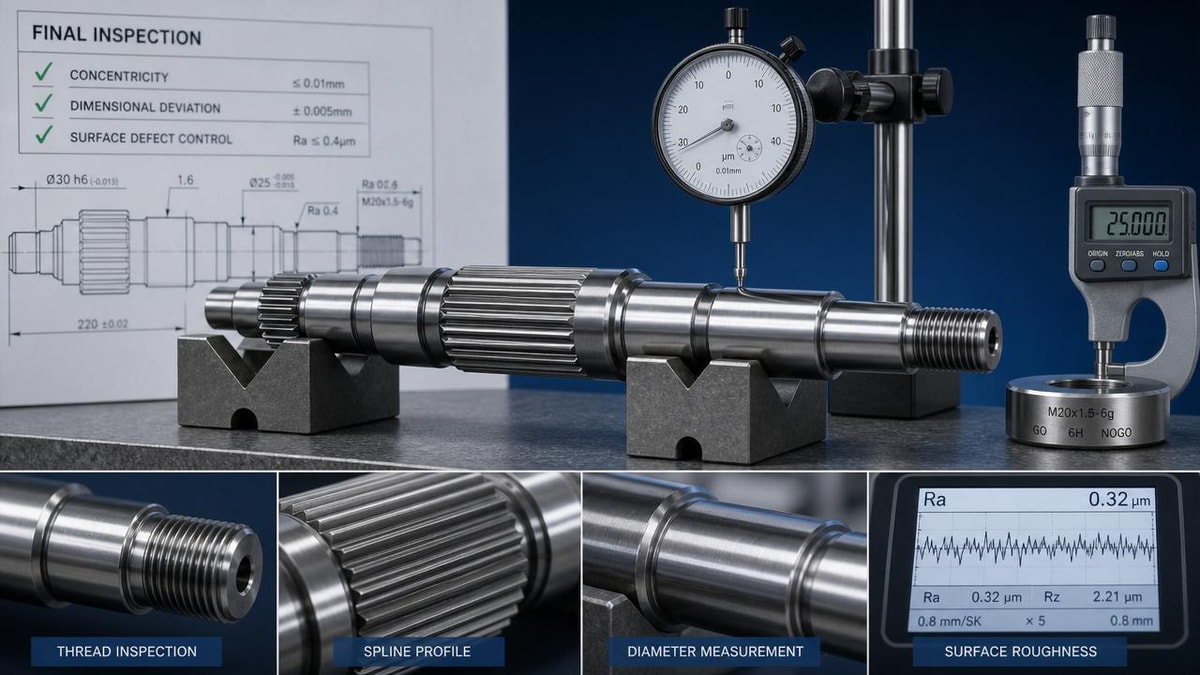
Final inspection is where many shaft part problems become visible for the first time, but in most cases, that is not where they actually begin. For quality control and safety management teams, late-stage findings such as excessive runout, out-of-tolerance diameters, poor surface finish, burrs, thread damage, and hardness inconsistency usually point to a deeper issue in process control, workholding, tool condition, heat treatment, or measurement strategy.
The core search intent behind this topic is practical and preventive: readers want to know which defects in Shaft Parts most often appear at final inspection, why they escape earlier detection, what risks they create, and how to reduce rework, scrap, customer complaints, and safety exposure. They are not looking for generic machining theory. They want inspection-focused judgment criteria, root-cause logic, and actions that can be implemented on the shop floor and across the quality system.
For the target audience, the biggest concerns are straightforward. First, which final-inspection failures are most likely to affect function, assembly, or operational safety? Second, which of these failures indicate unstable processes rather than isolated defects? Third, how should teams prioritize containment and corrective action when a batch of shaft parts is at risk? The most useful content is therefore a structured breakdown of common late-detected problems, their hidden causes, and the control methods that can stop them earlier in the manufacturing flow.
This article focuses on exactly those issues. It emphasizes real failure modes, inspection blind spots, and process decisions that matter to quality and safety teams. It deliberately gives less space to broad industry background and more space to defect patterns, risk signals, and prevention methods that help readers make faster and better decisions.
Why Shaft Parts Often Pass In-Process Checks but Fail at Final Inspection
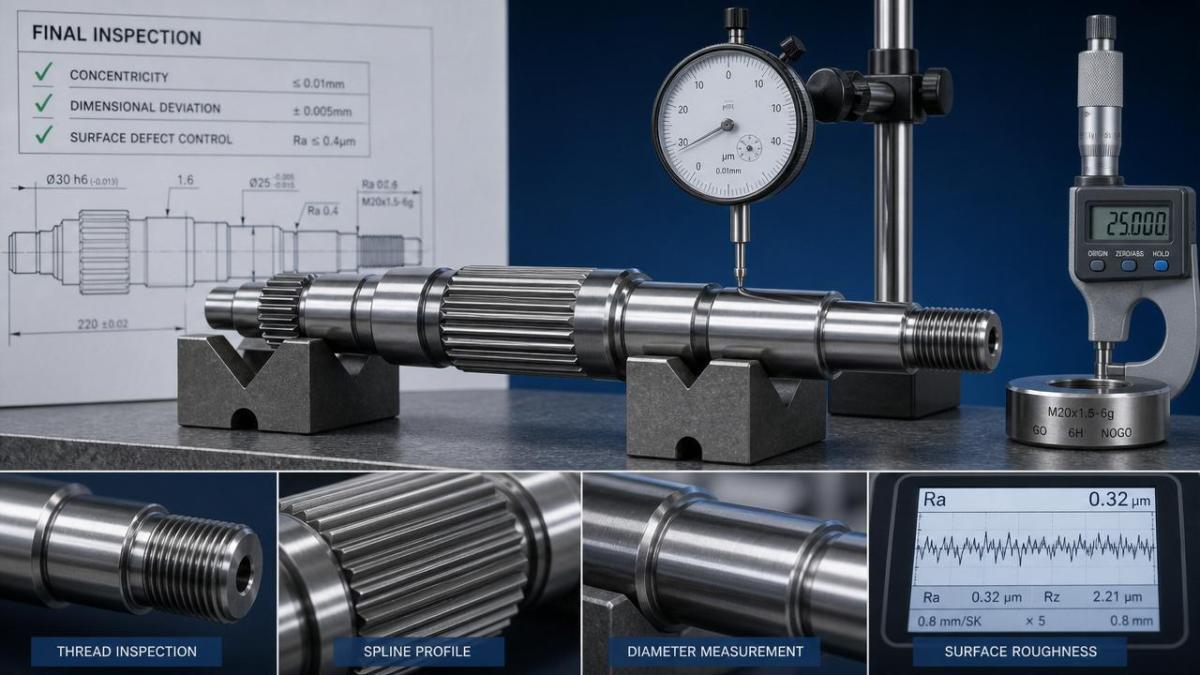
Shaft parts are deceptively difficult to control because many critical features interact with one another. A diameter may be within tolerance at one station, but the part can still fail later because of runout, taper, concentricity drift, unsupported slenderness during machining, heat-induced movement, or damage introduced during handling. Final inspection brings these relationships together, which is why hidden issues often surface only at the end.
Another reason is that in-process inspection is frequently local, while final inspection is functional. Operators may check a single journal diameter, thread size, or length feature after a turning cycle and conclude the part is acceptable. Final inspection, however, often measures total indicated runout, coaxiality between multiple journals, shoulder squareness, surface integrity, and fit-relevant geometry across the full shaft. A part that passes isolated checks may still fail as a complete component.
Measurement conditions also change the result. A shaft measured while warm from machining can appear compliant, then drift out of tolerance after cooling. Parts clamped differently during in-process checks may relax or deform when measured between centers or on V-blocks at final inspection. If the inspection method does not match the actual functional condition of the part, quality escapes are more likely.
For safety management personnel, this matters because shaft defects are not only dimensional problems. In rotating equipment, power transmission assemblies, automotive systems, and industrial machinery, shaft-related nonconformities can contribute to vibration, noise, premature bearing wear, seal leakage, poor balance, assembly interference, fatigue cracking, or field failure. A defect discovered late is therefore both a cost issue and a risk-control issue.
Runout and Concentricity Problems: The Most Common Final-Inspection Surprise
Among all final inspection failures in Shaft Parts, excessive runout is one of the most common and one of the most misunderstood. Teams often focus heavily on diameter tolerance but underestimate the importance of the relationship between journals, shoulders, center holes, and datum strategy. A shaft can have “good sizes” and still be unfit for service if the rotating axis is unstable.
Runout problems often show up late because they are not always measured after every operation. During rough and semi-finish turning, the part may be clamped in a chuck and appear stable enough. After additional operations such as heat treatment, grinding, keyway milling, thread rolling, or cross-hole drilling, the original geometry relationship may shift. If the process does not re-establish the correct datum or support method, the shaft can accumulate positional error step by step.
Common causes include worn chuck jaws, poor center-hole quality, tailstock misalignment, insufficient support for long slender shafts, inconsistent clamping force, residual stress release after roughing, and distortion after heat treatment. Even a small setup issue can become a final runout rejection when multiple features are stacked across length.
For QC teams, the key judgment is whether runout failure is random or systemic. If failures cluster around one machine, one fixture set, one operator shift, or one post-heat-treatment routing, the issue is probably process-related. If the same shaft design repeatedly shows marginal runout despite adjustments, the routing or datum plan itself may need review.
Useful controls include checking center quality before finish operations, using between-centers grinding when geometry demands it, verifying machine alignment on a scheduled basis, applying steady rests for long shafts, and adding interim runout checks after distortion-prone steps. Final inspection should also distinguish between total runout, circular runout, and concentricity-related criteria so the corrective action matches the actual failure mode.
Dimensional Drift That Appears Only After the Full Process Route
Dimensional drift is another issue that often surprises teams at final inspection. A shaft journal may be on target immediately after turning, then shift after cooling, coating, grinding, or post-process handling. In high-volume production, this can result in a batch trend rather than a single isolated defect, making it especially important for quality personnel to recognize early signals.
Tool wear is a major contributor. Shaft parts often involve repeated external diameters, grooves, shoulders, and threaded sections, and gradual tool wear can slowly change the actual cut size. If offsets are adjusted too late or based on limited sampling, the process may stay “apparently stable” until final inspection shows a clear drift toward one side of the tolerance band.
Thermal effects are equally important. Long cycle times, continuous production, and coolant variation can create different thermal conditions between the machine, the workpiece, and the gauge environment. Measuring a shaft while still thermally expanded can produce a false sense of compliance, especially on tight-tolerance features later checked in a controlled inspection room.
Material behavior must also be considered. Some shaft materials release residual stress after rough machining, especially when stock allowance is uneven or material quality varies from batch to batch. That movement may be small after one operation but significant after subsequent finishing. If the process plan assumes the material is fully stable when it is not, dimensional drift becomes difficult to predict.
The best response is layered control. Monitor tool life by actual trend, not by operator feeling alone. Compare machine-side measurement with final-inspection results regularly. Use control charts for critical journals and bearing seats. Where thermal sensitivity is high, standardize dwell time before measurement. And for shafts with known movement risk, leave controlled finishing stock after stress-relief or heat-treatment steps rather than trying to hold the full tolerance too early.
Surface Defects and Surface Integrity Issues That Create Bigger Risks Than They First Appear
Surface finish failures are often treated as cosmetic, but on shaft parts they can have direct functional and safety consequences. Rough bearing seats, damaged seal surfaces, chatter marks on rotating diameters, grinding burns, drag lines, dents, and local scoring can all reduce service life even when the basic dimensions are acceptable. Final inspection is usually the stage where these issues are judged more critically because the part is examined as a finished product.
Chatter is one frequent cause of rejection. It may result from unstable tool engagement, excessive overhang, inadequate rigidity, spindle condition, or poor support of long shafts. Because chatter can vary across part length, spot checks may miss it until final visual and roughness inspection. On bearing or sealing interfaces, even slight waviness can lead to assembly problems or accelerated wear in operation.
Grinding burn is more serious than many teams realize. A shaft may look dimensionally correct yet have altered surface metallurgy due to excessive heat. This can reduce fatigue resistance or lead to crack initiation. If the final inspection system relies only on visual checks and dimensional gauges, such damage may remain undetected unless nital etch, hardness comparison, or process capability review is part of the control plan.
Handling damage is another late-stage trap. Parts can leave machining in good condition and still fail at final inspection because of scratches from bins, contact marks from stacking, or edge damage during transport between processes. For quality teams, such defects are important signals that the problem lies not in cutting parameters but in material flow, packaging, or operator discipline.
To reduce surface-related escapes, inspection criteria should distinguish cosmetic imperfection from function-critical surface damage. Not every mark requires scrap, but every critical interface should have a defined acceptance standard tied to real product use. This is especially important when shaft parts operate at speed, in press-fit assemblies, or in environments where surface discontinuities can trigger fatigue or sealing failure.
Burrs, Sharp Edges, and Feature Damage: Small Defects with Large Downstream Impact
Burrs are among the most underestimated problems in Shaft Parts because they are easy to dismiss during production and expensive to discover at final inspection or assembly. A small burr on a thread start, oil hole, keyway edge, snap-ring groove, or shoulder transition can obstruct assembly, damage mating parts, contaminate lubrication systems, or create a handling hazard for workers.
These defects often appear late because deburring quality is inconsistent. Manual deburring depends heavily on operator attention, access, lighting, and time pressure. When production volume increases, deburring becomes one of the first tasks to become rushed, especially if burr formation is not controlled at the machining source. Final inspection then becomes the point where all the “minor” edge issues accumulate into a reject decision.
Safety managers should pay particular attention to burrs on parts that will be handled manually, assembled under force, or used in rotating systems. A burr is not only a product defect; it can also be a worker-safety issue and a source of downstream contamination. On safety-critical assemblies, edge condition should be treated as a controlled characteristic, not as a secondary cosmetic item.
Prevention starts with process design. Improve tool condition, optimize exit strategy on cross-holes and grooves, specify edge-break requirements clearly on drawings, and standardize deburring methods by feature type. Inspection should focus on hidden burr locations rather than only visible outer diameters. If one feature repeatedly shows burr-related rejection, the issue should be escalated as a process capability problem, not just a finishing oversight.
Why Heat Treatment and Secondary Operations Trigger Late Rejections
Many final-inspection failures are not created during the first turning operation at all. They arise after secondary processes such as heat treatment, straightening, grinding, plating, coating, thread rolling, or keyway machining. For shaft parts, each secondary step can change geometry, surface condition, hardness distribution, or residual stress, turning an apparently good semi-finished part into a final reject.
Heat treatment is especially influential. Distortion may alter straightness, runout, and journal relationships. Hardness variation can affect later grinding behavior. Surface oxidation or scale can interfere with final finishing allowance. If the process route does not account for predictable movement after hardening, final inspection will continue to capture the problem too late.
Straightening is another risk point. While it can recover usable parts, poor straightening practice may introduce localized stress or damage center references used in later operations. In some cases, parts pass straightness checks but later fail runout or concentricity checks because correction was not applied relative to the final datum structure.
Secondary machining can also damage previously controlled features. A keyway broach may distort a thin-wall section, plating may change fit dimensions, and aggressive post-heat-treatment grinding may create burn or microcracking. This is why quality teams should avoid treating each operation in isolation. A shaft should be evaluated as a process chain, not as a sequence of separate approvals.
A practical control measure is to define “risk transition points” in the routing. These are operations after which certain defects are known to emerge more often, such as post-heat-treatment runout, post-grinding surface damage, or post-thread-rolling diameter change. Adding targeted checks at these points is often more effective than simply tightening final inspection.
How QC and Safety Teams Should Investigate a Final-Inspection Failure
When a shaft part fails final inspection, the first priority is containment, but the second priority is classification. Not every rejection has the same operational meaning. Teams should quickly determine whether the defect affects function, assembly, safety, customer-specific compliance, or only appearance. This prevents both overreaction and underreaction.
Next, compare the failure against process history. Was the feature measured earlier? Was it near tolerance limits before? Did the problem appear suddenly or as a gradual trend? Review machine records, tool life status, setup changes, fixture maintenance, heat-treatment batch data, and operator notes. For shaft parts, root cause is often hidden in one upstream variation that only becomes visible at final inspection.
It is also important to recheck the measurement system. Some apparent shaft failures are actually caused by inconsistent support method, gauge setup, datum interpretation, or environmental conditions. This does not mean the defect is not real; it means the team must confirm that final inspection reflects the actual product requirement. Misinterpretation of runout or surface criteria can lead to false scrap or incorrect corrective action.
For safety-related products, failure investigation should include a risk-based disposition path. If the defect could affect rotating stability, fatigue life, fit retention, or sealing performance, the lot should not be released based on visual judgment alone. Engineering review, functional evaluation, or customer-specific concession rules may be necessary before any use-as-is decision.
How to Prevent Late Discovery of Shaft Part Defects
The most effective strategy is not to inspect more everywhere, but to inspect better at the right points. Final inspection should remain a verification step, not the first true discovery point for major problems. For shaft parts, that means aligning process controls with actual failure mechanisms rather than relying on basic dimensional checks alone.
Start by identifying the critical-to-function features: bearing seats, seal journals, spline or thread interfaces, snap-ring grooves, center references, runout-sensitive diameters, and any surface subject to fatigue or sliding contact. Then map where in the process each feature can be created, altered, or damaged. This simple exercise often reveals why final inspection keeps seeing the same types of failures.
Second, improve intermediate inspection. Add runout checks after distortion-prone operations, use roughness verification before parts move to protected storage, confirm burr removal on hidden features, and compare machine-side data with final-inspection trends. When possible, measure shafts in a condition that resembles actual functional support rather than the easiest available setup.
Third, strengthen process discipline. Maintain fixtures and centers, control tool wear, standardize part handling, separate conforming and suspect material clearly, and ensure deburring and cleaning are treated as controlled operations. For many shaft part manufacturers, consistent execution solves more quality problems than adding new equipment.
Finally, use final inspection data as a feedback system, not just a sorting function. If the same defect repeats, elevate it into process capability review, PFMEA updates, operator training, or routing redesign. Late-stage defects are expensive, but they are also valuable signals. They show exactly where the production system is not yet robust enough.
Conclusion: Final Inspection Reveals the Symptom, Not Always the Cause
When problems in Shaft Parts appear at final inspection, the immediate defect may be runout, dimensional drift, surface damage, burrs, or hardness-related distortion. But the real cause usually lies upstream in process planning, workholding, tool control, thermal management, secondary operations, or inspection strategy. Final inspection exposes the symptom because it is the first stage where the part is judged as a complete functional component.
For quality control and safety management teams, the right response is not only tighter rejection standards. It is better understanding of which shaft defects matter most, where they are introduced, and how they escape earlier detection. By linking final-inspection findings to process risk points, manufacturers can reduce scrap, prevent unsafe releases, improve reliability, and build a more stable production system for precision shaft parts.
PREVIOUS ARTICLE
NEXT ARTICLE
Recommended for You
 CNC Milling Capacity Gaps Can Hurt Small Batch ProfitabilityManufacturing Market Research Center
 Industrial Robotics Payback Is Changing in Mid-Size PlantsManufacturing Market Research Center
 Shaft Parts Machining Problems That Show Up at Final InspectionCNC Machining Technology Center
 Production Process Delays Usually Start Before Machining BeginsCNC Machining Technology Center
 Industrial Automation Projects Often Miss This Integration StepCNC Machining Technology Center
 CNC Metal Cutting Tool Wear Is Costing More Than You ThinkCNC Machining Technology Center



Aris Katos
Future of Carbide Coatings
15+ years in precision manufacturing systems. Specialized in high-speed milling and aerospace grade alloy processing.
▶
Shaft Parts Machining Problems That Show Up at Final InspectionCNC Machining Technology Center▶
Industrial Turning Accuracy Can Drift for Hidden ReasonsCNC Machining Technology Center▶
CNC Metalworking Costs That Often Get Missed Early OnCNC Machining Technology Center▶
Shaft Parts machining problems that show up after final inspectionCNC Machining Technology Center▶
Which Production Process changes bring the fastest output gains?CNC Machining Technology Center
Mastering 5-Axis Workholding Strategies
Join our technical panel on Nov 15th to learn about reducing vibrations in thin-wall components.

Providing you with integrated sanding solutions
Before-sales and after-sales services
Comprehensive technical support