• Global CNC market projected to reach $128B by 2028 • New EU trade regulations for precision tooling components • Aerospace deman
NYSE: CNC +1.2%LME: STEEL -0.4%

Industrial Robotics for Welding Applications: Best Fit for MIG, TIG, and Spot Welding
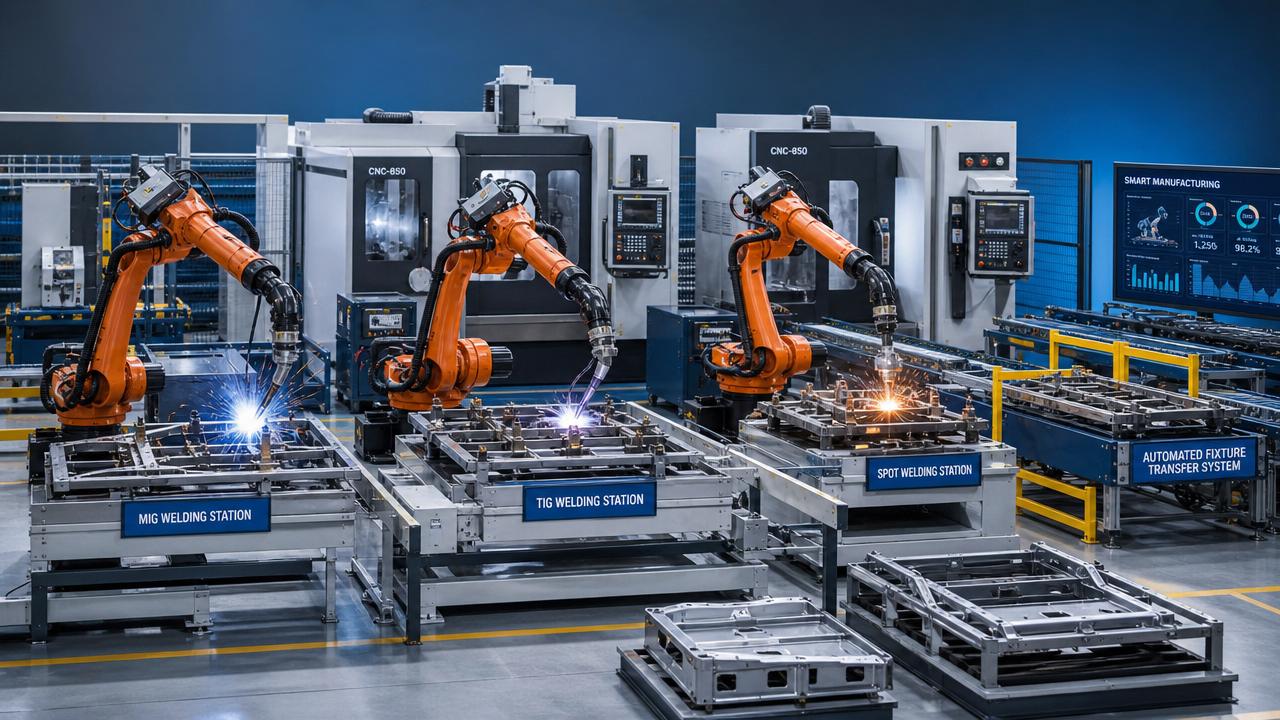
Industrial Robotics for Welding Applications are changing how modern factories balance quality, speed, and cost. In CNC machining, precision fabrication, and automated production lines, welding robots now sit alongside machine tools as core assets.
The real question is not whether to automate. It is where each process fits best. MIG, TIG, and spot welding all benefit from robotics, but they solve different production problems.
For high-mix projects, complex fixtures, or fast automotive cycles, the best answer depends on joint type, part variation, takt time, and quality targets. That is why a practical selection approach matters.
Where Industrial Robotics for Welding Applications Create the Most Value
In machine tool and precision manufacturing environments, welding automation works best when it supports stable upstream machining and predictable downstream assembly. A robot should improve the whole line, not just the weld cell.
[Image 01: Industrial robotic welding cell integrated with CNC machining and automated fixture transfer]
That is especially true in automotive, aerospace, energy equipment, and electronics enclosures. These sectors demand repeatable geometry, traceable quality, and tight coordination with CNC machining centers and flexible production lines.
- Use robotic MIG welding when throughput matters most, part thickness varies moderately, and weld paths are long enough to justify automated programming and fixture investment.
- Choose robotic TIG welding for thin materials, cosmetic seams, stainless parts, and precision assemblies where heat control and appearance matter more than raw speed.
- Apply robotic spot welding in sheet metal production with repeatable joints, short cycle demands, and established fixture accuracy across high-volume programs.
- Check part tolerance stack-up before automation, because even a strong robot cell cannot fully compensate for unstable upstream machining or poor fixture referencing.
- Confirm torch access early in design review, especially on multi-axis parts, boxed weldments, and compact structures common in precision equipment frames.
- Plan around total cell efficiency, including loading, clamping, wire changes, electrode maintenance, and inspection time, not just robot arc-on performance.
Best Fit for MIG, TIG, and Spot Welding
Industrial Robotics for Welding Applications succeed when the process matches the product. A wrong pairing can still produce decent welds, but cycle time, rework, and maintenance costs quickly rise.
MIG Welding: Fast, Flexible, and Production Friendly
Robotic MIG welding is usually the first choice for structural frames, machine bases, brackets, cabinets, and medium-thickness fabricated parts. It handles volume well and integrates smoothly into automated lines.
It also fits many global manufacturing clusters where product families share similar weld geometries. That helps spread fixture and programming costs across multiple SKUs.
- Pick MIG when the project needs higher deposition rates, steady takt time, and reliable welding on carbon steel or aluminum parts with consistent preparation.
- Add seam tracking or touch sensing if machined edges and formed parts show moderate variation, but avoid using sensors to hide poor process control.
TIG Welding: Precision First
Robotic TIG welding is slower, but it shines in high-value components. Think stainless housings, thin-wall tubing, aerospace brackets, or visible joints in premium industrial equipment.
In these cases, heat input control is often more important than cycle time. A clean weld profile can reduce post-processing and protect dimensional stability.
- Use TIG when distortion risk is high, weld aesthetics matter, or part value justifies slower automated welding with tighter gas and parameter control.
- Verify joint cleanliness standards before launch, because robotic TIG performance drops quickly when upstream handling, cutting, or storage introduces contamination.
Spot Welding: Volume and Repeatability
Spot welding remains a natural fit for sheet metal assemblies, especially in automotive structures, battery housings, appliance panels, and enclosure production. The process is proven, fast, and highly repeatable.
Still, success depends heavily on fixture precision and electrode management. Small positioning errors create quality drift faster than many teams expect.
- Deploy spot welding robots when sheet stacks are stable, joint locations are fixed, and the business case depends on very short cycle times.
- Monitor electrode wear, force consistency, and cooling performance from day one, since these factors often drive hidden scrap and downtime.
A Simple Selection View for Project Planning
A quick comparison helps narrow the best process before detailed RFQs, line simulation, or fixture design. It also helps align welding decisions with CNC production and assembly flow.
Common Situations in CNC and Precision Manufacturing
Heavy Fabricated Equipment Frames
For machine bases, support frames, and structural skids, robotic MIG welding is usually the strongest fit. These parts benefit from stable deposition and long continuous paths.
The key check is whether machined reference faces and welded datum features stay aligned after welding. If not, downstream CNC rework can erase the automation gain.
Precision Stainless Assemblies
For covers, clean-process components, and high-finish housings, robotic TIG welding often makes more sense. Lower distortion can protect tolerance-sensitive features before final machining or assembly.
The main check is surface preparation. If cutting oil, oxide, or inconsistent edge quality reaches the cell, weld appearance and consistency will suffer quickly.
Sheet Metal Cabinets and Enclosures
When volume is high and joint positions repeat, spot welding delivers strong economics. This is especially relevant in electronics cabinets, appliance housings, and light industrial panels.
The practical checkpoint is fixture repeatability across batches. If panel springback changes too much, the robot stays accurate while the product does not.
What Often Gets Missed During Implementation
Industrial Robotics for Welding Applications can underperform for reasons that have nothing to do with the robot brand. Most issues come from preparation, integration, and maintenance planning.
- Do not size the robot cell around average demand only; include peak mix changes, maintenance windows, and fixture changeover realities.
- Audit part variation at the source, because welding automation usually exposes hidden forming, cutting, and machining inconsistency rather than fixing it.
- Treat fixturing as a core investment, not an accessory, since clamp strategy and datum repeatability directly decide weld quality and cycle stability.
- Connect weld data with quality records where possible, especially in aerospace, energy equipment, and export-oriented manufacturing with traceability demands.
- Review safety and fume extraction early, because layout changes later can become expensive and may limit torch movement or operator access.
- Train maintenance teams on torches, wire feeding, dress packs, and sensors, since small consumable issues often create large downtime losses.
Practical Steps Before Final Equipment Selection
Before approving a cell, validate the process through real parts, not assumptions. A short pilot often reveals more than weeks of internal debate.
- Start with three questions: which welds drive bottlenecks, which defects cause the most cost, and where automation protects schedule performance best.
- Request sample trials using production fixtures or close equivalents, so weld quality and cycle time reflect actual plant conditions.
- Compare total cost by including rework, consumables, offline programming, utilities, and operator support instead of robot price alone.
- Check integration with CNC handling, conveyors, vision, and MES systems if the project is part of a broader smart factory roadmap.
The best Industrial Robotics for Welding Applications choice is usually the one that fits the product family, upstream process capability, and future expansion path at the same time.
If the parts are structural and throughput-driven, MIG is often the practical answer. If precision and appearance dominate, TIG deserves the slower cycle. If sheet metal volume leads the business case, spot welding stays hard to beat.
A careful review of weld type, fixture quality, part stability, and data requirements will usually point to the right investment. From there, a focused pilot and line-level cost check make the next move much clearer.
Recommended for You
![]() Zhongshan Xiaolan Machinery Exhibition Opens With Global Product DebutsMachine Tool Industry Editorial Team
Zhongshan Xiaolan Machinery Exhibition Opens With Global Product DebutsMachine Tool Industry Editorial Team Automated Production Machining: Which Parts and Batch Sizes Are a Good Fit?Machine Tool Industry Editorial Team
![]() FANUC Links FIELD System Data with Copilot to Advance Shop-Floor Data UseCNC Machining Technology Center
FANUC Links FIELD System Data with Copilot to Advance Shop-Floor Data UseCNC Machining Technology Center Smart Manufacturing for Aerospace: Building Traceability Across CNC OperationsCNC Machining Technology Center
![]() Mitsubishi Electric Announces Physical AI System Linking Humanoid Robots and CNC MachinesMachine Tool Industry Editorial Team
Mitsubishi Electric Announces Physical AI System Linking Humanoid Robots and CNC MachinesMachine Tool Industry Editorial Team Precision Machining for Defense: Supplier Quality and Traceability ChecksManufacturing Market Research Center


Aris Katos
Future of Carbide Coatings
15+ years in precision manufacturing systems. Specialized in high-speed milling and aerospace grade alloy processing.
▶
Automated Production Machining: Which Parts and Batch Sizes Are a Good Fit?Machine Tool Industry Editorial Team▶
Choosing Automated Machine Tools for High-Mix, Low-Volume ProductionMachine Tool Industry Editorial Team▶
Choosing Industrial Robots for Warehouse Picking and PalletizingMachine Tool Industry Editorial Team▶
Digital Manufacturing for Smart Factories: Connecting Legacy Machines to MESMachine Tool Industry Editorial Team▶
Selecting Machine Tools for Automotive Parts: Accuracy, Throughput, and AutomationMachine Tool Industry Editorial Team
▶
Mastering 5-Axis Workholding Strategies
Join our technical panel on Nov 15th to learn about reducing vibrations in thin-wall components.

Providing you with integrated sanding solutions
Before-sales and after-sales services
Comprehensive technical support