• Global CNC market projected to reach $128B by 2028 • New EU trade regulations for precision tooling components • Aerospace deman
NYSE: CNC +1.2%LME: STEEL -0.4%

Do energy-efficient machine tools reduce power use at partial load?
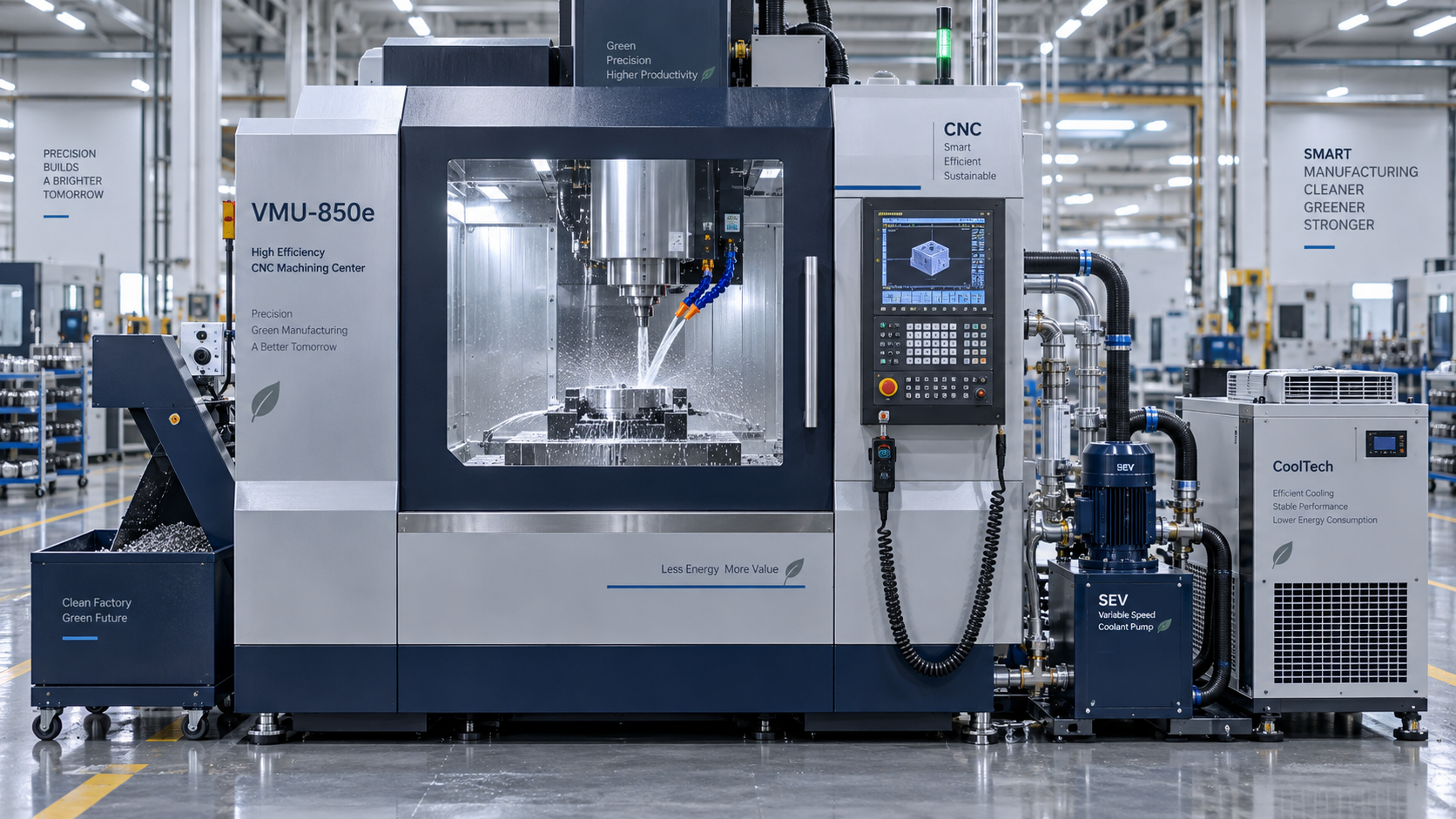
Energy-efficient machine tools can reduce electricity use at partial load, but lower spindle demand does not automatically mean proportionally lower machine power. The strongest gains come when spindle and axis drives, coolant delivery, hydraulic pressure, and thermal management respond to actual operating needs instead of remaining fully active throughout the cycle.
The decisive comparison is therefore not rated motor efficiency or installed power. It is measured energy consumption over a representative production cycle, including light cutting, positioning, tool changes, waiting, and recovery from reduced-power states. A machine can draw less power during cutting yet consume more electricity per acceptable part if its cycle is longer or its standby strategy requires extensive warm-up.
Partial load has more than one meaning
For a spindle motor, partial load describes operation below its rated mechanical output. For an entire CNC machine, the term is less precise. It can refer to low cutting torque, reduced feed-axis activity, intermittent machining, or substantial idle time between jobs. These conditions affect different components and should not be combined into a single load percentage.
A finishing operation illustrates the distinction. Cutting torque may be low while spindle speed remains high. Bearing losses, windage, and cooling demand can remain significant even though little power reaches the cutting zone. During a tool change, cutting power disappears, but the controller, lubrication system, cooling equipment, and other auxiliaries may continue operating.
Spindle-load values shown on a CNC display are useful for process monitoring, but they are not necessarily measurements of total electrical demand. Depending on the control system, the display may represent torque, current, or a manufacturer-defined load calculation. It should not be treated as a whole-machine efficiency indicator without checking its definition.
Why power consumption does not fall in proportion to cutting load
A useful conceptual balance is:
Machine input power = cutting-related demand + drive losses + auxiliary demand + control and readiness demand.
The terms interact rather than remaining perfectly independent. Higher spindle activity may increase cooling demand, while axis motion can change lubrication requirements. Nevertheless, the balance explains why reducing material-removal rate does not produce an equivalent reduction in total power.
Some loads depend strongly on the process: spindle torque, axis acceleration, coolant pressure, and chip-removal activity. Others remain active to keep the machine ready: CNC electronics, cabinet ventilation, hydraulic pressure maintenance, or temperature conditioning. At light cutting loads, these readiness requirements occupy a larger share of the total.
This does not mean auxiliaries always dominate. Their contribution depends on machine configuration and operating state. A machine equipped with high-pressure coolant, continuous hydraulic operation, and extensive thermal conditioning has a different partial-load profile from one with simpler services. Comparisons must therefore use equivalent equipment boundaries.
Reducing the relatively fixed portion of demand is especially valuable when production includes frequent interruptions or long positioning periods. Improving cutting-drive efficiency alone addresses only the portion of energy passing through that drive.
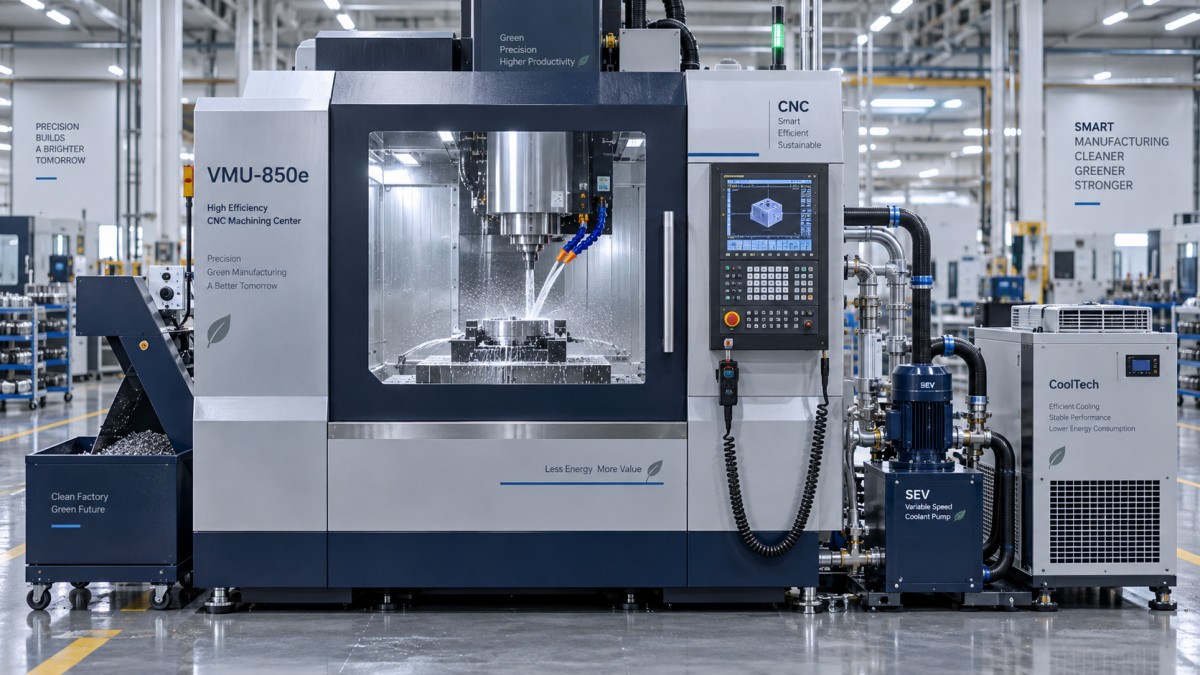
Which technologies actually help at partial load?
Drive efficiency across the operating map
A high-efficiency spindle motor can reduce conversion losses, but rated-point efficiency provides limited evidence about light-load performance. Motor losses include load-dependent losses and losses that remain significant at low output. Inverter behavior, spindle transmission, bearings, and cooling also influence electrical input.
A meaningful assessment therefore needs several torque-and-speed operating points. Low torque at high speed is not equivalent to low torque at low speed. The relevant points should reflect actual roughing, finishing, drilling, and non-cutting rotation rather than an arbitrary percentage of rated power.
Axis-drive regeneration can also help, particularly where repeated deceleration creates recoverable energy. However, a regenerative drive does not guarantee that all braking energy reduces grid consumption. Energy may be reused through a shared DC link, returned to the supply, or dissipated, depending on system architecture and operating conditions. Net incoming energy is the appropriate verification measure.
Demand-controlled pumps and hydraulic systems
Variable-speed coolant pumps can reduce unnecessary pumping when the process does not require maximum flow or pressure. The benefit depends on how the system controls delivery. Reducing pump speed is different from maintaining full speed while throttling flow or bypassing excess coolant.
The pump affinity laws explain why speed reduction can yield substantial savings in suitable centrifugal-pump systems. They are not a universal prediction for high-pressure coolant equipment, positive-displacement pumps, or systems with significant static-pressure requirements. Actual performance must be checked against the pump type and system resistance.
Hydraulic savings follow a similar principle: avoid continuously generating flow that the machine does not need. Pressure-controlled operation, accumulators, and intermittent pumping can reduce electrical demand. Any modification must preserve required clamping force, pressure stability, and safe response to faults. A lower power reading is not an acceptable gain if workholding integrity is weakened.
Thermal management and reduced-power states
Cooling systems can adjust compressor operation, pump speed, or temperature-control activity to match heat generation. Their limits are defined by machining accuracy as well as component protection. Allowing a wider temperature variation may reduce electricity consumption while increasing dimensional drift or extending recovery time.
Standby functions offer another route to savings by stopping unnecessary services during waiting periods. Effective designs distinguish short pauses from prolonged inactivity. They also retain the functions needed for safety, lubrication, control availability, and predictable restart.
For each reduced-power state, the relevant questions are what switches off, how quickly the state is entered, what triggers recovery, and when the machine is ready to produce conforming parts again.
Separate lower power from lower energy per part
Power is the instantaneous rate of electricity use. Energy is power integrated over time. Both are relevant, but they answer different questions.
A lower cutting-power reading may indicate reduced losses or simply reduced productivity. If feed rate is lowered, instantaneous demand can fall while the longer cycle keeps pumps, controls, and cooling systems active for additional time. Total energy per part may consequently increase.
Useful measures include:
- Power by operating state: cutting, positioning, ready, standby, and restart.
- Energy per completed cycle: including the operations and services inside the declared boundary.
- Energy per acceptable part: accounting for output that meets the specified quality requirements.
- Energy over a representative duty period: including realistic waiting and reduced-power intervals.
Peak demand can matter for electrical infrastructure and tariffs, but it does not establish energy efficiency. Likewise, a low standby value says little about production consumption unless the machine spends a meaningful amount of time in that state.
For a defined sequence of states, duty-period energy can be expressed as E = Σ(Pi × ti) + Etransitions, where each power value is the average for its state. Transition energy covers entry and recovery where those events have not already been included. This prevents an attractive standby figure from hiding restart costs.
Measure the whole system under comparable conditions
The measurement boundary should be agreed before testing. A supply meter at the machine’s electrical connection can capture integrated equipment, but it may exclude a separate coolant unit, central extraction, or externally supplied compressed air. These exclusions can change the apparent result substantially.
Compressed-air consumption deserves particular attention because its energy cost occurs at the compressor rather than at the machine meter. Record it separately and use a clearly documented allocation method if it is converted into an energy figure. Do not silently combine estimated utility energy with directly measured electrical energy.
Comparative tests need equivalent workpieces, material, tooling condition, workholding, coolant requirements, and acceptance criteria. They should also record cycle time and the actual machining parameters. Matching nominal spindle power is not a substitute for matching the production task.
Thermal conditions must be controlled or documented. Comparing a fully warmed machine with a cold machine can distort both energy and accuracy results. Include the warm-up and recovery behavior that the intended schedule actually requires.
Use a suitable power analyzer capable of measuring real power on the machine supply. Multiplying current by nominal voltage can misrepresent consumption when power factor, harmonics, or supply conditions are not accounted for. The instrument’s range, accuracy, sampling interval, and logging configuration should suit both brief transitions and longer operating states.
Synchronize the power trace with machine-state information. CNC events, PLC signals, or other timestamped records help distinguish coolant startup from spindle acceleration and identify whether a low-power interval is productive, idle, or recovering. Component-level measurements are useful for explaining savings, while the incoming supply measurement establishes the net result.
Repeat comparable cycles and report variation rather than relying on one trace. If the observed difference is close to measurement uncertainty or normal cycle variation, the test does not support a strong efficiency claim.
What standards can—and cannot—establish
The ISO 14955 series provides a relevant framework for evaluating machine-tool environmental performance with a focus on energy, including measurement of energy supplied to machines and their components and principles for energy-efficiency testing. Its value is in making operating conditions, measurement methods, and evaluation boundaries explicit.
A reference to ISO 14955 is not, by itself, proof that one machine consumes less energy than another. A test report should identify the applicable part and edition, the machine configuration, the operating states or tasks tested, and the measurement boundary. Results remain specific to those conditions.
Motor efficiency classifications and drive-system assessments provide narrower evidence. IEC 60034-30-1 concerns efficiency classes for line-operated AC motors within its scope, while IEC 61800-9-2 addresses efficiency indicators for power-drive systems and related equipment. Neither establishes whole-machine energy use under a particular machining cycle.
These distinctions matter when specifications use “energy-efficient” as a general description. Component compliance may be valid while leaving coolant delivery, thermal control, standby operation, and cycle productivity unevaluated. The supporting evidence should match the scope of the claim.
When partial-load savings are credible
A credible efficiency improvement has an identifiable mechanism and a measurable effect under the intended duty cycle. Reduced coolant speed should correspond to lower pump input while preserving delivery requirements. A standby function should reduce accumulated energy after accounting for recovery. An improved spindle system should show lower losses at relevant speed-and-torque points, not just at its rated operating point.
The duration of idle periods determines whether deeper standby is worthwhile. Conceptually, the minimum useful idle duration depends on the additional recovery energy divided by the difference between ready-state and standby power. Production delays, warm-up needs, and thermal stabilization must also be considered; electrical break-even alone does not establish operational suitability.
The strongest evidence for energy-efficient machine tools is therefore a matched comparison showing lower duty-cycle energy, unchanged or improved productive output, and acceptable accuracy after transitions. Where only rated motor efficiency, installed capacity, or a single idle-power figure is available, partial-load savings remain unproven. The next useful evidence is a state-resolved power trace tied to a representative machining task—not another headline specification.
Recommended for You
![]() Mitsubishi Electric Announces Physical AI System Linking Humanoid Robots and CNC MachinesMachine Tool Industry Editorial Team
 Precision Machining for Defense: Supplier Quality and Traceability ChecksManufacturing Market Research Center
![]() Nidec Machine Tool Launches MVR-5X Five-Axis Gantry MachineMachine Tool Industry Editorial Team
 Choosing a Precision Disc Parts Manufacturer in China: Tolerances and Quality ChecksManufacturing Market Research Center
![]() Siemens Executive Says AI Could Raise Factory Automation to 80%Manufacturing Market Research Center
 Choosing Automated Machine Tools for High-Mix, Low-Volume ProductionMachine Tool Industry Editorial Team


Aris Katos
Future of Carbide Coatings
15+ years in precision manufacturing systems. Specialized in high-speed milling and aerospace grade alloy processing.
▶
Choosing a CNC Machine for Mold Making: Accuracy, Rigidity, and Surface FinishCNC Machining Technology Center▶
How to Cut CNC Machining Energy Use per Part Without Longer Cycle TimesCNC Machining Technology Center▶
Will a Mazak CNC retrofit work with your existing servo drives?CNC Machining Technology Center▶
Do energy-efficient machine tools reduce power use at partial load?CNC Machining Technology Center▶
Comparing energy-efficient machine tools by energy use per partCNC Machining Technology Center
▶
Mastering 5-Axis Workholding Strategies
Join our technical panel on Nov 15th to learn about reducing vibrations in thin-wall components.

Providing you with integrated sanding solutions
Before-sales and after-sales services
Comprehensive technical support