• Global CNC market projected to reach $128B by 2028 • New EU trade regulations for precision tooling components • Aerospace deman
NYSE: CNC +1.2%LME: STEEL -0.4%

Multi-Axis CNC Manufacturing vs 3-Axis: When the Added Complexity Is Worth It
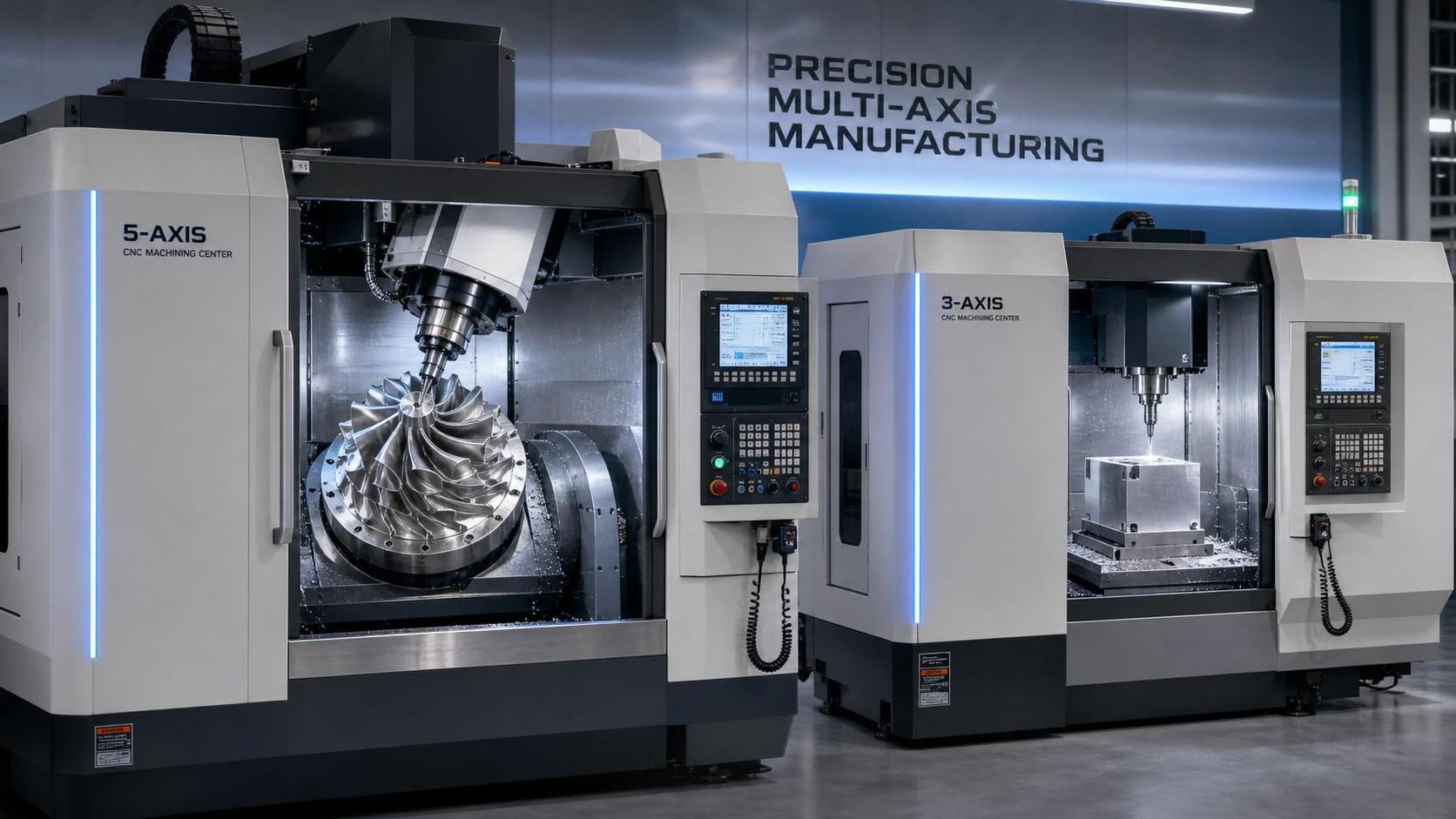
Why does the choice between 3-axis and multi-axis CNC manufacturing matter so much now?
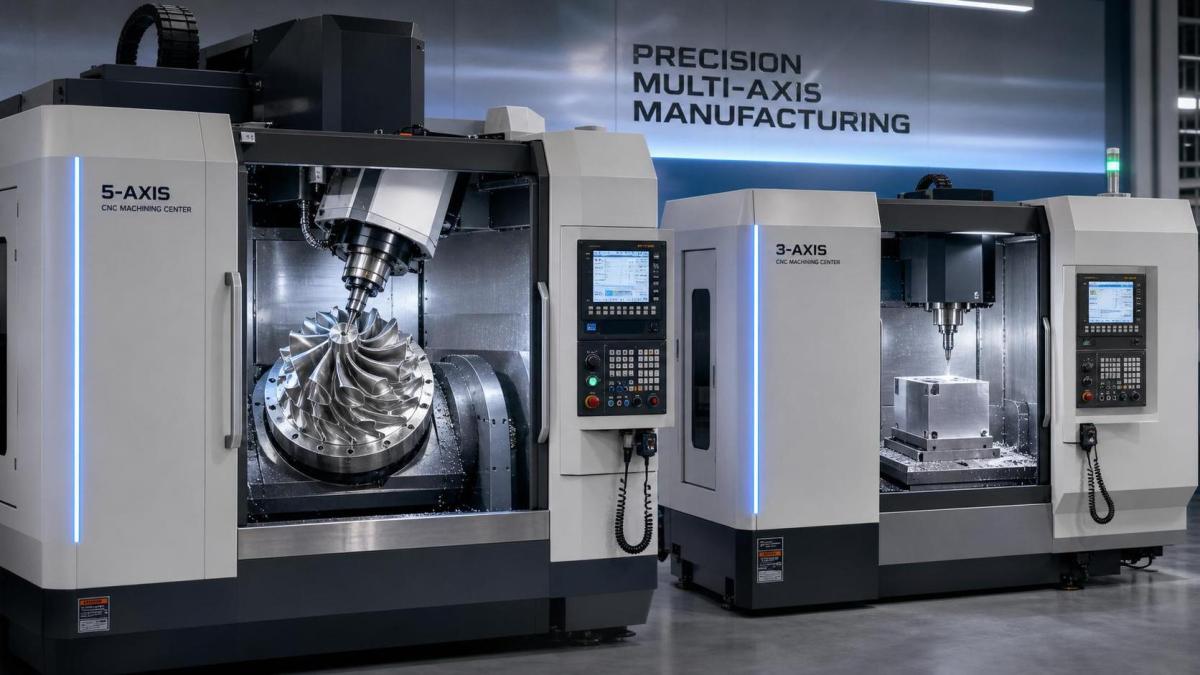
The gap between standard machining and advanced machining is no longer a niche topic.
In many industrial sectors, part geometry, tolerance pressure, and delivery speed now shape competitiveness as much as price.
That is why multi-axis CNC manufacturing keeps moving from specialized capability to strategic production decision.
A 3-axis machine still handles a large share of production work very well.
It remains practical for flat surfaces, simple pockets, drilling, and many fixtures, housings, and standard structural parts.
But once shapes become deeper, more contoured, or harder to reach, extra axes can change the economics.
In actual production, the real question is rarely which technology sounds more advanced.
The better question is when multi-axis CNC manufacturing creates measurable gains in accuracy, setup reduction, and throughput.
This matters across aerospace, automotive, energy equipment, electronics, and precision industrial components.
It also fits a broader industry shift toward automation, digital integration, and smarter production lines worldwide.
So what really separates multi-axis CNC manufacturing from 3-axis machining?
The simplest difference is movement and access.
A 3-axis machine cuts along X, Y, and Z directions.
That works well when the tool can reach all critical surfaces through straightforward positioning.
Multi-axis CNC manufacturing adds rotational motion, often through 4-axis or 5-axis configurations.
This allows the tool or part to tilt and rotate during machining.
The result is not just more movement.
It is better access to undercuts, angled features, deep cavities, and curved surfaces in fewer setups.
That setup reduction is often where the business value appears.
Every time a part is removed, re-fixtured, and re-aligned, the risk of cumulative error increases.
Lead time also expands, especially on low-volume complex parts.
A useful way to compare both options is this table.
This is why the comparison should never stop at machine price alone.
When is the added complexity actually worth paying for?
The strongest case appears when complexity removes more cost than it adds.
That usually happens in parts with several machined faces, compound angles, organic curves, or strict positional tolerances.
Think turbine components, impellers, medical-style precision parts, EV structural components, or aerospace brackets.
In those cases, multi-axis CNC manufacturing can cut cycle time by reducing manual handling.
It can also improve surface finish because the tool approaches the part more efficiently.
Tool life may improve too, since cutting angles can be optimized rather than forced.
A common turning point is low-to-medium volume production with high part complexity.
In that situation, repeated setups often become more expensive than the premium of advanced machining.
The same logic applies when product updates are frequent.
Flexible machining capability can support engineering changes faster than rigid process chains.
More importantly, multi-axis CNC manufacturing aligns well with smart factory goals.
Fewer setups and better automation compatibility help support lights-out machining and digital process control.
Where does 3-axis still make more sense than a multi-axis upgrade?
This is where many investment decisions become clearer.
If most parts are prismatic, flat, or easy to fixture, 3-axis often remains the more rational choice.
The same applies when tolerances are demanding but geometry is still straightforward.
In practice, many industrial parts do not need simultaneous 5-axis motion.
They need stable processes, predictable cost, and easy operator training.
A well-optimized 3-axis cell can outperform a poorly utilized advanced machine.
This is especially true in higher-volume work with repeatable fixtures and mature programs.
Another point is organizational readiness.
Multi-axis CNC manufacturing demands stronger CAM capability, collision simulation, and post-processing discipline.
Without that foundation, the technology may create delays rather than remove them.
A sensible upgrade path is often incremental.
- Review whether current parts truly require fewer setups or better tool access.
- Check how much scrap, rework, or alignment loss comes from re-fixturing.
- Assess CAM resources, operator skills, and process validation methods.
- Compare machine cost against total production cost, not only spindle time.
That approach avoids buying capability that remains underused.
What cost and lead-time questions should be answered before choosing multi-axis CNC manufacturing?
The headline price of the machine is only one line in the decision.
A better evaluation includes programming time, fixturing cost, inspection burden, scrap risk, and scheduling flexibility.
For many complex parts, multi-axis CNC manufacturing reduces total process steps.
That can shorten lead time even when programming takes longer at the beginning.
The cost balance often improves further when one machine replaces several setup stages.
Still, not every project benefits equally.
A practical screening table helps identify where the return is more likely.
This broader cost view is especially relevant in global manufacturing networks.
Suppliers in China, Germany, Japan, and South Korea increasingly compete on process capability, not just unit price.
That makes manufacturing method a sourcing decision as much as an engineering one.
What are the most common mistakes when evaluating multi-axis CNC manufacturing?
One mistake is assuming that more axes automatically mean faster production.
If programming, tooling, and inspection are not aligned, complexity can slow the first runs.
Another mistake is focusing only on cycle time.
The bigger savings may come from fewer fixtures, less WIP, and lower quality risk.
A third issue is underestimating process governance.
Multi-axis CNC manufacturing works best when digital simulation, tool libraries, and setup verification are disciplined.
It also helps to validate supplier depth, not just equipment lists.
- Ask for comparable parts already produced in similar materials.
- Review how the shop handles collision checks and toolpath simulation.
- Confirm in-process measurement and final inspection capability.
- Check whether fixturing, tooling, and automation are integrated or improvised.
Those details often reveal whether the added capability will produce reliable value.
How should the final decision be made?
A strong decision usually starts with the part family, not the machine brochure.
Map the current number of setups, tolerance risks, material cost, and expected engineering changes.
Then compare those realities against what multi-axis CNC manufacturing can remove or simplify.
If complexity is occasional, 3-axis plus selective outsourcing may be enough.
If complexity is frequent, recurring, and quality-critical, the upgrade case becomes much stronger.
The most useful next step is to build a short decision matrix around five items.
- Average setup count per part
- Geometry accessibility and surface requirements
- Tolerance sensitivity after re-fixturing
- Programming and inspection readiness
- Total cost impact across lead time, scrap, and flexibility
When those factors are reviewed together, the decision becomes less about complexity and more about fit.
That is usually the clearest way to judge whether multi-axis CNC manufacturing is an advantage or an unnecessary upgrade.
Recommended for You
 How to Select a CNC Lathe for Small Parts Without Sacrificing Accuracy or Cycle TimeCNC Machining Technology Center
 How to Select a Slant Bed Lathe for High-Precision Shaft and Chuck WorkCNC Machining Technology Center
 Smart Manufacturing for Small Businesses: Where Automation Delivers the Fastest ROIMachine Tool Industry Editorial Team
 How to Specify a CNC Lathe for High-Volume Automotive Shaft ProductionCNC Machining Technology Center
 How Automated Precision Machining Maintains Tolerance in High-Mix ProductionCNC Machining Technology Center
 How to Evaluate a Machine Tool Factory Before Sourcing CNC EquipmentGlobal Machine Tool Trade Research Center


Aris Katos
Future of Carbide Coatings
15+ years in precision manufacturing systems. Specialized in high-speed milling and aerospace grade alloy processing.
▶
How Automated Precision Machining Maintains Tolerance in High-Mix ProductionCNC Machining Technology Center▶
CNC Programming Explained: From CAD Models to Reliable Shop-Floor ToolpathsCNC Machining Technology Center▶
How Multi-Axis Machining Produces Complex Components With Fewer SetupsCNC Machining Technology Center▶
How Much Does CNC Programming Software Cost in 2026?CNC Machining Technology Center▶
CNC Machining Explained: Processes, Tolerances, and Parts It Can ProduceCNC Machining Technology Center
Mastering 5-Axis Workholding Strategies
Join our technical panel on Nov 15th to learn about reducing vibrations in thin-wall components.

Providing you with integrated sanding solutions
Before-sales and after-sales services
Comprehensive technical support