• Global CNC market projected to reach $128B by 2028 • New EU trade regulations for precision tooling components • Aerospace deman
NYSE: CNC +1.2%LME: STEEL -0.4%

How to Evaluate 5 Axis Machining Services in USA for Complex Precision Parts
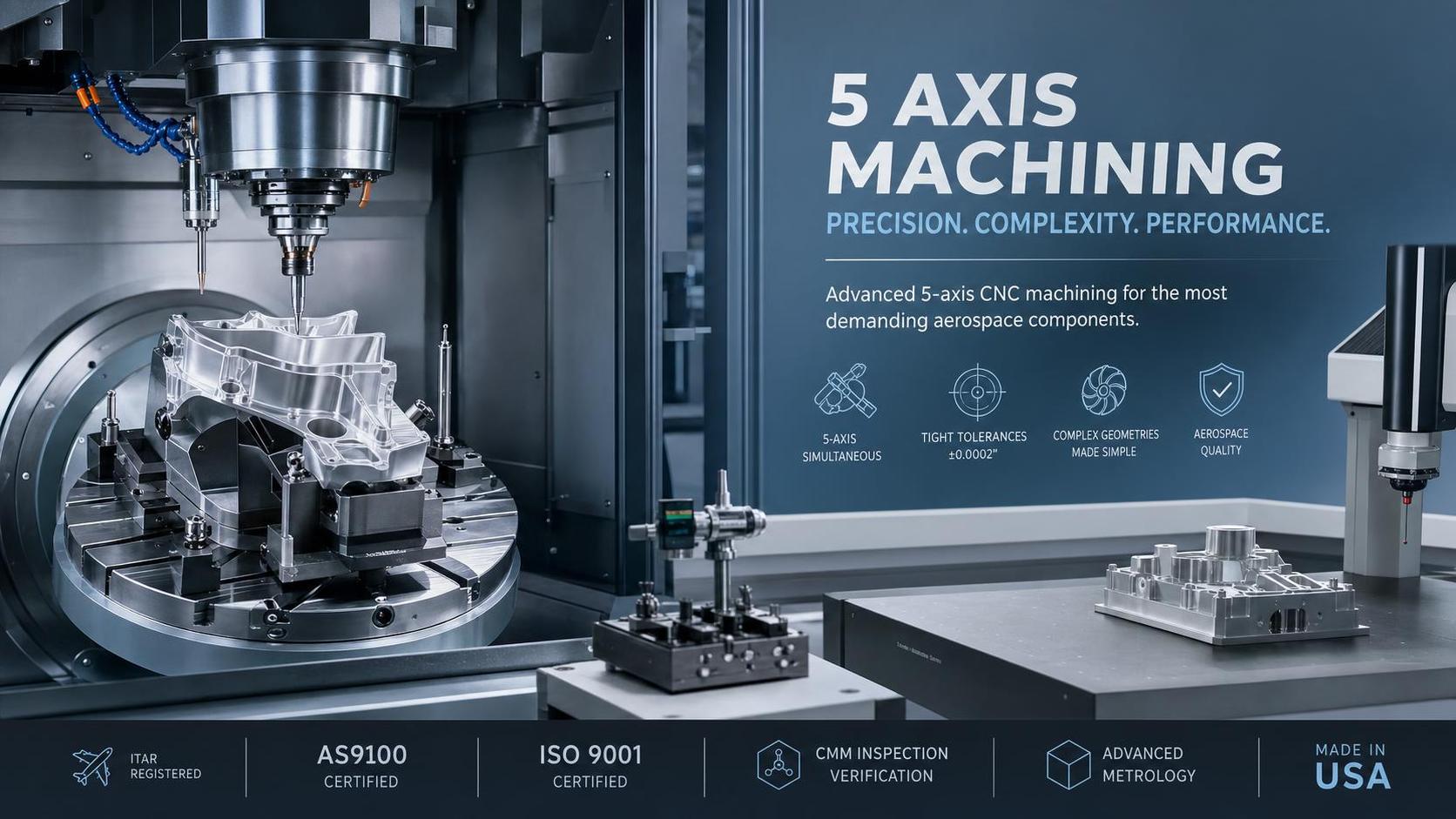
Start with the part, not the supplier brochure
When you are comparing 5 Axis Machining services in USA, the fastest way to make a bad decision is to begin with a generic capability list. For complex precision parts, the real question is much narrower: can this shop hold your geometry, your material condition, your inspection requirements, and your delivery rhythm without turning every build into an engineering debate?
That means your evaluation should follow the life of the part. Read the print, identify the features that actually drive risk, and then test each supplier against those points. Price matters, but after capability is proven. If the part has deep cavities, compound angles, thin walls, hard alloys, or tight positional relationships, a supplier that is merely “equipped for 5-axis” may still be the wrong fit.
A useful review usually starts with four questions:
- Which features are impossible or inefficient on 3-axis or indexed setups?
- Which tolerances are function-critical rather than just printed on the drawing?
- Which surfaces require true simultaneous motion, stable tool reach, or specialty workholding?
- What must be verified in-process versus only at final inspection?
Once those are clear, supplier comparisons become much more honest.
Check whether the machine configuration matches the part geometry
Not all 5-axis capacity is equivalent. Some shops are strong in trunnion-style machines for smaller, high-accuracy components. Others are better set up for larger prismatic parts, longer reach, or heavier workpieces. What you need to know is not just whether they have 5-axis equipment, but whether their machine envelope, spindle characteristics, rotary travel, and rigidity match your part family.
Ask for a technical review of the most difficult features on your drawing. A capable supplier should be able to explain:
- how the part will be oriented,
- where the workholding risks are,
- which surfaces can be completed in one setup,
- and where tool deflection or collision risk becomes a concern.
If the answer stays at the level of “we machine aerospace parts” or “we do complex components all the time,” keep pushing. Good evaluators want setup logic, not marketing language.
Look at material experience in the exact condition you will buy
Material familiarity is often where quoting optimism breaks down. Shops may be comfortable with aluminum prototypes, then struggle when the production job moves into stainless, titanium, Inconel, hardened steel, or unstable cast stock. Even within one alloy family, the delivered condition changes the machining behavior. Annealed stock, pre-hard stock, forged blanks, and heat-treated material do not machine the same way.
During evaluation, ask what they typically watch for in your material: burr control, heat input, tool wear rate, stress release, chatter, surface pullout, or movement after roughing. You are not looking for a textbook answer. You are listening for whether they understand what usually goes wrong and where they insert control points.
A common mistake is approving a supplier based on geometry capability alone. Complex geometry in a forgiving material tells you very little about how they will perform on a difficult alloy with a demanding finish callout.
Separate true process control from general quality claims
Most shops can say they inspect parts. That is not the same as controlling the process. For complex precision parts, ask where the control happens: at setup approval, after roughing, after semi-finishing, before unclamping, after heat treatment if applicable, and at final verification.
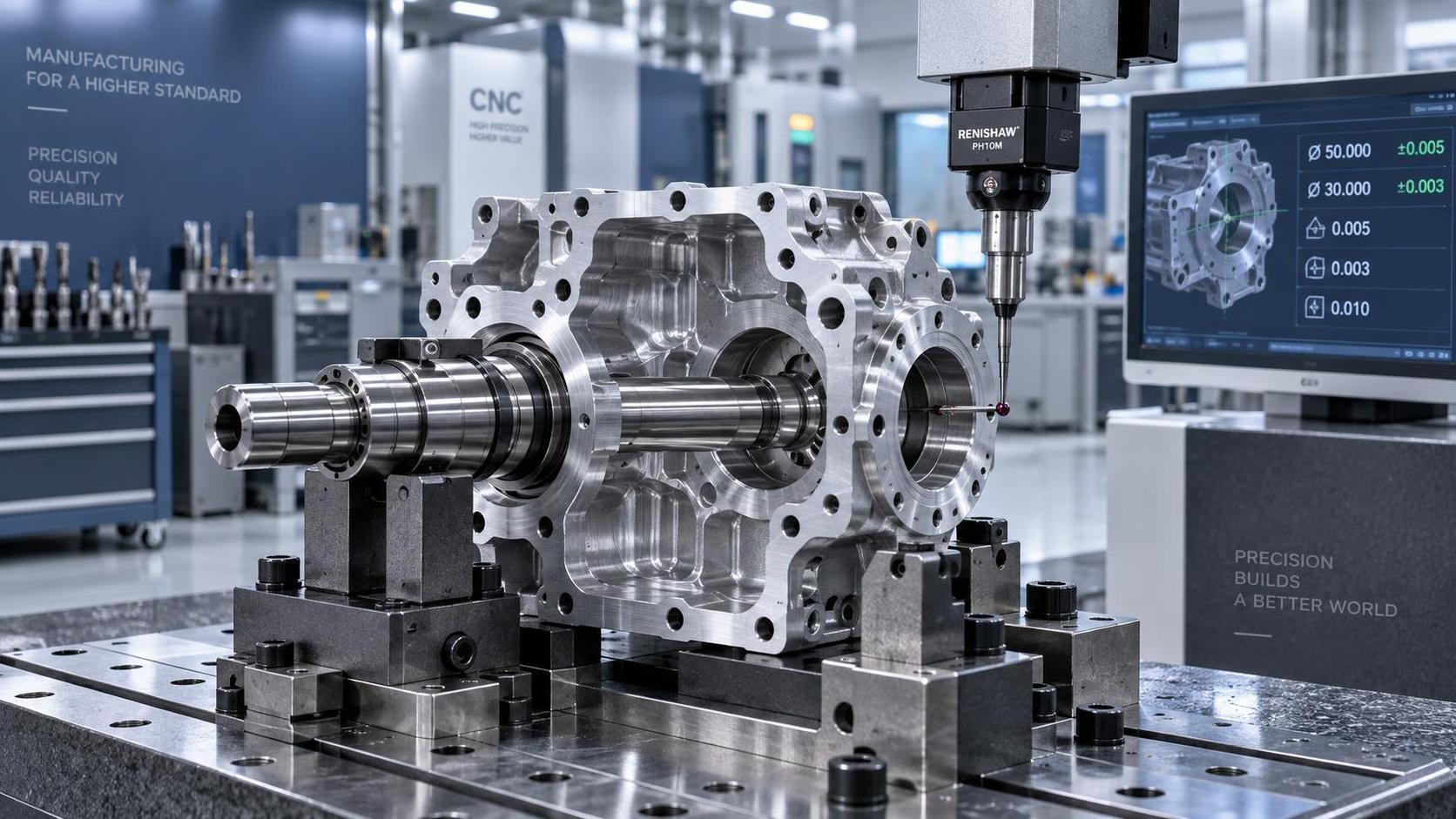
This matters because many dimensional problems are created long before final inspection. By the time the CMM report shows a feature drift, the part may already be scrap. A shop with disciplined process control will describe when they probe datums, how they manage tool offsets, how they monitor wear on long-cycle jobs, and how they prevent stack-up across multiple operations.
If your drawing includes critical true position, profile, concentricity, or surface finish requirements, ask which of those are checked in-process and which are only confirmed at the end. That answer tells you a lot about risk.
Review inspection capability against the drawing, feature by feature
Do not accept “full inspection available” as a complete answer. Instead, walk through the print and identify the features that are hard to measure, not just hard to machine. Five-axis parts often include hidden faces, blended surfaces, angled bores, and datum relationships that can be misunderstood if the inspection plan is weak.
A practical check looks like this:
You do not need every supplier to have the same metrology setup. You do need them to show a credible route from drawing requirement to inspection result.
Ask how they handle first-article risk
The first build tells you more than the quote ever will. For a new complex part, the main evaluation point is how the shop reduces uncertainty before volume begins. That includes CAM review, fixture design, probing strategy, tool access verification, and whether they expect to prove out the part with extra cycle time before chasing efficiency.
Be cautious with suppliers who promise production pricing and production lead time on an unproven part without discussing setup learning. Serious shops usually distinguish between first-article effort and repeat production performance. That is a healthy sign, not a drawback.
Check capacity in terms that affect your delivery, not theirs
A supplier may have excellent machines and still be a poor choice if your part will always be waiting behind larger customers or longer-running programs. Capacity review should cover more than machine count. Look at scheduling discipline, fixture availability, operator coverage, and whether the part can move through inspection without becoming stuck in queue.
This is especially important for low-volume, high-complexity parts. Those jobs often consume engineering attention, setup time, and inspection resources out of proportion to the piece count. Ask how they schedule repeat orders, engineering changes, and hot jobs. A supplier that treats every exception manually tends to become unpredictable under load.
Do not ignore workholding and datum transfer
In many evaluations, people focus on spindle power and miss the fixture strategy. That is backwards. Complex precision parts are often won or lost on how the part is held, how distortion is managed, and how datums are transferred across operations. Thin-wall parts, freeform geometries, and hard-to-reach features become much more difficult when clamping introduces movement or blocks tool access.
Ask whether custom fixturing is expected, whether soft jaws or modular systems are enough, and whether the same datum structure can be preserved from machining into inspection. If that path is vague, expect instability later.
Use the quote to expose assumptions
A good RFQ response does more than give a price. It shows what the supplier assumed about stock form, tolerance interpretation, finish scope, inspection level, and lot size. When comparing 5 Axis Machining services in USA, line-item detail is often more useful than the total number at the bottom.
Watch for hidden gaps:
- inspection included, but no mention of specific report content,
- tight lead time based on ideal material availability,
- surface treatment or secondary processing not clearly assigned,
- revision control not referenced,
- first-article effort blended into production assumptions.
When a quote looks much better than the others, that usually means some risk has been priced out rather than engineered out.
Evaluate communication through technical response time
For complex parts, communication quality is part of manufacturing capability. The useful signal is not friendliness. It is how quickly the supplier can return with clarifying questions, manufacturability concerns, and a consistent plan. If drawing notes are ambiguous, a strong shop will identify the exact conflict and point to the feature, datum, or tolerance frame involved.
That behavior matters later when a revision hits, a raw material issue appears, or a feature needs disposition. Slow or vague technical communication is usually an early warning of production friction.
A practical shortlist method
If you need a clean decision process, run suppliers through this order:
- Screen for machine fit based on your hardest features.
- Remove any shop that cannot explain a credible workholding and inspection path.
- Compare material experience in the exact alloy and condition you plan to purchase.
- Review quote assumptions line by line.
- Test responsiveness with a few technical follow-up questions.
- Only then compare price and lead time as decision factors.
That sequence keeps you from rewarding the most optimistic proposal over the most reliable one.
What usually separates a reliable choice from a risky one
Reliable suppliers tend to narrow the discussion quickly. They ask where function really lives on the part, identify likely failure points, and describe how they will control them. Risky suppliers stay broad. They talk about general experience, broad industry coverage, and available machines, but avoid the exact features that will decide whether the part succeeds.
For technical evaluators, that is the core rule: choose the shop that makes the risk visible early. In complex precision machining, the best decision is rarely the one with the smoothest sales process. It is the one backed by clear setup logic, realistic inspection planning, and enough process discipline to repeat the result when the part moves from trial to production.
Recommended for You
 How Automated Precision Machining Maintains Tolerance in High-Mix ProductionCNC Machining Technology Center
 How to Evaluate a Machine Tool Factory Before Sourcing CNC EquipmentGlobal Machine Tool Trade Research Center
 CNC Programming Explained: From CAD Models to Reliable Shop-Floor ToolpathsCNC Machining Technology Center
 How Multi-Axis Machining Produces Complex Components With Fewer SetupsCNC Machining Technology Center
 How Does Precision Machining Differ From Standard Machining?CNC Machining Technology Center
 What Production Volume Justifies a CNC Turning Investment?Manufacturing Market Research Center



Aris Katos
Future of Carbide Coatings
15+ years in precision manufacturing systems. Specialized in high-speed milling and aerospace grade alloy processing.
▶
How Does Precision Machining Differ From Standard Machining?CNC Machining Technology Center▶
CNC Precision: Which Tolerances, Materials, and Processes Fit Your Part?CNC Machining Technology Center▶
How to Choose Metal Machining Processes for Tight Tolerances and Production VolumeCNC Machining Technology Center▶
Production Process Explained: Key Stages, Controls, and Quality CheckpointsCNC Machining Technology Center▶
How to Select a Machine Tool for Electronics Manufacturing with Tight Tolerance NeedsCNC Machining Technology Center
Mastering 5-Axis Workholding Strategies
Join our technical panel on Nov 15th to learn about reducing vibrations in thin-wall components.

Providing you with integrated sanding solutions
Before-sales and after-sales services
Comprehensive technical support