• Global CNC market projected to reach $128B by 2028 • New EU trade regulations for precision tooling components • Aerospace deman
NYSE: CNC +1.2%LME: STEEL -0.4%

Vertical Lathe Limits to Check Before Large-Part Orders
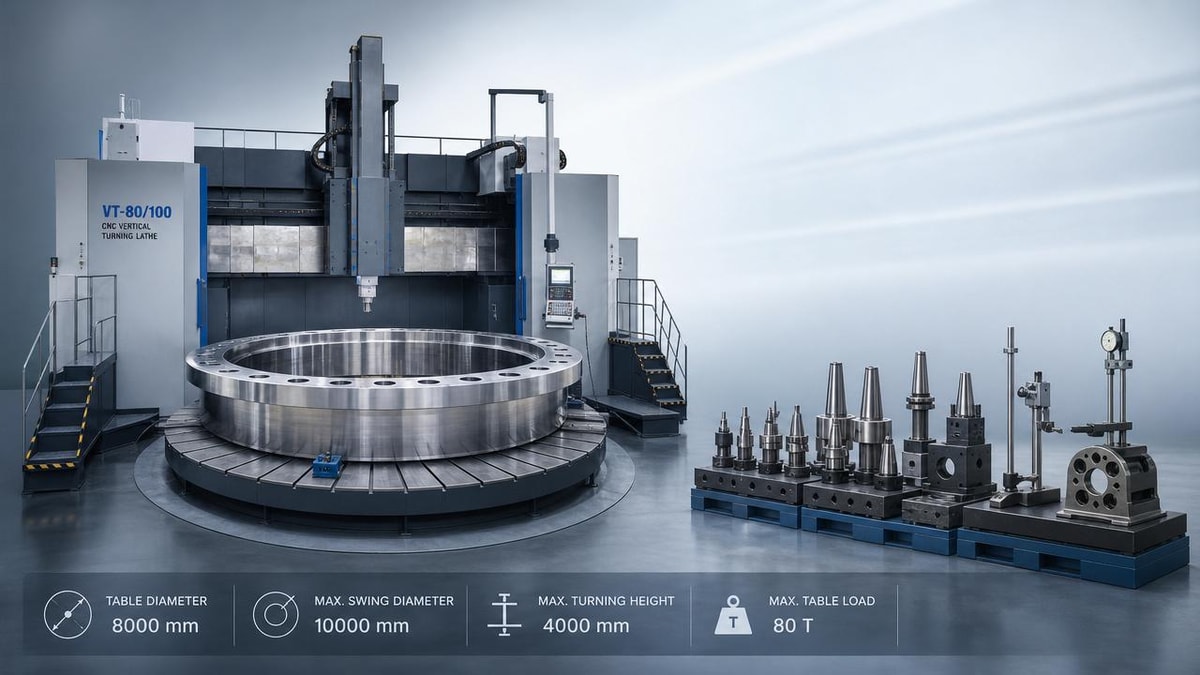
Before placing a large-part order, the key question is not simply whether a supplier has a vertical lathe, but whether that machine can handle your specific part envelope, weight, tolerance target, and process route without creating hidden risk. For business evaluators, the most important limits to verify are table diameter, maximum swing, workable turning height, table load capacity, spindle power, tooling range, and machine stability under real cutting conditions. A vertical lathe that looks suitable on paper can still become a delivery problem if the part approaches capacity limits or requires multiple setups, special fixturing, or tight roundness control.
In practice, large-part sourcing decisions should be based on manufacturability, consistency, and risk exposure rather than headline machine size alone. The right evaluation method is to compare your drawing requirements against the usable capacity of the vertical lathe, then ask how much performance margin remains for safe machining, process stability, and inspection. This article explains the limits that matter most before large-part orders and how buyers can check them with a commercial and technical mindset.
Why “machine size” alone is not enough when evaluating a vertical lathe
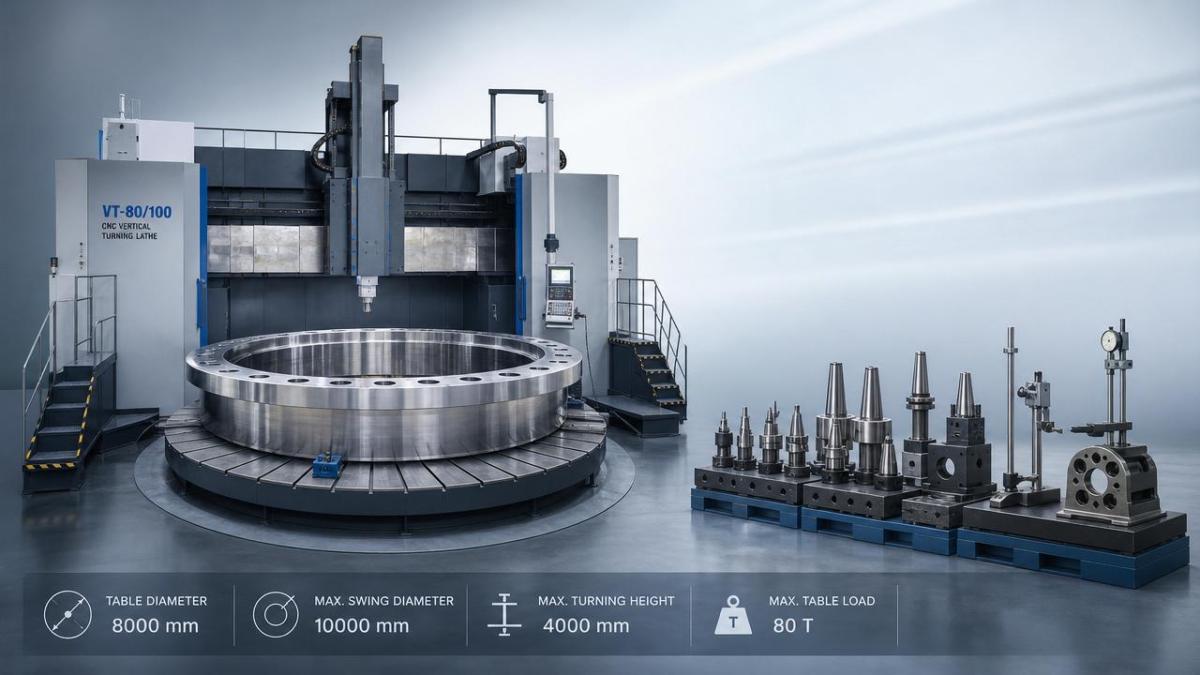
When buyers review a supplier profile, they often see only simplified specifications such as table diameter, maximum turning diameter, or maximum load. Those figures are useful, but they do not tell the full story. A large part may fit inside the machine’s nominal envelope and still be difficult to machine because of tool reach, clamping interference, limited ram travel, or deformation caused by weight distribution.
For example, a vertical lathe may advertise a maximum swing of 2,500 mm, yet the practical cutting diameter may be lower once jaws, fixtures, and safety clearance are considered. The same issue applies to heavy workpieces. A machine rated for a certain load may only achieve stable cutting when the part’s center of gravity is well positioned and the loading method is controlled. For procurement teams, this means the real question is usable capacity, not catalog capacity.
Large-part orders also amplify the cost of misjudgment. If a supplier accepts an order that pushes the vertical lathe near its limit, the result may be slower cycle times, lower cutting parameters, extra manual intervention, or even outsourcing to another facility. Any of these outcomes can affect price, lead time, and quality control. That is why evaluating machine limits early is a practical risk-reduction step rather than a purely technical exercise.
Check the true work envelope: table diameter, swing, and turning height
The first screening step is to compare your part dimensions with the machine’s real working envelope. Three dimensions matter most: table diameter, maximum swing, and maximum turning height. These figures determine whether the part can be loaded, rotated safely, and fully machined within the available vertical travel.
Table diameter affects how the workpiece sits and how much fixture space remains. A part may have an outer diameter that technically fits the machine, but if the base contact area is too small or the clamping points consume too much table space, workholding stability can become a concern. Buyers should ask not only for the table size but also for examples of similar parts previously machined on that vertical lathe.
Maximum swing is another commonly misunderstood number. It represents the largest theoretical diameter that can rotate without collision, but the actual machinable diameter may be smaller depending on chuck type, toolpost arrangement, guarding, and setup method. If your part is near the machine’s swing limit, request confirmation of the usable turning diameter under production conditions rather than relying on brochure data.
Turning height is equally important for tall rings, housings, valve bodies, turbine components, and large flanges with raised features. In some cases, the total part height is not the only issue. Tool access to upper and lower features may require extra travel, different tool holders, or multiple setups. A vertical lathe can fit the part in principle but still struggle to machine the full feature set efficiently.
A practical buying rule is to avoid planning large-part orders at the absolute edge of machine capacity unless the supplier has proven experience with the same geometry. Capacity margin supports better fixturing, safer cutting conditions, and more predictable production scheduling.
Verify load limits, balance, and table support for heavy components
For large parts, weight can be a bigger constraint than diameter. A vertical lathe is often selected because its table supports the workpiece from below, making it suitable for heavy discs, rings, housings, and large cylindrical parts. However, the published maximum table load does not automatically mean every part below that weight can be machined without issue.
What matters is total mass, weight distribution, and rotational balance. A 12-ton workpiece with a stable, symmetric geometry is very different from a 12-ton casting with uneven wall thickness, eccentric features, or a high center of gravity. Imbalance can reduce safe rotation speed, increase vibration, and affect surface finish. It can also force the supplier to use conservative cutting parameters that extend lead time.
Business evaluators should ask how the supplier handles off-center loading, balancing checks, and fixture design for large components. If the part is irregular, request a setup assessment before placing the order. The answer will reveal whether the supplier has real process planning capability or is only matching your drawing to a nominal vertical lathe specification.
Another point worth checking is whether the machine table bearing system is designed for continuous heavy-duty machining or only occasional high-load work. For long production runs or repeat orders, durability and thermal stability matter. The machine may carry the weight once, but repeatability over multiple cycles is what protects commercial quality performance.
Look beyond capacity to accuracy at size
A vertical lathe that can hold a large part is not automatically capable of holding the required tolerance on that part. Accuracy becomes more difficult as diameter, weight, and cutting forces increase. This is especially relevant for business evaluations in industries such as energy, aerospace support equipment, mining, marine systems, and heavy industrial assemblies.
Ask the supplier to separate general machine accuracy from achieved part accuracy. Machine-tool positioning data is useful, but buyers need evidence tied to actual production. Roundness, flatness, concentricity, perpendicularity, and face runout on large diameters are more meaningful than a generic claim of “high precision.” A capable supplier should be able to discuss what tolerance ranges their vertical lathe can maintain on similar parts and under what setup conditions.
Thermal behavior also deserves attention. Large parts often require long cutting cycles, which means heat buildup in the machine structure, tool, and workpiece can affect dimensions. If your order includes tight tolerances, ask whether the supplier uses in-process measurement, temperature control practices, or finish-machining compensation. These details directly influence scrap risk and rework cost.
Inspection capability is part of the same conversation. A supplier may machine a part on a vertical lathe but still lack suitable measuring equipment for large diameters or tall workpieces. If verification depends on subcontracted inspection, lead time and accountability can become more complex. From a sourcing perspective, machining capacity and inspection capacity should be reviewed together.
Assess spindle power, torque, and rigidity for the actual material
One of the most overlooked checks before placing large-part orders is whether the vertical lathe has enough spindle power and low-speed torque for the material being cut. Large diameters often require strong torque at relatively low rotational speeds, especially when machining alloy steel, stainless steel, heat-resistant materials, or large castings with interrupted cuts.
A machine may have sufficient dimensional capacity but still be underpowered for efficient roughing. In that case, the supplier may need to take shallow cuts, reduce feed rates, or increase tool changes, all of which affect cycle time and cost. This is especially important when buyers compare quotations that appear similar in price but come from suppliers with very different machine performance levels.
Rigidity is equally important. Large-part machining generates substantial cutting forces, and insufficient structural rigidity in the ram, column, table, or toolholding system can lead to chatter, unstable surface finish, and poor dimensional control. These risks are greater when the part includes interrupted surfaces, hard skins on castings, or long tool overhangs.
To evaluate this properly, procurement teams should ask what materials the vertical lathe commonly machines, what typical roughing depth and feed ranges are used, and whether similar parts have been produced at comparable scale. This line of questioning helps reveal whether the supplier’s process capability matches your commercial expectations for speed and consistency.
Confirm tooling flexibility and feature coverage before order release
Many large parts require more than simple turning. Grooves, internal bores, facing operations, drilling, tapping, contouring, and special profiles may all be needed in one component. That is why tooling flexibility should be checked early. The best sourcing outcome is usually achieved when a vertical lathe can complete most or all critical features in as few setups as possible.
For buyers, the key issue is not whether the machine is technically a CNC vertical lathe, but whether it has the attachments, tool stations, ram travel, and programming capability required for the specific drawing. Some suppliers can rough-turn large parts but must transfer them to another machine for drilling or finishing operations. Every additional setup introduces alignment risk, handling time, and schedule complexity.
Request a process breakdown by feature. Which dimensions are machined on the vertical lathe? Which require secondary equipment? Are special boring bars, angle heads, live tooling, or custom fixtures needed? If yes, are these already available or must they be sourced for your order? Answers to these questions help business evaluators estimate the real readiness of the supplier.
Tooling flexibility also affects future scalability. If the order may expand into multiple variants or repeat batches, a supplier with broader tooling capability is usually better positioned to absorb design changes without major process disruption. This can improve long-term procurement resilience, not just the first order outcome.
Review setup method, handling logistics, and production risk
In large-part machining, loading and setup are often major determinants of delivery reliability. Even a capable vertical lathe can become a bottleneck if crane capacity, fixture preparation, setup alignment, or unloading procedures are inefficient. For business evaluators, this means the machine should be assessed as part of a production system rather than in isolation.
Ask how the part is loaded, centered, clamped, and verified before cutting starts. Large components can consume significant setup time, and if the process is highly manual, repeatability may depend heavily on operator skill. This is not necessarily a deal breaker, but it should be reflected in timeline expectations and quality planning.
Another practical point is work-in-progress handling. If your parts require multiple machining stages, where are they stored between operations, and how are datum surfaces protected? Heavy parts are expensive to move and vulnerable to accidental damage. A supplier with disciplined internal logistics will typically deliver more predictable results than one focused only on machine ownership.
Capacity planning matters as well. Some shops own a vertical lathe suitable for your parts, but that machine may already be committed to long-running jobs. Buyers should verify not just technical fit, but actual production availability. A realistic delivery promise depends on machine scheduling, setup turnover, operator coverage, and maintenance status.
Questions business evaluators should ask before approving a supplier
To move from general interest to a defendable sourcing decision, evaluators should request clear, comparable answers. A good supplier should be willing to discuss machine limits in relation to your drawing, not just send a brochure. The most useful questions are practical and evidence-based.
Start with capacity match: What are the table diameter, usable turning diameter, maximum turning height, and maximum workpiece load for the specific vertical lathe proposed for this order? How much margin remains between those limits and our part dimensions? Margin is a better indicator of risk than a simple yes or no answer.
Then ask about process capability: Has the supplier machined similar parts in similar materials at comparable size and tolerance? Can they share anonymized examples, inspection points, or case references? Real experience reduces execution uncertainty, especially for first-time cooperation.
Next, review feature coverage and setup count: Can all critical features be machined on one vertical lathe, or are secondary transfers required? What fixtures, tools, or programming preparations are needed before production begins? This reveals hidden lead-time factors that often do not appear in initial quotations.
Finally, ask about quality assurance and contingency: How are large parts measured? What happens if vibration, balance issues, or stock variation affect machining? Is there a documented corrective process? Strong answers here indicate a supplier that understands not only machining, but delivery accountability.
How to make a lower-risk sourcing decision
The safest commercial choice is rarely the supplier with the largest published vertical lathe or the lowest initial price. A lower-risk sourcing decision comes from matching part requirements to proven usable capacity, process stability, and inspection competence. In other words, the right supplier is the one whose machine limits are comfortably above your order demands and whose team can explain the process with confidence.
If your part is near the upper edge of diameter, height, or weight, request a formal manufacturability review before purchase order release. If tolerances are tight, ask for sample inspection data from comparable jobs. If multiple features require complex setups, ask for a routing plan. These checks create a clearer picture of whether the supplier’s vertical lathe is a reliable production resource or only a theoretical fit.
For strategic buyers, this approach also improves negotiation quality. Once you understand the true limits of the vertical lathe, you can better compare quotations, identify where lead-time risk comes from, and challenge vague capability claims. That leads to stronger supplier selection and fewer surprises after order placement.
In summary, before placing large-part orders, evaluate a vertical lathe through the lens of usable envelope, load handling, accuracy at scale, power and rigidity, tooling flexibility, setup control, and production readiness. These are the factors that determine whether a supplier can turn your drawing into repeatable, on-time output. For business evaluators, checking these limits upfront is one of the most effective ways to reduce sourcing risk and protect project outcomes.
PREVIOUS ARTICLE
NEXT ARTICLE
Recommended for You
 CNC Milling Capacity Gaps Can Hurt Small Batch ProfitabilityManufacturing Market Research Center
 Industrial Robotics Payback Is Changing in Mid-Size PlantsManufacturing Market Research Center
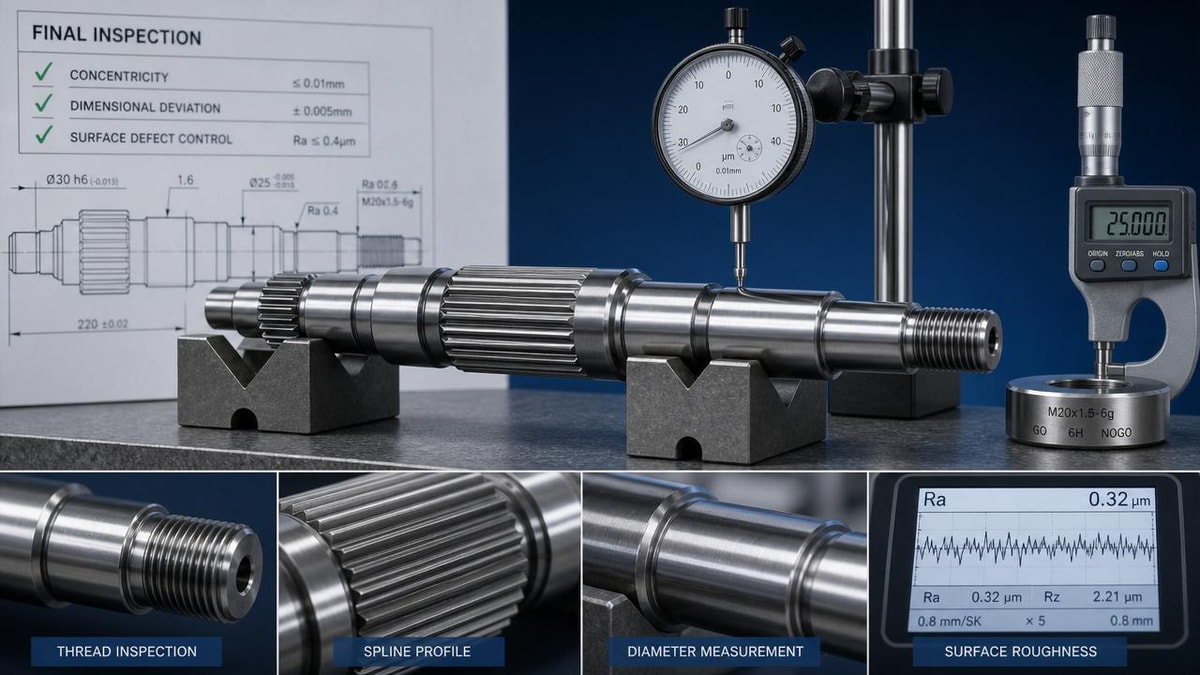
 Shaft Parts Machining Problems That Show Up at Final InspectionCNC Machining Technology Center
 Production Process Delays Usually Start Before Machining BeginsCNC Machining Technology Center
 Industrial Automation Projects Often Miss This Integration StepCNC Machining Technology Center
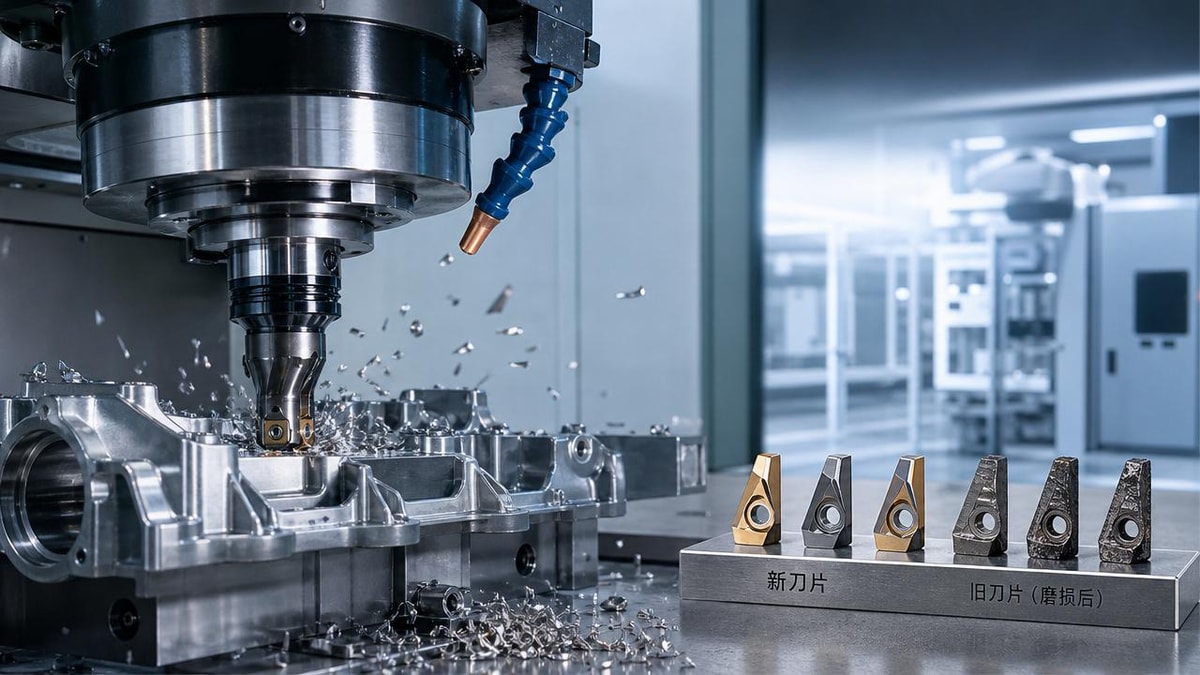
 CNC Metal Cutting Tool Wear Is Costing More Than You ThinkCNC Machining Technology Center

Aris Katos
Future of Carbide Coatings
15+ years in precision manufacturing systems. Specialized in high-speed milling and aerospace grade alloy processing.
▶
CNC Metal Lathe Choices That Affect Delivery SpeedMachine Tool Industry Editorial Team▶
Vertical Lathe Limits to Check Before Large-Part OrdersMachine Tool Industry Editorial Team▶
Metal Lathe vs CNC Upgrade: When Retrofitting Still WorksMachine Tool Industry Editorial Team▶
How much rigidity does a CNC metal lathe really need?Machine Tool Industry Editorial Team▶
When does an automated lathe start saving real labor time?Machine Tool Industry Editorial Team
Mastering 5-Axis Workholding Strategies
Join our technical panel on Nov 15th to learn about reducing vibrations in thin-wall components.

Providing you with integrated sanding solutions
Before-sales and after-sales services
Comprehensive technical support