• Global CNC market projected to reach $128B by 2028 • New EU trade regulations for precision tooling components • Aerospace deman
NYSE: CNC +1.2%LME: STEEL -0.4%

CNC industrial systems or manual lines: where costs shift
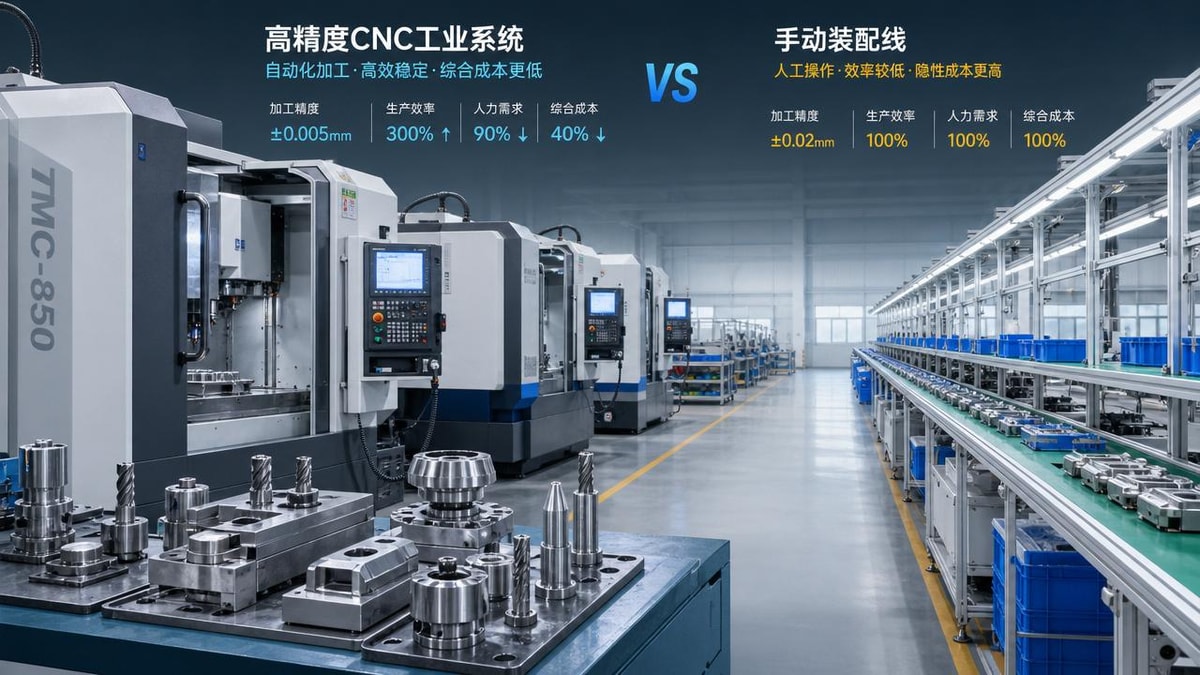
When manufacturers compare CNC industrial systems with manual production lines, the real question is not just upfront investment but where costs move over time. From labor and precision to downtime, output consistency, and scalability, each model reshapes profitability in different ways. For decision-makers, understanding these cost shifts is essential to building a competitive and resilient production strategy.
What does the cost debate between CNC industrial systems and manual lines really mean?
In many factories, the first comparison starts with purchase price. A manual line often appears cheaper because the initial equipment package is lighter, installation may be simpler, and training can begin with familiar workflows. By contrast, a CNC industrial setup usually requires higher capital spending on machine tools, controls, tooling, fixtures, software, and integration. That surface-level gap is real, but it is only the first layer of the decision.
The deeper issue is cost migration. A manual line shifts more expense into labor intensity, operator dependency, process variation, scrap, and production bottlenecks. A CNC industrial system moves more expense into depreciation, maintenance planning, programming, and technical support, but often reduces repeatability problems and raises throughput. For enterprise decision-makers, the question is not which model is universally cheaper. The better question is which cost structure aligns with product mix, order volatility, customer quality expectations, and long-term growth plans.
This is especially important in sectors tied to precision manufacturing, automotive components, electronics, aerospace supply chains, energy equipment, and industrial subcontracting. In these markets, delivery reliability and dimensional consistency are increasingly tied to revenue stability. A low-entry production model may win in the short term, but if it creates hidden operational drag, total profitability can weaken over time.
Where do costs typically shift when a company moves toward CNC industrial production?
The most visible shift is from direct labor to capital and process control. In a manual line, more value creation depends on hands-on setup, adjustment, inspection, and material handling. Labor cost is not only a wage issue; it also includes hiring difficulty, training turnover, inconsistent execution across shifts, and the operational risk of relying on a few experienced individuals.
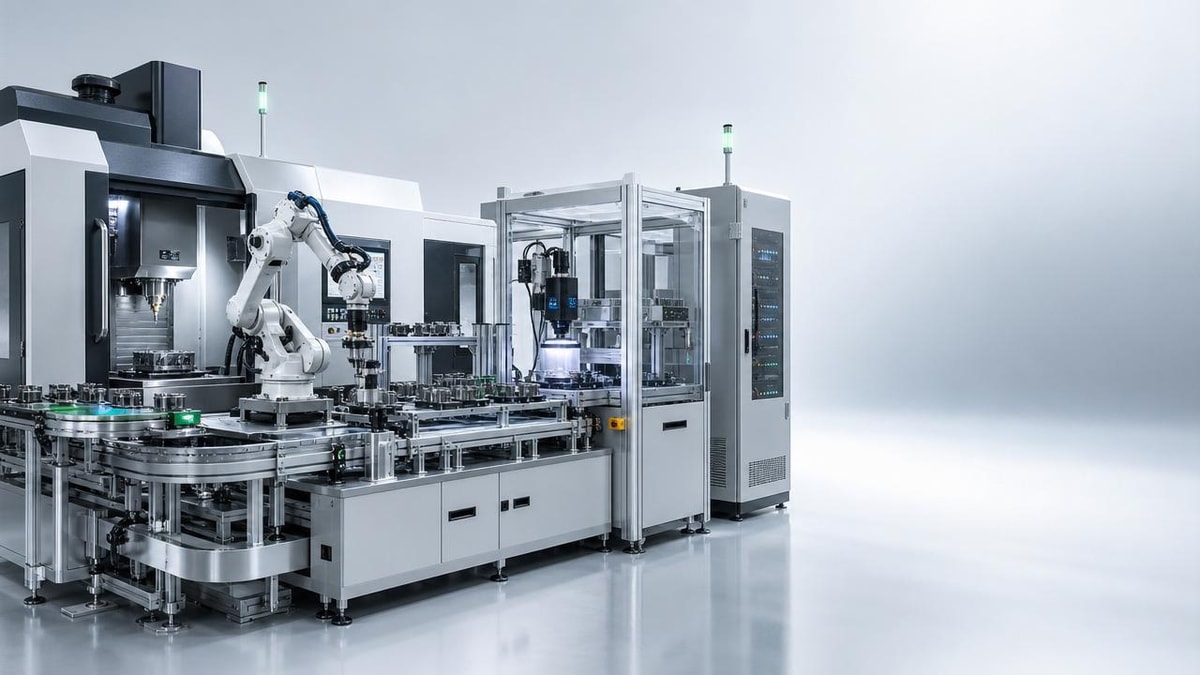
A CNC industrial environment reduces some of that exposure by embedding precision into programmed motion, standardized tooling, and automated repeat cycles. However, the savings do not simply disappear from the budget. They reappear in machine financing, software licensing, preventive maintenance, spindle utilization planning, tool life management, and engineering capability. The cost line becomes more technical and less manual.
Another major shift is from visible waste to measurable efficiency. Manual lines may hide losses in rework, inspection overload, setup delays, and slower changeovers. These losses are often accepted as normal because they are spread across departments. CNC industrial systems tend to expose production data more clearly. Once output, cycle time, downtime, and tool wear are measured, inefficiencies become easier to identify and correct. That transparency can improve margins, but only if managers are ready to use the data.
There is also a shift in quality cost. Manual production may manage simple parts effectively, but tolerances can drift as operator fatigue, process variation, or fixture wear increases. In precision machining and multi-batch manufacturing, this often leads to scrap, customer complaints, warranty claims, or delayed deliveries. CNC industrial systems usually lower these risks, especially for complex geometries and repeat orders, though they demand more disciplined process setup at the front end.
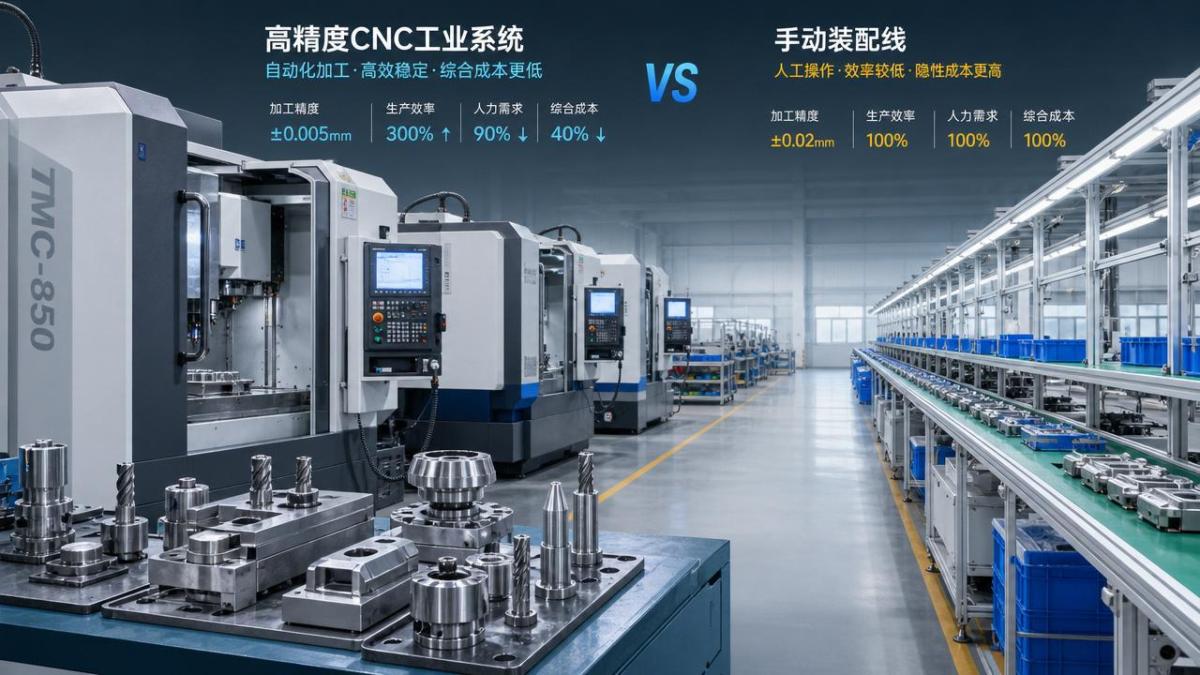
How should decision-makers compare total cost instead of only upfront price?
A useful evaluation starts with total cost of ownership rather than machine price alone. This means looking at the full production economics over several years. A manual line with lower acquisition cost can become expensive if labor rates rise, order complexity increases, or customers require tighter tolerances and traceability. A CNC industrial investment can seem expensive on day one yet become more economical once capacity utilization improves and repeat jobs accumulate.
Leaders should assess at least six dimensions: capital expenditure, labor dependency, scrap and rework, maintenance and downtime, output consistency, and future scalability. If one product family accounts for high volume and stable specifications, CNC industrial equipment often delivers stronger economics through repeatability and cycle efficiency. If the product mix is highly variable, low-volume, and less precision-sensitive, a manual or semi-manual line may remain commercially reasonable.
The time horizon also matters. A short-term cash-preservation strategy may favor manual capacity, especially for smaller firms or uncertain demand. But if the business objective is export growth, supplier qualification, or entry into regulated manufacturing sectors, CNC industrial capability often supports stronger long-term positioning. Buyers and OEM customers increasingly evaluate process stability, documentation, and delivery discipline, not just unit price.
Quick comparison table for cost judgment
The table below summarizes where costs and operational pressure usually move in each model.
Which production scenarios favor manual lines, and which favor CNC industrial systems?
Manual lines can still make business sense. They are often practical when product complexity is low, tolerances are forgiving, and demand is inconsistent. They also fit situations where a company needs a fast launch with limited capital or must handle highly customized work that changes too frequently for formal automation to pay back quickly. In emerging operations, a manual line can serve as a bridge while market demand is tested.
CNC industrial systems are usually stronger when the production environment requires repeat precision, faster cycle times, better utilization of materials, and easier scaling. They are especially relevant for complex shaft parts, precision discs, structural components, multi-axis machining, and production linked to export quality standards. In these cases, consistency is not a luxury. It is a condition for customer retention and contract growth.
A mixed strategy is often the most realistic answer. Some companies reserve CNC industrial capacity for high-value parts, tight tolerances, and stable repeat orders, while keeping manual or semi-manual stations for prototyping, secondary tasks, or irregular low-volume work. This model can balance capital discipline with technical competitiveness, especially in diversified manufacturing groups.
What hidden costs do companies often underestimate in both models?
The most underestimated cost in manual production is usually inconsistency. On paper, labor-based workflows may seem flexible and affordable. In reality, hidden losses appear in inspection burdens, quality sorting, delayed shipments, overtime, and customer confidence erosion. These costs are rarely visible in a single purchase decision, yet they influence profitability every quarter.
In CNC industrial projects, the most common underestimate is implementation readiness. A company may buy advanced machine tools without fully preparing process documentation, operator training, tooling strategy, fixture design, or preventive maintenance routines. When that happens, the expected productivity gains arrive slowly, and management may incorrectly conclude that automation failed. The issue is often not the technology itself but the maturity of deployment.
Energy use, spare parts, downtime response, and software integration should also be included in the comparison. A CNC industrial environment can improve efficiency significantly, but if service support is weak or spare part lead times are long, downtime can become expensive. On the manual side, unplanned absenteeism or loss of experienced operators can create equally damaging disruptions. Hidden cost, in both cases, is usually linked to dependency: dependency on people in one model, dependency on systems and support capability in the other.
How can leaders avoid the most common decision mistakes?
One mistake is treating CNC industrial investment as a branding decision rather than an operational one. Buying advanced equipment simply to appear modern does not create value unless there is a matching production plan, order structure, and capability roadmap. Another mistake is assuming that manual lines are always more flexible. In some factories, a well-programmed CNC industrial cell with the right fixtures and tooling can switch jobs faster and with less quality risk than a heavily manual process.
A second mistake is comparing only machine output while ignoring upstream and downstream flow. If material preparation, clamping, inspection, or packaging remain bottlenecks, the full benefit of CNC industrial production may not be realized. Likewise, if a manual line is supported by poor process control, management may underestimate how much waste exists because the inefficiency is distributed across departments.
A third mistake is failing to segment products. Not every component deserves the same production model. Grouping parts by tolerance level, annual volume, cycle complexity, and quality risk often reveals that the best answer is not a factory-wide conversion but a targeted allocation of CNC industrial resources where they create the highest return.
FAQ-style checklist before making the choice
What should companies confirm before procurement, upgrade, or cooperation?
Before choosing between a manual line and a CNC industrial approach, decision-makers should confirm the economics of their actual part families, not theoretical averages. That means reviewing annual volume, tolerance bands, rework rates, setup frequency, labor availability, and customer quality requirements. They should also assess whether growth will come from low-cost volume, high-mix customization, or higher-value precision manufacturing. Each path favors a different production design.
It is also wise to confirm supplier support depth. For CNC industrial equipment, service speed, training quality, spare part access, software compatibility, and upgrade potential matter as much as the machine specification. For manual lines, the focus should be on process documentation, standard work, fixture reliability, and talent continuity. In both cases, the right decision depends on whether the factory can sustain the chosen model operationally, not just purchase it financially.
If a company needs to move forward with a more precise evaluation, the first discussion points should include target parts, expected annual output, tolerance requirements, labor assumptions, tooling and fixture plans, maintenance capability, payback horizon, and whether future expansion may involve robotics, flexible production lines, or smart factory integration. These questions help translate the broad CNC industrial debate into a practical investment path that supports resilience, margin control, and long-term competitiveness.
PREVIOUS ARTICLE
Recommended for You
 Industrial Robotics payback depends on more than labor savingsManufacturing Market Research Center
 Shaft Parts machining problems that show up after final inspectionCNC Machining Technology Center
 Which Production Process changes bring the fastest output gains?CNC Machining Technology Center
 Industrial Automation projects fail when integration is underestimatedCNC Machining Technology Center
 CNC metal cutting costs rise fast when material data is wrongCNC Machining Technology Center
 High precision lathe claims to verify before accepting deliveryMachine Tool Industry Editorial Team


Aris Katos
Future of Carbide Coatings
15+ years in precision manufacturing systems. Specialized in high-speed milling and aerospace grade alloy processing.
▶
Can space-saving CNC manufacturing still handle heavy workloads?CNC Machining Technology Center▶
CNC milling tool paths that waste cycle time without noticeCNC Machining Technology Center▶
What affects surface finish most in CNC metalworking?CNC Machining Technology Center▶
CNC industrial systems or manual lines: where costs shiftCNC Machining Technology Center▶
CNC Programming Errors That Waste More Material Than ExpectedCNC Machining Technology Center
Mastering 5-Axis Workholding Strategies
Join our technical panel on Nov 15th to learn about reducing vibrations in thin-wall components.

Providing you with integrated sanding solutions
Before-sales and after-sales services
Comprehensive technical support