• Global CNC market projected to reach $128B by 2028 • New EU trade regulations for precision tooling components • Aerospace deman
NYSE: CNC +1.2%LME: STEEL -0.4%

CNC Lathe vs CNC Milling: Which Parts and Geometries Are Better Suited to Each?
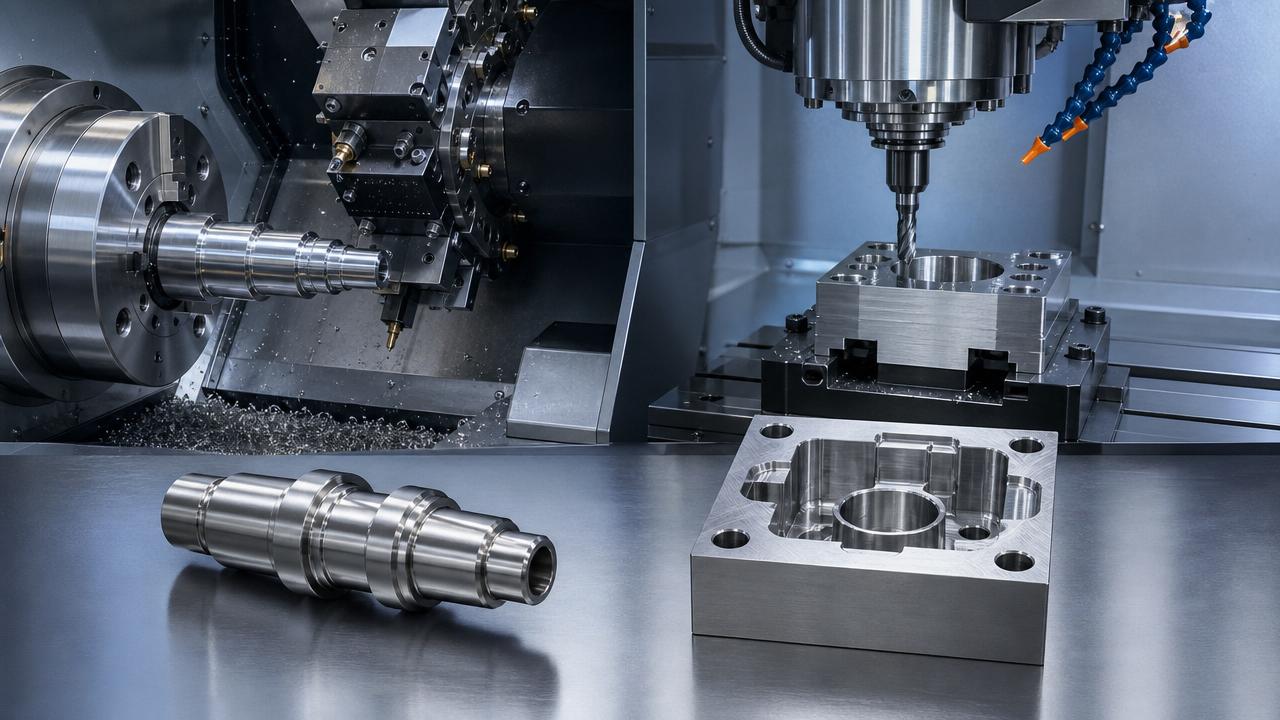
Choosing between a CNC Lathe and a CNC milling machine is not just a shop-floor detail. It directly affects geometry control, cycle time, fixture complexity, and total project cost.
In modern manufacturing, that decision also shapes scheduling, automation compatibility, and downstream inspection. When tolerances tighten and lead times shrink, the right process matters early.
A simple rule helps at first: if the part is mainly rotational, a CNC Lathe often wins. If the part needs prismatic features, complex faces, or multi-side machining, milling usually fits better.
Still, many real parts sit in the gray area. Shafts may need cross-holes. Housings may include turned bores. That is why geometry, tolerance path, and batch volume should be reviewed together.
The sections below break down where each method performs best, what tends to be overlooked, and how to make a cleaner process choice for high-precision industrial components.
Where a CNC Lathe Fits Best
Before comparing edge cases, it helps to start with the core strength of a CNC Lathe: stable, efficient cutting on parts built around a center axis.
[Image 01: CNC Lathe machining a stepped shaft with dimensional callouts and surface finish annotations]
In automotive, energy, aerospace, and general industrial equipment, this usually means shafts, pins, bushings, sleeves, threaded bodies, and precision discs.
- Use a CNC Lathe for round parts with OD, ID, grooves, tapers, and threads. It keeps concentricity easier to control and usually shortens machining time.
- Choose a CNC Lathe when surface finish on cylinders matters. Turning often delivers smoother rotational surfaces with fewer setups and more predictable tool engagement.
- Prefer a CNC Lathe for long shaft components. Supporting the workpiece with tailstock or steady rest improves rigidity and reduces chatter risk.
- Use turning for high-volume rotational parts. Bar feeders and automated loading integrate well, making the CNC Lathe a strong option for repeat production.
- Pick turning when tight runout matters more than complex faces. A CNC Lathe naturally aligns features around one axis and simplifies in-process control.
This is especially useful in smart factories where cycle consistency matters as much as nominal accuracy. A stable turning process also supports easier automation and better repeatability across shifts.
One common mistake is assuming any round part belongs on a lathe. Once flats, angled pockets, off-center holes, or multiple indexed faces appear, turning alone may no longer be the most efficient route.
Where CNC Milling Has the Advantage
CNC milling stands out when part geometry is defined by planes, pockets, slots, contours, and features located across several faces rather than one rotating axis.
This is common in electronic enclosures, valve blocks, fixtures, brackets, machine frames, and aerospace structural parts where feature relationships drive function.
- Choose milling for box-shaped or plate-like components. It handles flatness, pockets, slots, and multiple face features much better than a CNC Lathe.
- Use milling for off-center holes, keyways, and irregular contours. These features usually require positional flexibility that turning cannot provide efficiently.
- Prefer milling for multi-face datum control. Machining centers make it easier to manage feature relationships across top, side, and angled surfaces.
- Select milling for parts needing 3D surfaces or sculpted geometry. Dies, impeller-like forms, and organic contours are far beyond standard CNC Lathe capability.
- Use milling when feature variation is high across low-to-medium batches. It offers better programming flexibility for engineering changes and mixed product runs.
In digitally integrated production lines, milling also supports better adaptability. That matters when product versions change fast or when a single cell must process several related components.
The tradeoff is setup complexity. Milling often needs stronger fixture planning, more tool changes, and closer attention to access angles, especially on deep cavities or thin walls.
How Geometry Should Drive the Decision
When the part includes both rotational and prismatic features, the choice should follow the feature that controls function, tolerance stack-up, and machining time.
If the critical dimensions are diameters, coaxial bores, bearing seats, or threaded journals, a CNC Lathe often handles the core geometry more cleanly.
If the critical dimensions are hole patterns, pocket depths, slot position, or face-to-face relationships, milling usually gives stronger process control.
A practical checkpoint is this: ask which feature would be hardest to recover if it drifts. That feature should usually decide whether the CNC Lathe or milling machine leads the route.
Typical Industrial Scenarios
Rotational powertrain and fluid components
For pump shafts, couplings, valve stems, and bearing seats, a CNC Lathe is often the better starting point. These parts depend on roundness, coaxiality, and stable surface finish.
The main checks are length-to-diameter ratio, support method, and whether secondary milling features can be handled with live tooling or need a separate machine.
Structural, mounting, and enclosure parts
For servo mounts, sensor brackets, base plates, and aluminum housings, milling usually makes more sense. Datum transfer across several faces matters more than rotational symmetry.
Key checks include fixture access, wall stiffness, tool reach, and whether future design revisions may add pockets, threaded holes, or cable-routing channels.
Hybrid parts in automated production
Some parts do not fit a clean split. A turned hub may need bolt circles and side slots. A milled body may require highly concentric bores.
In these cases, route planning matters more than labels. A CNC Lathe with live tooling, or a turn-mill platform, can reduce transfers and improve consistency.
What Often Gets Overlooked
- Do not judge only by part shape. The critical tolerance chain may point to a CNC Lathe even when the part includes several non-round secondary features.
- Check clamping distortion early. Thin walls, long overhangs, or soft materials can change geometry more than machine accuracy itself.
- Review inspection strategy before release. A part that is easy to machine but hard to measure can create hidden delivery risk.
- Consider batch size with setup time. Milling may be flexible, but a CNC Lathe can be far more economical on repeat rotational work.
- Account for material behavior. Stainless steel, titanium, and heat-resistant alloys can shift the preferred process because of tool wear and rigidity demands.
Another frequent issue is forcing one process to do everything. That can look efficient on paper but often increases scrap, prolongs setups, and complicates quality control.
A Practical Way to Decide Faster
A faster decision usually comes from five simple checks made before quoting or releasing the route sheet.
- Identify the functional datum first. If the part lives around a centerline, a CNC Lathe often deserves priority in the process plan.
- Rank features by tolerance sensitivity. The operation controlling the tightest geometry should come earlier, not later, in the route.
- Estimate setup count before cycle time. Fewer transfers often improve quality more than a slightly faster cutting path.
- Match the machine to future revisions. If design changes are likely, milling may offer more resilience without major tooling disruption.
- Check automation compatibility. For stable rotational parts, a CNC Lathe usually integrates more smoothly with bar feeding and unattended production.
For globally distributed manufacturing programs, this matters even more. Standardizing the right process improves repeatability across facilities in China, Germany, Japan, South Korea, and other major machining hubs.
That consistency supports better delivery control, cleaner supplier communication, and fewer surprises during first article approval or process transfer.
Final Takeaway
A CNC Lathe is usually the stronger choice for shafts, sleeves, discs, and any part where concentricity, roundness, and rotational efficiency define success.
CNC milling is usually better for blocks, brackets, housings, complex surfaces, and parts that depend on multi-face feature relationships.
When the part combines both, let the most critical geometry lead the decision. Then review setup count, inspection access, material behavior, and automation fit before locking the route.
If that review is done early, the choice between a CNC Lathe and milling becomes much clearer, and the result is usually better quality, lower risk, and a more predictable production plan.
Recommended for You
![]() Mitsubishi Electric Announces Physical AI System Linking Humanoid Robots and CNC MachinesMachine Tool Industry Editorial Team
Mitsubishi Electric Announces Physical AI System Linking Humanoid Robots and CNC MachinesMachine Tool Industry Editorial Team Precision Machining for Defense: Supplier Quality and Traceability ChecksManufacturing Market Research Center
![]() Nidec Machine Tool Launches MVR-5X Five-Axis Gantry MachineMachine Tool Industry Editorial Team
Nidec Machine Tool Launches MVR-5X Five-Axis Gantry MachineMachine Tool Industry Editorial Team Choosing a Precision Disc Parts Manufacturer in China: Tolerances and Quality ChecksManufacturing Market Research Center
![]() Siemens Executive Says AI Could Raise Factory Automation to 80%Manufacturing Market Research Center
Siemens Executive Says AI Could Raise Factory Automation to 80%Manufacturing Market Research Center Choosing Automated Machine Tools for High-Mix, Low-Volume ProductionMachine Tool Industry Editorial Team


Aris Katos
Future of Carbide Coatings
15+ years in precision manufacturing systems. Specialized in high-speed milling and aerospace grade alloy processing.
▶
Manual vs. CNC Lathe for Simple Parts: How Batch Size Affects the ChoiceCNC Machining Technology Center▶
How to Select a CNC Metal Lathe for Tight-Tolerance Shaft and Sleeve PartsCNC Machining Technology Center▶
CNC Lathe Quick Installation Guide: Alignment Checks Before First Production RunCNC Machining Technology Center▶
How to Select a CNC Lathe for Small Parts Without Sacrificing Accuracy or Cycle TimeCNC Machining Technology Center▶
How to Select a Slant Bed Lathe for High-Precision Shaft and Chuck WorkCNC Machining Technology Center
▶
Mastering 5-Axis Workholding Strategies
Join our technical panel on Nov 15th to learn about reducing vibrations in thin-wall components.

Providing you with integrated sanding solutions
Before-sales and after-sales services
Comprehensive technical support