• Global CNC market projected to reach $128B by 2028 • New EU trade regulations for precision tooling components • Aerospace deman
NYSE: CNC +1.2%LME: STEEL -0.4%

How to Select CNC Production Equipment for High-Mix, Low-Volume Manufacturing
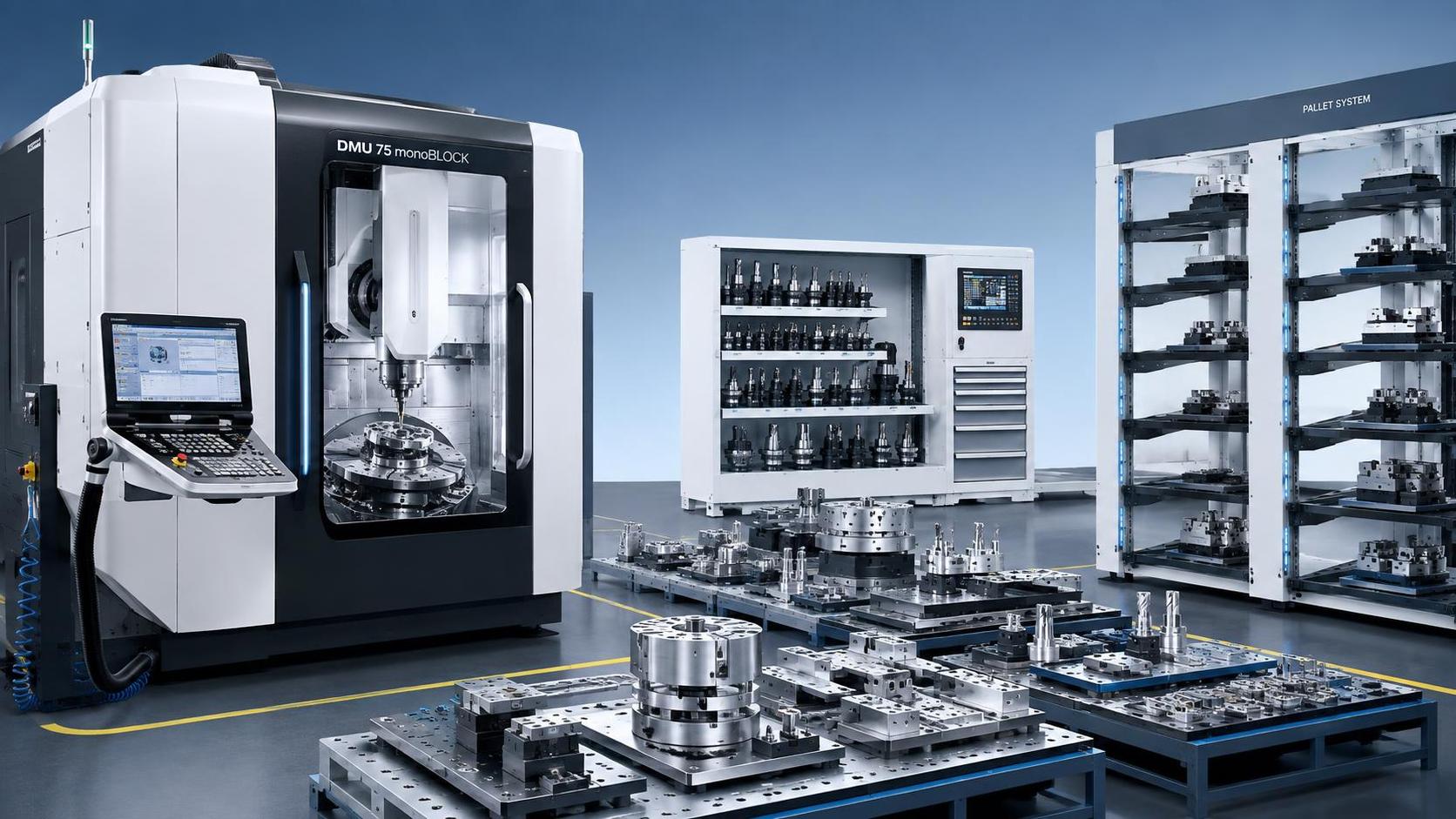
High-mix, low-volume manufacturing changes the economics of CNC equipment selection. The limiting factor is rarely spindle speed alone. It is the time and risk attached to changing from one part number to another: programming, fixturing, tool preparation, proving out, inspection, and recovering stable quality after a setup change.
A machine that delivers an impressive cycle time on one repeat part may be a poor fit when production runs are short, routings change frequently, and components range from simple turned parts to prismatic housings or multi-feature assemblies. The right CNC production equipment is the configuration that preserves capability across that variation while keeping non-cutting time, operating complexity, and total ownership risk under control.
Start with the production mix, not the machine catalogue
“High mix” is often treated as a broad label, but it can describe very different operating conditions. A workshop producing 30 families of aluminum enclosures needs a different equipment strategy from a manufacturer making stainless valves, hardened tool components, and occasional large castings. Before comparing quotations, the part portfolio should be translated into a practical equipment requirement.
The most useful inputs are not average part dimensions or annual piece count alone. They include the range of materials, maximum and typical workpiece envelope, feature complexity, tolerance-critical operations, batch size distribution, expected repeat demand, required changeover frequency, and the share of work that requires secondary operations. This information reveals whether flexibility is needed primarily in workholding, tool access, axis motion, machine capacity, or material handling.
For example, a three-axis vertical machining center may be sufficient for parts that can be repositioned easily and produced in short, predictable batches. If a part family repeatedly requires machining on multiple faces, angled holes, compound surfaces, or tight positional relationships between setups, the apparent saving can disappear through repeated clamping, handling, and inspection. In that case, a four-axis or five-axis machine may reduce total process time even if its hourly ownership cost is higher.
Part-family analysis also prevents an expensive but common mistake: selecting one highly capable machine to cover every possible job. Equipment should be sized around the work that drives scheduling pressure and cost, not the rarest or largest component that might appear. Exceptional jobs can sometimes be subcontracted or routed through a separate capacity plan; building all everyday production around exceptions can leave a facility with expensive underused capability.
Measure setup burden as carefully as cutting performance
In low-volume work, setup time is production time. A machine with a fast rapid rate and powerful spindle does not compensate for a fixture that takes hours to align, a tool list assembled manually at the machine, or programs that need extensive re-proving after each changeover.
Equipment evaluation should therefore examine the complete changeover sequence:
- Removal of the previous fixture, jaws, pallets, and tools;
- Installation and datum verification of the next setup;
- Tool loading, presetting, measurement, and life-data entry;
- Program retrieval, revision control, and offset transfer;
- First-off machining, inspection, and correction;
- Release to unattended or attended production.
A machine’s standard features matter greatly in this sequence. A probing package can shorten datum setting and support in-process verification, but only when probing cycles are integrated into the programming and inspection method. Tool measurement systems reduce uncertainty in tool length and breakage detection, but their value depends on reliable tool-data discipline. A large tool magazine is useful when it avoids repeated tool swaps between part families; it offers little benefit if tool management is disorganized or the machine cannot accommodate the tools needed for the real mix.
Quick-change workholding deserves the same level of scrutiny as the machine itself. Zero-point clamping, standardized base plates, modular vises, tombstones, and repeatable jaw systems can substantially reduce setup effort. Their benefit is not simply faster clamping. Repeatability reduces the amount of manual indication, probing, and first-piece adjustment required after every change.
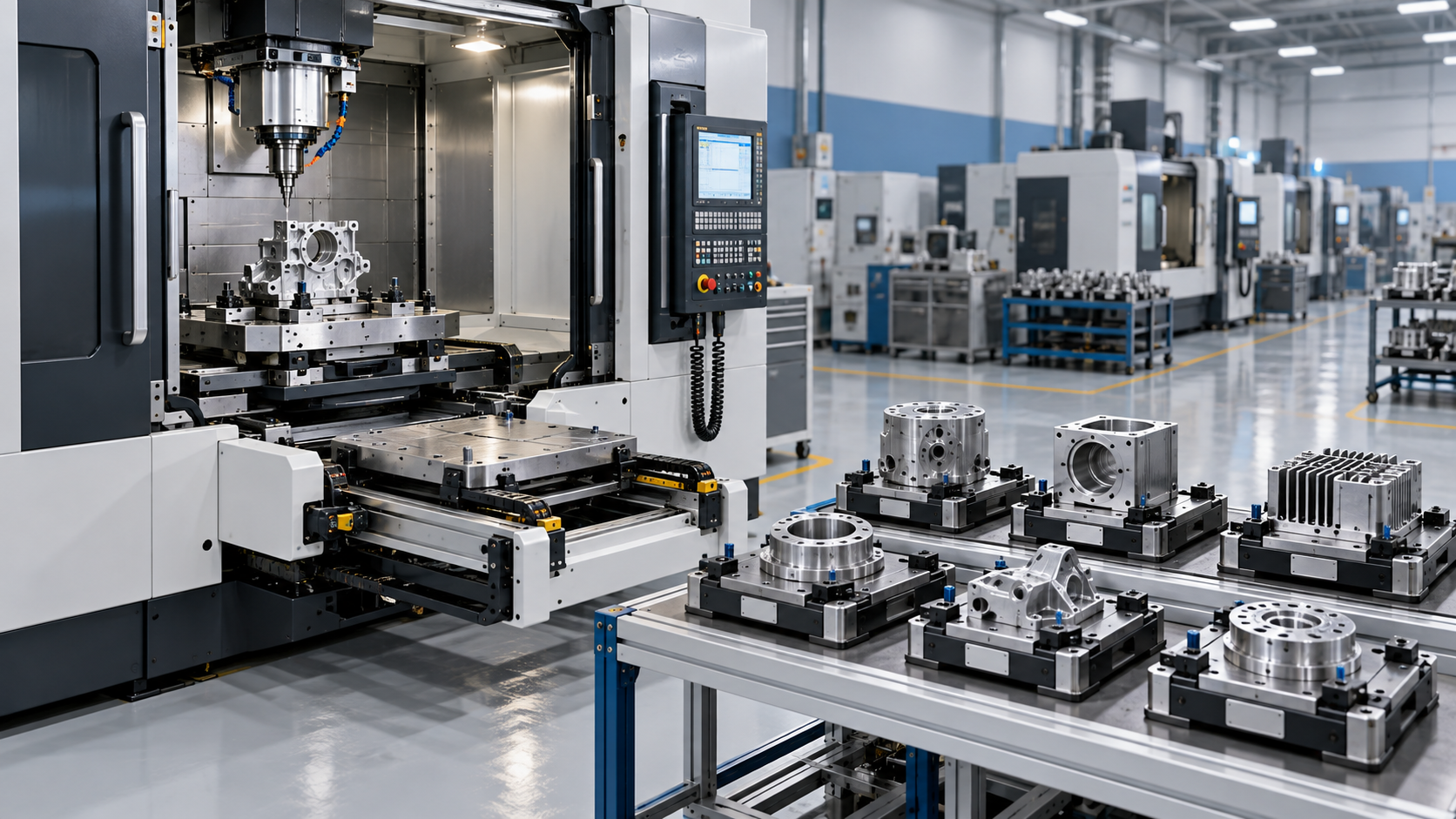
The purchase specification should define whether fixtures will be changed at the machine, prepared offline, or mounted on pallets. That decision affects the value of pallet changers, rotary tables, loading access, and work envelope. A pallet system can raise spindle utilization by allowing fixture preparation outside the machining zone, but it is not automatically justified for every low-volume environment. It adds capital cost, floor-space demand, maintenance requirements, and programming discipline. Its strongest case is where setups are frequent, fixtures are repeatable, and the machine otherwise waits for operators to load and verify work.
Choose axis configuration by process consolidation, not prestige
Axis count should follow the number of setups that can be removed without creating new process instability. A three-axis machining center remains an efficient and accessible choice for many plate-like, prismatic, and straightforward cavity parts. Its advantages include lower acquisition cost, simpler programming, broad operator familiarity, and generally easier access for manual loading.
A fourth axis becomes valuable when indexing permits multiple faces to be machined in one clamping, especially on smaller prismatic parts, shafts with radial features, and components that benefit from tombstone-style loading. The key question is whether indexed access eliminates enough re-clamping and inspection to offset the rotary device cost and reduced usable space.
Five-axis equipment should be justified by the part geometry and process route. Simultaneous machining can be necessary for complex surfaces, but many high-mix applications gain value from five-axis positioning rather than continuous five-axis cutting. Access to several faces in one setup can improve geometric relationships, reduce fixture complexity, and shorten lead time for prototype or short-run parts. However, five-axis capability also imposes demands: collision management, postprocessor quality, CAM verification, toolholder selection, and skilled process planning all become more important.
The distinction between trunnion-style and swiveling-head five-axis machines is equally practical. Trunnion configurations can provide excellent access to smaller components, but workpiece mass, fixture height, and rotation clearance must be checked carefully. Head-head or head-table arrangements may better suit larger or heavier work, though their dynamics, spindle reach, and usable travel vary significantly by design. Travel specifications alone do not establish what can safely rotate inside the machine.
For turned parts, the equivalent decision is not simply CNC lathe versus turn-mill center. A two-axis lathe may be the most productive option for a stable family of rotational components. Live tooling, Y-axis capability, sub-spindles, and bar feeders become justified when they remove secondary milling, cross-drilling, part transfer, or manual handling. Each added function should be traced to a recurring operation in the routing. Buying multitasking capacity for occasional convenience can increase programming time, maintenance exposure, and setup complexity without improving throughput.
Accuracy specifications need to be read in operating context
Positioning accuracy, repeatability, spindle runout, and thermal behavior all influence part quality, but catalogue figures cannot be compared in isolation. The relevant question is whether the machine can consistently hold the required tolerance under the anticipated material, cutting load, duty cycle, ambient conditions, and setup method.
Repeatability may be more important than absolute positioning accuracy for recurring short batches, especially when probing and offset correction are part of the process. Thermal stability becomes significant when long cycles, heavy roughing, tight bore locations, or extended unattended runs are involved. A machine that reaches stable thermal conditions predictably may be easier to control than one with attractive nominal specifications but greater drift during changing workloads.
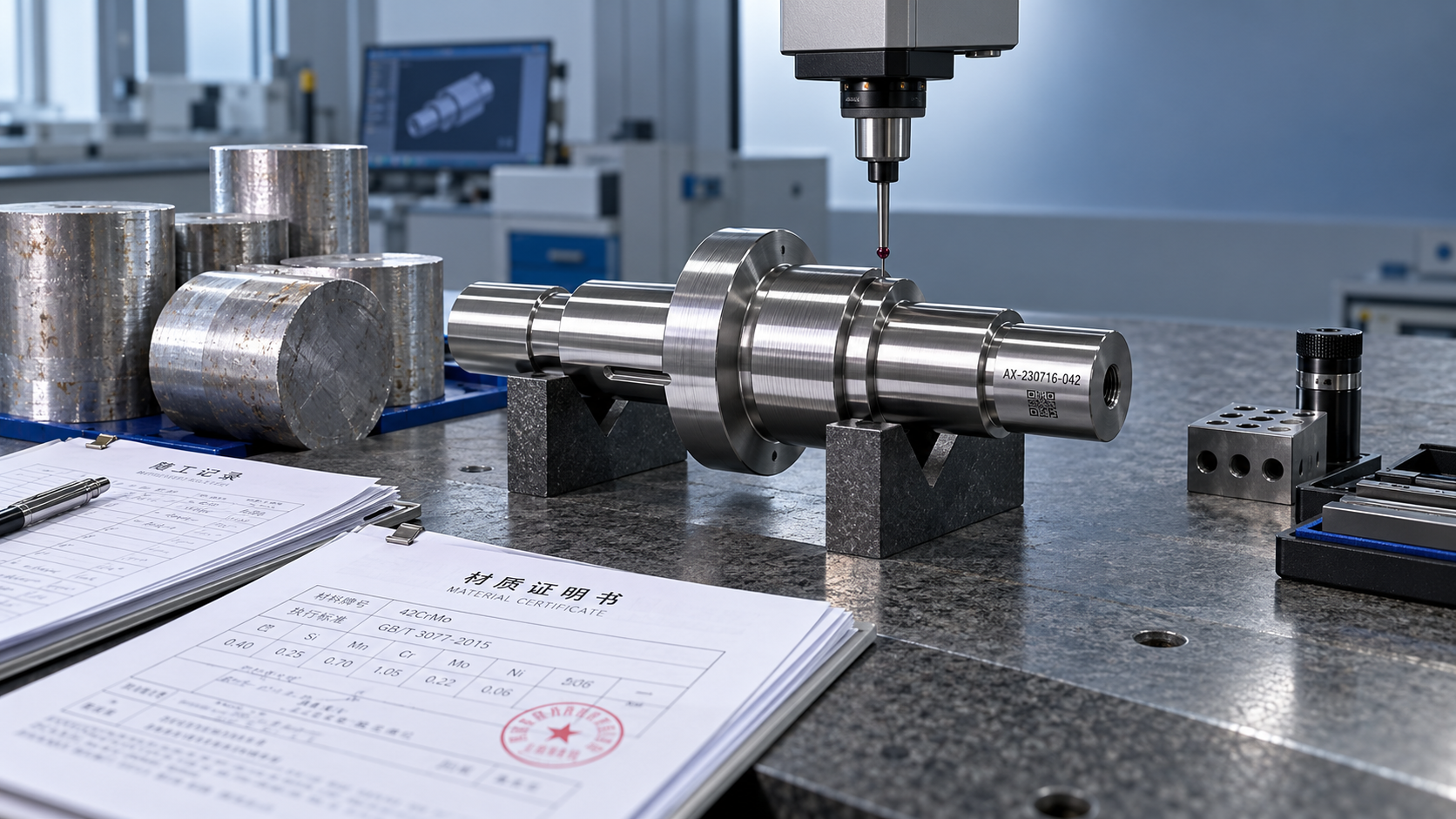
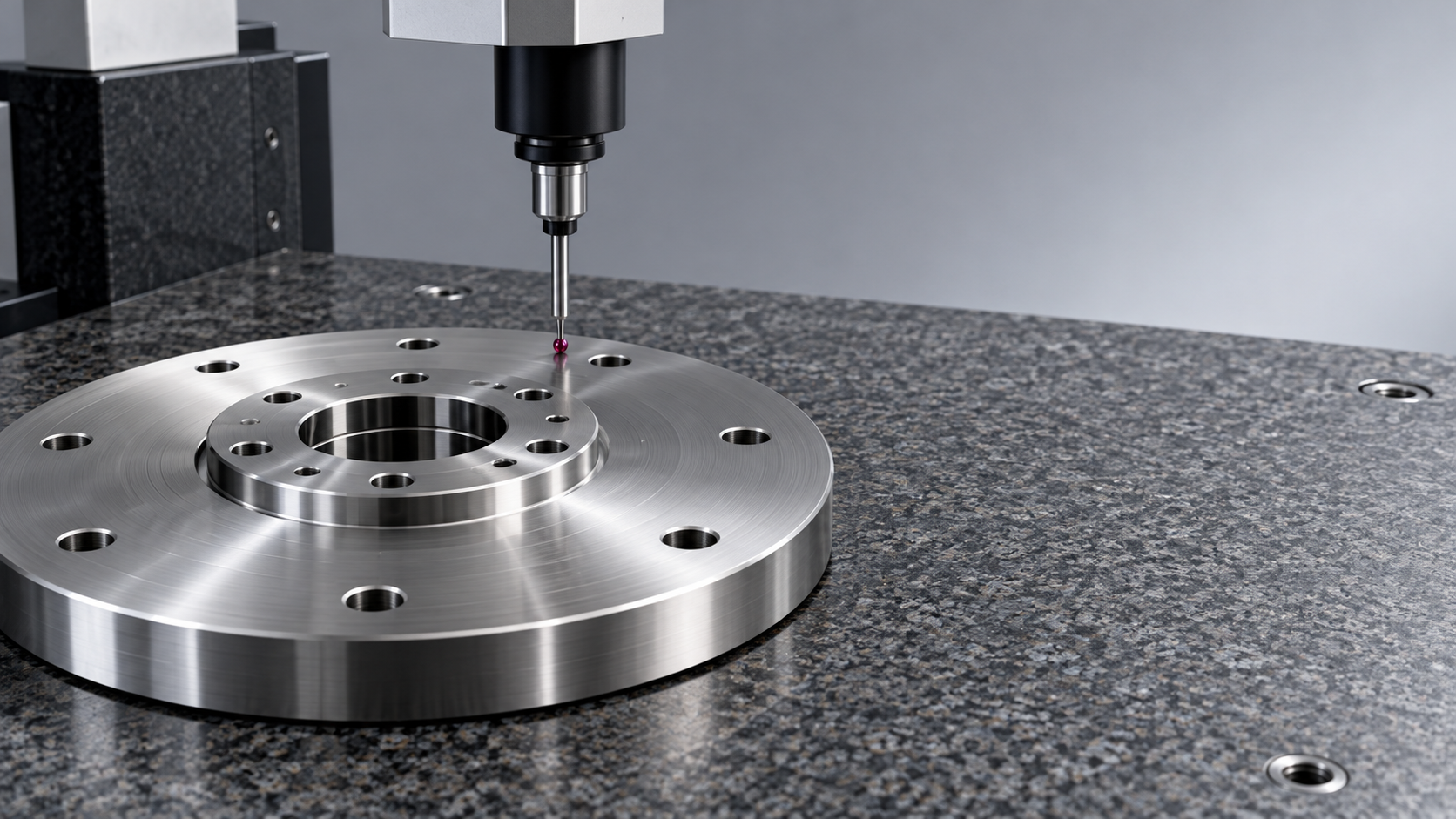
Evaluation should also cover the measurement chain outside the machine. Tight-tolerance production is not secured by machine capability alone. It depends on fixture rigidity, tool condition, coolant control, gauge strategy, calibration, and the ability to feed inspection results back into offsets. If a process relies on a coordinate measuring machine or specialist gauges, their capacity and programming time must be considered alongside machining capacity. Otherwise, an investment intended to shorten lead times merely shifts the bottleneck to inspection.
Automation should solve a defined constraint
Automation in high-mix manufacturing is most effective when it addresses a specific source of lost capacity: repeated loading, limited overnight running, tool-change interruption, or unsafe handling of heavy components. It is less effective when the real constraint is unstable programming, incomplete fixtures, inconsistent raw material, or slow first-article approval.
Robot tending can work well for repeatable part families where gripper changes, orientation control, and loading datums are manageable. It becomes more demanding as part variety increases. A realistic assessment must include gripper inventory, raw-stock presentation, chip control, part identification, recovery from failed picks, and the process for introducing a new part number. The robot cell should not be evaluated as a separate item; it must be assessed with the machine enclosure, workholding, probing, safety system, and control interface.
Bar feeders and part catchers are often a more focused automation route for turned components. Pallet pools are often more relevant for prismatic work. Automated tool management may deliver greater benefit than robot loading where the main interruption is tool preparation rather than part handling. The automation level should match the maturity of the production system. A manual process with rapid, standardized setup can be more responsive than a complex cell that requires extensive engineering for each new job.
Compare total operating cost at the routing level
Purchase price is a weak proxy for economic suitability. The relevant comparison is the cost and risk of producing representative jobs over the machine’s expected service life. That comparison should include not only machine depreciation or financing, but also setup labor, programming time, fixtures, tooling, inspection, energy use, maintenance, spare parts, floor space, operator training, and the cost of capacity lost during breakdowns.
Representative-part trials are more informative than generic demonstrations. A meaningful trial uses an actual drawing or a closely comparable feature set, expected material, realistic tooling, and the intended workholding approach. The objective is not to obtain the supplier’s best possible cycle time. It is to understand setup effort, access limitations, chip evacuation, tool reach, surface finish, measurement approach, and likely operator interventions.
Quotation comparisons should be normalized. One proposal may include probing, coolant management, chip conveyance, toolholders, installation, training, or postprocessor support while another lists them as options. A lower initial quotation can become less competitive once the equipment is configured to run the intended work. Similarly, a machine offered with a capable controller may still require separate costs for CAM posts, simulation, network integration, and operator training.
Service, control ecosystem, and documentation are procurement risks
For mixed production, equipment downtime has consequences beyond lost spindle hours. It can interrupt several customer orders at once, invalidate a tightly planned schedule, and force urgent rerouting of parts. Service capability should therefore be assessed as part of the technical selection, not as an afterthought.
Relevant questions include the availability of local field engineers, remote diagnostics, parts stocking, preventive maintenance requirements, and the lead time for high-risk components such as drives, encoders, spindles, hydraulic units, and control hardware. The supplier’s ability to support the selected control platform matters because controls influence programming availability, operator familiarity, data transfer, and integration with CAM and manufacturing systems.
Documentation should be reviewed before placing an order, particularly when equipment will cross borders. Electrical specifications, language requirements, installation responsibilities, warranty boundaries, packing methods, commissioning scope, and acceptance criteria should be explicit. Where applicable, the machine must meet the legal and safety requirements of the destination market; compliance claims should be supported by the documentation required for that market rather than assumed from a general statement in a quotation.
A practical selection decision
The strongest selection is usually not the machine with the widest specification range. It is the one that makes the recurring production mix easier to schedule, set up, verify, and recover when priorities change. That often means favoring repeatable workholding, accessible programming, dependable tool management, and service support over marginal gains in headline speed.
For high-mix, low-volume manufacturing, CNC production equipment should be purchased as part of a process system. Machine configuration, fixturing, CAM, tools, inspection, material flow, and supplier support all determine whether flexibility is real or merely listed in the specification. When those elements are evaluated against representative part families and complete routing costs, the resulting investment is far more likely to protect lead times and quality as the mix changes.
Recommended for You
![]() Mitsubishi Electric Announces Physical AI System Linking Humanoid Robots and CNC MachinesMachine Tool Industry Editorial Team
Mitsubishi Electric Announces Physical AI System Linking Humanoid Robots and CNC MachinesMachine Tool Industry Editorial Team Precision Machining for Defense: Supplier Quality and Traceability ChecksManufacturing Market Research Center
![]() Nidec Machine Tool Launches MVR-5X Five-Axis Gantry MachineMachine Tool Industry Editorial Team
Nidec Machine Tool Launches MVR-5X Five-Axis Gantry MachineMachine Tool Industry Editorial Team Choosing a Precision Disc Parts Manufacturer in China: Tolerances and Quality ChecksManufacturing Market Research Center
![]() Siemens Executive Says AI Could Raise Factory Automation to 80%Manufacturing Market Research Center
Siemens Executive Says AI Could Raise Factory Automation to 80%Manufacturing Market Research Center Choosing Automated Machine Tools for High-Mix, Low-Volume ProductionMachine Tool Industry Editorial Team


Aris Katos
Future of Carbide Coatings
15+ years in precision manufacturing systems. Specialized in high-speed milling and aerospace grade alloy processing.
▶
Choosing a CNC Machine for Mold Making: Accuracy, Rigidity, and Surface FinishCNC Machining Technology Center▶
How to Cut CNC Machining Energy Use per Part Without Longer Cycle TimesCNC Machining Technology Center▶
Will a Mazak CNC retrofit work with your existing servo drives?CNC Machining Technology Center▶
Do energy-efficient machine tools reduce power use at partial load?CNC Machining Technology Center▶
Comparing energy-efficient machine tools by energy use per partCNC Machining Technology Center
▶
Mastering 5-Axis Workholding Strategies
Join our technical panel on Nov 15th to learn about reducing vibrations in thin-wall components.

Providing you with integrated sanding solutions
Before-sales and after-sales services
Comprehensive technical support